Solar energy is solar radiation that travels from the sun to the earth as electromagnetic waves and is then converted to useful energy. Visible light, infrared radiation, and ultraviolet light are the three components of the electromagnetic spectrum that are present in solar radiation.
Introduction
Solar energy travels from the sun to the earth in the form of electromagnetic waves. Only part of the electromagnetic spectrum is present in solar radiation. The part present in solar radiation is made up of visible light, infrared radiation, and ultraviolet light. When the incoming solar radiation strikes something, it will be reflected, passed through the object, absorbed by the object, or some combination of the three. More details follow.
The Electromagnetic Spectrum
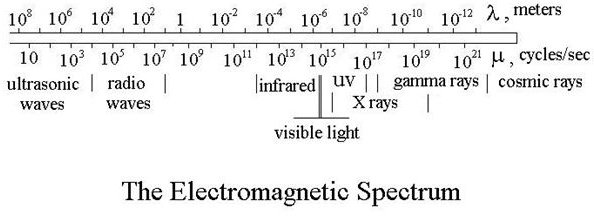
The electromagnetic spectrum contains many familiar types of electromagnetic waves, including cosmic rays, gamma rays, x-rays, ultraviolet light, visible light, infrared radiation (heat), radio waves and ultrasonic waves. Any of these types of electromagnetic waves has a characteristic wavelength (λ) and frequency (μ). The figure at the left shows the electromagnetic spectrum, that is the range of wavelength and frequency of common types of electromagnetic waves. Any of the types of electromagnetic radiation travels at the speed of light, so wavelength times frequency must equal the speed of light. Thus for all electromagnetic waves: λμ = c = 300,000,000 m/sec.
The Solar Radiation Spectrum
Most of solar radiation is between wavelengths of 0.1 and 3 μm. This
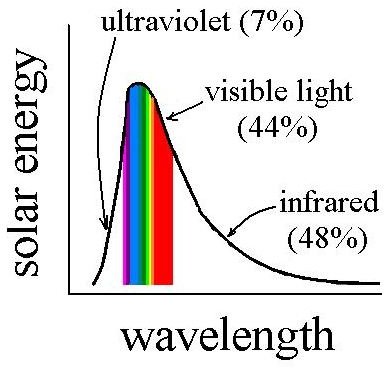
range of wavelengths includes infrared radiation, visible light and ultraviolet light. Over 90% of the solar radiation reaching the Earth’s atmosphere is visible light and near-infrared radiation, with a wavelength range of 0.7 and 1.5 μm. Ultraviolet (uv) light, which has wavelengths from 0.01 to 0.4 μm, makes up less than 10% of solar radiation. The figure at the right illustrates the solar spectrum.
What Happens to Solar Radiation When It Strikes An Object?
When solar radiation has traveled from the sun to the earth and the electromagnetic waves strike something, either in the atmosphere or at the earth’s surface, one or more of three things must happen to that solar radiation. The electromagnetic waves (and the energy
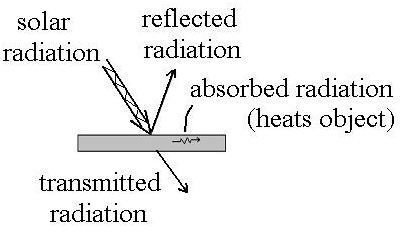
in them) will be reflected, absorbed or transmitted through the object. The combination of the three that will occur depends upon the nature of the object and its surface. If the surface is shiny and smooth like a mirror, then most of the solar radiation striking it will be reflected. On the other hand, if the surface of the object has a dark colored, dull, matte finish, then most of the solar radiation will be absorbed by the object and will thus heat the object. If the object is transparent or translucent to electromagnetic waves in the range of solar radiation, then all or part of the incoming solar radiation will pass through the object. The transmitted solar radiation will continue in a straight line until it strikes something else.
The absorbed fraction of incoming electromagnetic waves is called the absorbance (α); the reflected fraction is called the reflectance (ρ); and the transmitted fraction is called the transmittance (τ). Since all of the incoming electromagnetic waves must be absorbed, reflected and/or transmitted, the sum of the absorbance, reflectance and transmittance must be one, or: α + ρ + τ = 1
How is Solar Radiation Converted to Useful Forms of Energy?
There are two major ways that incoming solar radiation in the form of electromagnetic waves is converted into useful forms of energy. It is used to heat something that it strikes or it is converted directly to electricity when it strikes a photovoltaic cell. When the solar radiation strikes a solar thermal collector, it will typically heat water or air that is used to heat a house, to heat water, or to generate electricity from the heated water using a heat engine. Photovoltaic cells are able to generate an electric current directly without first generating heat, when solar radiation strikes them.
About the Author
Dr. Harlan Bengtson is a registered professional engineer with 30 years of university teaching experience in engineering science and civil engineering. He holds a PhD in Chemical Engineering.