The Searl Effect Generator is supposed to be the most controversial green technology ever invented. Though not proven, the concept of the Searl effect, if true, might solve the present energy crises to a great extent. Find out more about this unusual concept in the article inside.
Introduction
The Searl effect generator, based on the “Searl effect” was first invented by “Professor” John Searl. Capable of converting any ambient source of energy into electrical power, the Searl Effect generator can be used efficiently with a small amount of drop in air and device temperature.
However, up to now no Searl Effect generator has ever been found working, although the inventor claims that his last working SEG was confiscated in the year 1982. Presently, no working SEG is available for examination.
It was also hyped that the operation of Unidentified Flying Objects (UFOs) is based on this technology. However, neither UFOs or SEGs have been proven! Moreover, the inventor, John Searl has been alleged to be a fraudster and all his claims has been stated false or fakes- yet he has managed to amass a huge fan base who believe that his claims are true and that an SEG exists.
Construction
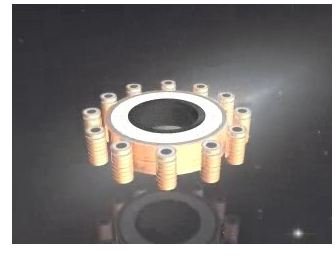
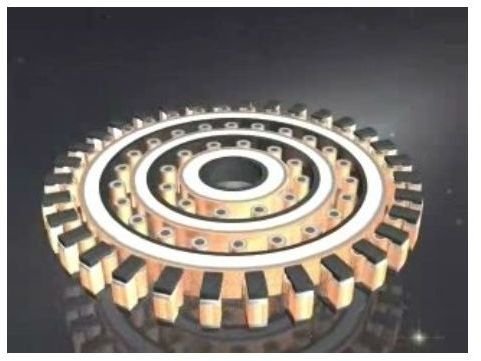
The arrangement of the Searl Effect Generator (SEG) consists of a series of three magnetic rings and cylindrical counterparts. The three magnetic rings acts as a stator and the oppositely magnetized cylindrical parts acts as a rotor.
Thus the construction of the generator consists of an arrangement with first, a magnetic ring, and then a series of rollers. This pattern repeats alternately till the last magnetic ring. The SEG works on the principle of a linear induction motor.
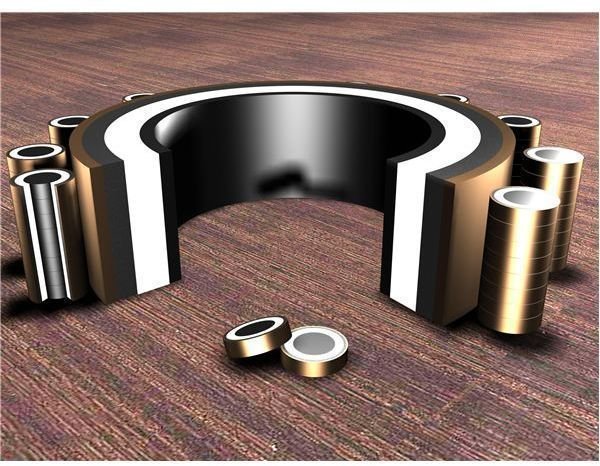
The SEG is made up of four different materials and the layering sequence is the same for both rotor and stator.
The materials are:
Neodymium– This bright silvery metal is extremely rare and is used to collect free electrons and also to act as reservoir.
Teflon or Nylon 66- Acts like a gate, regulating the flow of electrons to the next layer.
Permanent magnet material- Acts as an accelerator for electrons, helping them during the change in magnetic field while revolving and orbiting rollers around the stator ring.
Copper- Acts like an emitter of high velocity electrons from Neodymium and develops eddy currents between the stator and rotor.
Working
For understanding the operation of SEG, let’s divide the arrangement into three parts – an electron reservoir, a magnetized accelerator, and an electron regulator.
To start the process, the accelerator which is generally made of iron, is magnetized in a unique pattern combining both an AC and DC magnetizing sequence. This leads to the formation of innumerable poles on the surface of the iron plate (accelerator). The iron plate pulls in electrons both from the electron reservoir and the surrounding air. Because of this process, a large number of electrons are accumulated and high pressure is generated. The amount of electrons entering the area is controlled by the electron regulator. If a magnetic material is kept in this pressure area, it will start moving in a particular direction, depending on the flow of electrons.
However, when this material is in the zone, a peculiar thing happens. The material is acted upon by two forces– a magnetic force and a centrifugal force. The magnetic force, as a result of the magnetized plate, holds down the material and the centrifugal force because of the movement of the material, pulls it away. Because of this the material neither touches the surface nor moves away from it, thus creating a frictionless motion. The material as it moves also cuts the magnetic flux created around the plate, resulting in the generation of potential**.**
Though based on the principles of a linear induction motor, the SEG has a circular design especially made for the moving rotors. The rollers are cylindrical in shape and move over the fixed stator rings without any kind of friction. Both stator and rotor are uniquely charged in such a way that they make a matching pole pattern. The rollers starts moving because of the magneto-motive forces created as a result of the radial currents generated by the electrons emitted from the neodymium layer. The rotors start rotating in a motion that is at a right angle to both the electric and magnetic fields. As the magnetic rotors move, they cut the magnetic flux generated around the stator. Moreover, the rotors also produce eddy currents because of the interaction between two copper surfaces, resulting in the generation of magnetic bearings that allow a frictionless motion.
As per Searl, when he first activated the device with some external source of energy the rollers (rotors) began to spin around the plate (stator) and started generating a charge of electrons. After attaining a particular threshold speed, it was observed that no external source was required and the device was self sustaining in its motion. The device kept on rotating with the magnetic forces produced in it. The rollers moved continuously as the neodymium layer kept discharging the electrons.
According to the inventor, even a small SEG model is able to produce energy of approximately 200 watts per kg of the generator’s mass. A large sized SEG can produce energy up to several gigawatts, enough to supply to the whole city’s power needs.
Application
As the device is self rotating, it can be used for power production. Also after reaching superconductivity state it produces an “anti-gravity effect” that can be used for producing antigravity equipment and machinery.