It is said that even the most advanced solar energy driven equipment can utilize only 30% of the sun’s energy that reaches the earth. However, the new Johnson Thermoelectric Energy Conversion System promises to convert 60% of the sun’s energy into electrical energy. Find out more about JTEC inside.
Introduction
A more efficient way of using solar energy has now been invented by a former NASA scientist, Lonnie Johnson. The system is called the Johnson Thermoelectric Energy Conversion System, or JTEC, and it is an ambient energy conversion system that can achieve solar energy conversion rate of sixty percent using a heat engine. Basically a device for converting solar or any other fuel energy into electrical energy, JTEC is a small engine with no moving parts. It is said that only thirty percent of the solar energy is utilized by any device using solar energy. However, JTEC promises to utilize sixty percent of the solar energy to convert it into electricity.
Some what similar to the working of a fuel cell, the Johnson Heat Engine uses temperature difference to generate a pressure that forces ions to pass through a thin film. This method is different from the conventional way of using the pressure generated to move a mechanical system. Made by the Johnson Electro Mechanical Systems Inc., the engine’s main goal is to make alternate energy to meet future’s energy needs.
How does it Work?
It is to note that unlike any equipment using solar energy, this new heat engine doesn’t use any kind of semi-conductors or photovoltaic cells to convert solar energy to electrical energy. The engine just uses hydrogen and a source of heat, similar to one found in the internal combustion engine or solar energy.
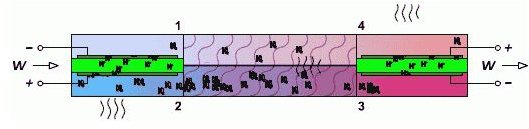
The new heat engine is a solid state heat engine that works on the Ericsson cycle, which provides the same efficiency as that provided by the Carnot cycle for an engine operating between two different temperatures. The system uses the electrochemical potential of the hydrogen pressure that is applied throughout a membrane electrode assembly (MEA).
The arrangement of the heat engine consists of two membrane electrode assemblies, with one end of an MEA attached to a high temperature source using solar energy, and the other stack attached to a low temperature source, which is generally at room or lower temperature. The end which is at a lower temperature acts as a compressor stage whereas the other end acts as a power stage.
The working of the engine is initiated by an electric spark, which creates a pressure difference, producing a voltage across the whole stack. The voltage is mainly caused because of the difference in pressure between the two ends. The high temperature end with a higher voltage will act as a power stage and force the hydrogen at the lower temperature end to move in the opposite direction. The hydrogen will eventually pass through the proton membrane and generate a current. This whole process of hydrogen traveling from low pressure area to high pressure area, along with the pressure difference, produces the electrical charge, which can be used to drive other devices.
Application
The Johnson Ambient Heat Engine can supply power to both small electromechanical systems and also to large scale plants such as a fixed power plant. The same technology can also be applied to moving vehicles, generators, and even spacecraft. Moreover, JAHE can utilize heat from renewable energy sources such as engine exhaust, solar, fuel cells, combustion turbines, etc.
References
Image credits