Geothermal energy is created by the slow decay of radioactive minerals such as uranium, which causes the rocks to become magma. Tectonic plate movement causes the magma to flow upwards from the plate edges, forming a geothermal reservoir from which steam and hot water can be extracted through wells.
Introduction to Geothermal Power Plants and How they Produce Green Electricity
Geothermal energy is created far below the earth’s surface, in the form of hot molten rock or magna, being generated by the action of decaying radioactive materials such as uranium. This energy becomes accessible at the boundaries of tectonic plates, where through rubbing together and one sliding under the other, columns of magma break up from the edges pushing them nearer to the surface of the earth forming a geothermal reservoir.
This is an article on renewable energy and in particular the use of geothermal energy to produce electrical power.
Here we shall examine what geothermal energy is and how geothermal energy is used to generate electricity. We begin then with a look at how geothermal energy is used to generate electricity.
How is Geothermal Energy used to Generate Electricity?
A geothermal reservoir can be exploited to raise steam to power steam turbines much like the conventional steam turbine power plants. The world’s first geothermal power plant, a dry steam type, was built in 1904 at Larderello in Italy. Since then wherever there are tectonic plate boundaries or where the reservoirs are near enough to the surface to facilitate drilling, a variety of geothermal power plants have been built close to them. These include plants which are located in Iceland, California USA,(currently the largest), Costa-Rica, New Zealand, and the Philippines.
Geothermal energy is considered renewable energy because it is sustainable and, although some pollutants are released to the atmosphere during production, these emissions are much less than those from conventional power stations. Therefore, geothermal energy could mitigate global warming if used in place of fossil fuels in power plants.
When a geothermal reservoir has been located, two wells are drilled down into it; an injection well which is used to inject water and to re-inject condensate and gasses into the reservoir, circulating around the cracks in the hot rocks and replenishing the steam/hot water. This is forced up through a second well; the production well, where it flashes off to steam as it reaches the lower pressure of the earth’s surface.
There are three types of geothermal power plants;
- Dry Steam Power Plant
- Flash Steam Power Plant
- Binary Cycle Power Plant
Types of Geothermal Power Plants.
- Dry Steam Power Plant
This was the original, and the least common type of geothermal power plant, utilizing the dry steam straight from the production well, drilled into the geothermal reservoir. The high pressure dry steam passes up the production well and through a rock catcher; a series of mesh filters which catch any rocks, stones or other debris, which would damage the turbine blades. The steam then passes through a steam turbine that drives an electrical generator , which produces electricity for the grid.
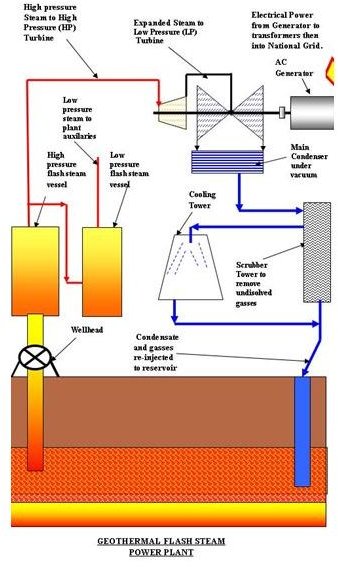
The steam exits the LP stage of the turbine and into the turbine condenser, that is under a vacuum. From here the condensate is pumped through a series of scrubbing towers that remove any residual non-condensable gasses. The condensate is then pumped to the water cooling towers, where it is cooled, with any remaining incondensable gasses re-circulated to the scrubbers before being re-injected with the cooled condensate down the injection well into the geothermal reservoir.
- Flash Steam Power Plant
This type of plant injects water and condensate into the geothermal reservoir through the injection well that forces water at a high temperature (360°F) up through the production well. From the production well it is pumped through a series of pressure vessels which being at a lower internal pressure than the hot geothermal fluid, causes the water to flash off into low, medium and high pressure steam. The steam then passes through the steam turbine, condensing and being treated as per a dry steam plant, returning to the geothermal reservoir along with the non-condensable gasses through the injection well.
- Binary Cycle Power Plant
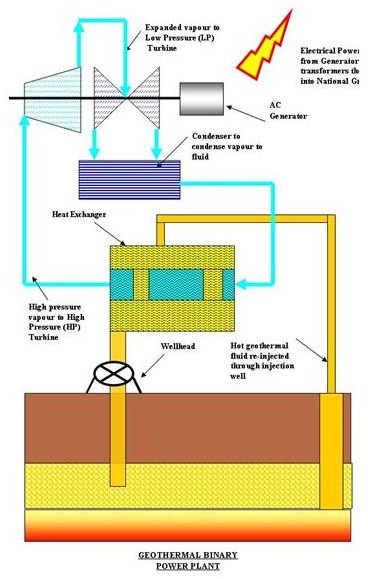
This type of plant uses high temperature geothermal water to heat another fluid which has a lower boiling point than water. The secondary fluid, (usually isobutene or isopentane), is heated by the geothermal fluid through a heat exchanger and flashes of to a vapour. This vapour is used to drive a turbine, similar to a steam turbine and condensed back to a fluid before returning to the heat exchanger to start the cycle again. Because the geothermal fluid passes from the production well, through the heat exchanger and back down the well in a continuous closed loop system. Therefore in this type of plant there is no escape of noxious gasses nor is there any gas scrubbing required. (Thus the plant type binary, meaning two, in this case referring to the two cycles).
Reference Webs:
1. Oregon Gov
This post is part of the series: Geothermal Energy - Energy from the Earth
This is a series about geothermal energy. It begins by examining how the heat is produced under the rocks and continues with itsextraction to tthe different types of geothermal power stations and how they operate. It continues with the different types of heat pumps and the loops that supply them