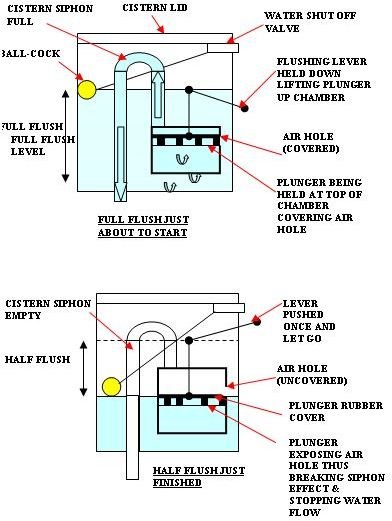
How do dual flush toilets work? They have a half flush or full flush mechanism operated by a lever or a button on the cistern. The user has the choice to use the half flush for disposal of liquid waste or the full flush for disposal of solid wastes, therefore dual flush toilets use less water.
Introduction
So, how do dual flush toilets work? Before we look at their operation it will be useful to examine the function of a normal toilet.
There are several types of toilets, the siphon toilet fully described in the next section which was developed by Crapper in the 1800’s and the flap valve system. These two were the most popular gravity flushing toilets until the development of the dual flush toilet.
The siphon type used a siphon in the cistern to supply the water to the bowl. Another siphon in the actual bowl outlet was used to drag the contents from the bowl, through the S bend and into the soil pipe.
The flap valve system was relatively simple; the operation of the lever caused a valve in the bottom of the cistern to open, allowing water to flow down into the bowl.
Both types used a ball-cock system to maintain the water levels in the cisterns and a lever on the side of the cistern to operate the flush mechanism.
However, the British Government became concerned about excessive water losses from the cisterns of the nation’s toilets, and opted for the siphon toilet, relaxing the laws governing the water loss through the visible overflow pipe. The overflow was usually due to people jamming the water flap valve slightly ajar, (supposedly to freshen the toilet) rather than to bad design fault.
Eventually, an Australian invented the dual flush toilet, a great water saver, and money (if you were metered) was made. This was particularly important to drought prone countries such as Australia, the USA and the Far East.
So, let’s examine how dual flush toilets work then compare this with the normal siphon toilet and compare their different operating criteria.
The Dual Flush Toilet
Dual Flush Toilet Cistern
There are several recent cistern designs on the market which enable the toilet to be flushed using two buttons on the lid. I found these types leaked water into the bowl after flushing, due to the buttons being slightly depressed. I ended up having to put a spacer between the lid and the cistern because all of the adjustment to the buttons was used up. So the most reliable, in my opinion is still the old tested and tried siphon cistern type.
The cistern contents are basically the same, the water tank, ball-cock, and siphon with plunger plate and chamber. However, there are two distinct differences in the design, the lever operating the plunger is oval and operates up and down and, the plunger chamber itself has an air hole drilled at the half flush water-level.
This air hole is covered by the plate skirt by holding the lever down and operating a full flush allowing the whole contents of the tank to flow to the bowl. But, with a single-push and let go of the flushing lever, the water flows into the siphon from the chamber until the air hole is uncovered. Air is thus allowed to enter into the chamber and holds the rubber gasket against the plunger slots, breaking the siphon seal and stopping the water flow at the half-flow water level.
The Dual Flush Toilet Bowl.
The bowl is a very different design. Gone is the siphon effect which drew the water and waste away from the bottom of the bowl. The dual flush toilet bowl is designed with a larger outlet to the S bend, sometimes twice the diameter of the old bowl siphon type.
This allows the water and waste to be pushed out of the bowl by the flushing water, thus using less water. Some manufacturers claim that this type of bowl prevents blockages which were caused by the old bowl small diameter siphon design.
It is possible to retrofit the dual flush toilet cistern, but this has led to difficulties in flushing, sometimes requiring two or three flushes, mainly due to the original bowl being retained with the siphon still in place, obviously defeating the purpose.
A dual flush toilet can use as little as 3 liters in a half flush and 6 liters in a full flush compared with a conventional toilet which can use up to 20 liters a flush.
The Siphon Toilet
Cistern
-
Ball-Cock & Water Shut Off Valve– this is a hollow ball on the end of an arm which floats on the surface of the water in the tank. It is connected to the water inlet valve and controls the flow of water into the cistern. As the water is used, the ball falls to the bottom opening the inlet valve admitting water to the cistern, then as the water reaches a predetermined level, the ball floats up again and the water shuts off the water inlet valve.
-
Tank Siphon – this is an inverted U tube with a circular plunger plate within a larger chamber at one end, the other end being connected to the bowl for flushing. The plunger plate is perforated with slots and a thick flexible rubber gasket covers the slots. The plate and gasket are connected at their center to the flush operating lever on the side of the cistern and, when pushed down the plate is pulled up pushing water up the chamber and into siphon. This causes the siphoning effect which draws the rest of the water into the tank through the plunger plate slot and into the siphon, until the tank has emptied into the bowl. The plate then sinks to the bottom of the chamber.
Advertisement
Bowl
- Bowl Siphon – this is a siphon built into the outlet pipe at the bottom of the bowl just before the S bend. When the toilet is flushed the water enters the bowl through a series of holes around the rim. The water then flows into the siphon which causes a dragging effect. This effect drags the waste away with the water right over the S bend until the seal is broken by air. This maintains the level of water in the bowl and, prevents odors emitting from the down pipe into the bathroom.
As you can see there is no control over the amount of water used to flush the toilet, it is all or none, so a lot of water is wasted.
Now we will look at how dual flush toilets work and, compare their operation to the normal flushing toilets and discover how it is that they save water in flushing.
Article Summary
Now that we have seen how the dual flush toilet works, we shall have a look at the pros and cons of having one installed in your bathroom.
Looking at the cons first, be prepared to have your patience severely tested, at least until you can get the operating mechanism adjusted so there are no water leaks from the cistern into the bowl. This is particularly prevalent after a short flush. Second, with the button operated flushes, the buttons tend to jam open together, or sometimes operate simultaneously; this is due to user error, rather than a fault with the mechanism.
Do not give up - it will settle down eventually.
The pros, however, are the great environmental benefits of using less water to flush the toilet and, don’t forget, less water washing down the sewer system, means less water to treat at the sewage processing works.
There is also the financial benefit to be gained when using a dual flush toilet - if you are on metered water, your yearly water bill could be halved!