Blu-Ray can’t be expected to be the final resolution level in video entertainment. Japan has already made sure that something better will soon be here, and it’s called Ultra High-Definition. Japan, along with two other countries, want it a reality by 2015…
The Blu-Ray industry has been doing a good job in convincing the consumer that it’ll be the last format in DVD you’ll ever need. But anybody who follows what’s happening in the development of high-definition in other countries knows that 1,080 lines of resolution isn’t the final number we’ll see in our lifetimes on a DVD. What would such a thing be called and how many lines of resolution could there be?
Here’s what might be happening in America within a mere five years:
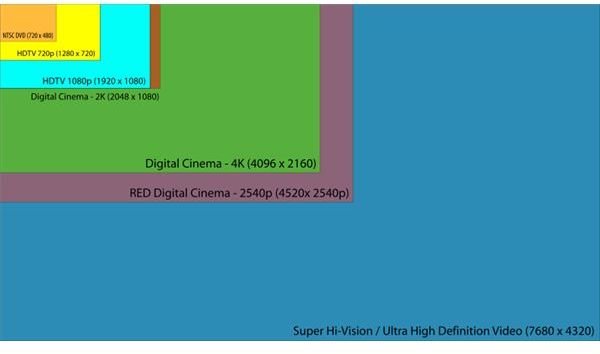
Ultra High-Definition is 16 times higher resolution than 1080p
How the American populace would warm to or deal with a DVD resolution level that’s close to virtual reality would be a fascinating economic and sociological experiment. As always, Japan may have a say in getting it to our living rooms. When their major TV network NHK first experimented with a higher resolution video format in 2003, they let the world know several things:
-
They decided to name their super hi-def picture experiment Super Hi-Vision. It’s better known now as Ultra High Vision Television in Europe–with a more logical name of Ultra High-Definition once it comes to America.
-
Resolution levels for Japan’s initial Super Hi-Vision experiments were an eye-popping 7680 x 4320 pixels. With a resolution that may be hard to fathom for many people, the first demonstrations lasted a mere eighteen minutes due the clarity level taxing even Japan’s technology of the time.
Advertisement -
Japan’s NHK was so concerned about Ultra High-Definition, with its potential physical and psychological effects on viewers, they considered it a major health threat should it get into people’s homes.
Could Ultra High-Definition Bring Illness to the World?
There’s no insinuation here of Ultra High-Definition spreading a deadly virus to anybody who decides to look at it. It was Japan’s NHK that showed initial concern over how our eyes and minds can take looking at an 8k resolution on a TV screen without causing a mental imbalance in comparison to current standards. NHK gave these concerns as a call to bring Ultra High-Definition into reality as a professional endeavor instead of making it available to every household:
Images
-
Nausea. This basic side effect would be the result of sitting too close to a TV screen broadcasting at 8k. The more complex reasons are because the movement on an Ultra High-Definition DVD is faster than we have now–hence tampering with a person’s perceptions and potentially throwing off their equilibrium.
Advertisement -
In technical terms, it means Ultra High-Definition broadcasts at 60 frames-per-second, a movement that most people can’t handle in large doses. Watching a movie at home on an Ultra High-Definition DVD at this movement rate could also potentially be psychologically damaging with the intense realism. Ultimately, it depends on how big your TV screen is.
What other countries are bringing an Ultra High-Definition international standard?
Japan isn’t the only country experimenting with this technology. Great Britain also started giving demonstrations at conventions in the last few years. Italy has also, and all three are teaming up to set up an international standard to make Ultra High-Definition a reality before 2015.
Setting up an international standard, though, is about as challenging as it was back in the day when the thought of a higher resolution DVD seemed out of reach. But the immense compression rates that Ultra High-Definition needs to have in order to become a reality is already on a shorter road to reality than anything before. The problem of how much power it would take (approx. 2400 Giga Operations per Second) to sustain a TV broadcast or watch a movie on DVD in the format gets the exclamation point of being impossible.
Nevertheless, the confidence is there that it’ll be usable in media by the second decade of the 21st century.
Would consumers ditch Blu-Ray for Ultra High-Definition?
The answer to the above is dependent on the economy in America and the world. At the time of this writing, the world economy doesn’t look rosy, so an adamant push of Ultra High-Definition by three major countries seems more a pipe dream. That doesn’t mean it won’t become reality and evolve into a major push by its creators and retailers to get consumers to switch over to Ultra High-Definition discs.
When it comes to persuading consumers to switch, the high-definition industry knows that the public isn’t necessarily afraid to shelve any prior format for the sake of having a profound and collective experience with entertainment.
Source: