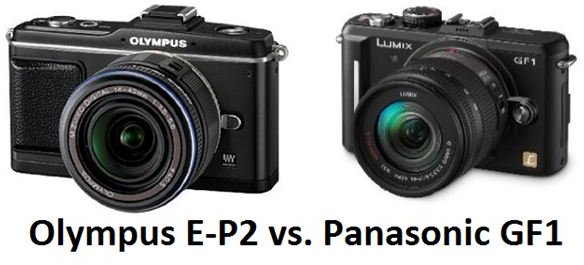
This article compares and contrasts two DSLR’s based on the Micro Four Thirds system, namely the Olympus E-P2 and the Panasonic GF1.
Introduction
Micro Four Thirds cameras provide many advantages over compact cameras such as greater control over depth of field and are smaller when compared to regular D-SLR’s due to the absence of a mirror box, which makes the final camera smaller and lighter.
This head-to-head comparison of Olympus E-P2 and Panasonic GF1 analyzes these cameras across various parameters such as Design & Build Quality, Ergonomics, Performance and Price to Value comparison.
Design & Build Quality
In terms of design, the Olympus E-P2 is based on the legendary PEN series of cameras from Olympus. The Panasonic GF1 on the other hand, is a Lumix series camera and has an aluminum body which is finished to a high extent typical of the Lumix series.
The GF1 is significantly lighter at 285g when compared to the Olympus E-P2 at 335g which has a nice solid feel to it.
Key Features of the Olympus E-P2
- Higher ISO speed (6400) when compared ot the GF1
- Electronic viewfinder which can be angled to 90 degrees
Key Features of the Panasonic Lumix GF1
- Brighter LCD monitor when compared to E-P2
- Better autofocussing system (23 points)
- Built-in flash (which is missing in the Olympus E-P2)
Ergonomics
The LCD screen on the Panasonic GF1 is brighter and has greater clarity. Also, the built-in flash provides more shooting options. The GF1 autofocusses faster when compared to the Olympus E-P2.
The Olympus E-P2 has a finger rest on the front panel which makes it very comfortable to use. The Olympus E-P2 also has many art filters which will appeal to the more creatively inclined.
Performance
Both the cameras offer similar performance across most parameters and some of the differences are highlighted here.
Autofocussing
The Olympus E-P2 has significantly improved when compared to its predecessor and one important feature is autofocus tracking. However, it is still slightly slower than the Panasonic GF1.
The Olympus E-P2 has better metering options with features such as highlight metering and shadow spot metering which are not present in the Panasonic GF1.
Noise
Up to ISO 800, both the cameras performed similarly. Beyond that setting, the Olympus E-P2 performed better in terms of image noise.
Price to Value
In the above comparison of the Olympus E-P2 vs. Panasonic GF1, both the cameras are close in terms of performance, with the Panasonic GF1 showing some advantages.
The Panasonic Lumix GF1 offers a better price to value proposition because of the following factors:
- Presence of a Built-In flash
- Brighter LCD and faster focussing
- Cheaper than the Olympus E-P2 by about 33%
The Panasonic GF1 can be obtained from Amazon. At the time of writing this article, it was available for $754.94.
As described above, the Olympus E-P2 is very alluring to fans of the PEN series. Also, certain other factors in favour of the E-P2 are:
- Art filters
- Additional metering options (highlights and shadow spot metering)
- Better performance on the image noise front
The Olympus E-P2 can be obtained from Amazon . The Olympus E-P2 cost $998.95 at the time of writing this article.