The word game we know as Pig Latin was played by Thomas Jefferson in his youth, and there are a number of references to it throughout the 19th century. Learn about its history, how to use it, and how to access Google in Pig Latin. Learn Holiday greetings in Pig Latin- Appyah Olidayshay!
Oday uoyay eakspay igpay atinlay?
Spring holiday greetings in Pig Latin
Appyhay Oundgray Og’shay. Idday ethay oundgray oghay eesay ishay adowshay?
Appyhay Alentine’svay Ayday
Appyhay Inesechay Ewnay Earsyay Ayday
Aintstay Atrick’spay Ayday
Ingspray Siay Ungspray!
PrilAay Oolsfay!
Appyhay Stereaay
Assoverpay Eetingsgray
Appyhay Aymay Ayday
Appyhay Other’smay Ayday
Summer greetings
Appyhay Ather’sfay Ayday!
Ongratulationscay, aduategray
Appyhay Ependenceinday Ayday
Oolschay siay utoay!
Pig Latin greetings for the WInter holidays
- Appyah Olidayshay!
- Errymay Istmaschray!
- Easonssay Eeetinggray!
- Appyhay Ewnay Earyay!
- Ulday Anglay Angsay!
- Appyhay AnukkahḤay!
- Aay Reiliḥinfay AnukkahḤay!
- Olsticesay Eeetinggray!
and of course,
- Antasay Ausclay
and
- Udolphray
Learning Pig Latin
Pig Latin is a constructed play language used by English speakers. There are minor variants, but anyone who is familiar with the general principles of how to form words in Pig Latin can understand the different Pig Latin versions. It has been studied in Linguistic journals and conferences, as well taught to children by each other in almost every school and playground in the United States.
Take the consonant at the beginning of the word, and put it at the end of the word, then add an -ay to the end of the word. An example is operay (rope.)
If the word begins with a vowel, the version I learned merely says the word and adds an -ay at the end (addsay.) Variations sometimes end the word with -yay (addsyay), or -way (addsway).
Sometimes a hyphen is used when writing the word, if the meaning can be ambiguous.
Google in Pig Latin
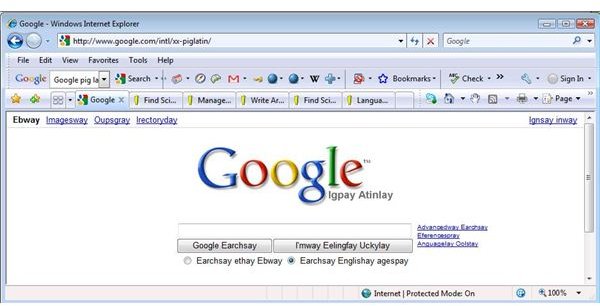
Google is available in Pig Latin . Google does not become Ooglegay, but the search button reads earchsay, and web becomes ebay. If you type in search instructions in piglatin, Google does not try to translate them, but it does give you the message in Pig Latin that it could not find esultsray. You use it just as you would use Google normally, and the links are not converted, but all of Ooglergay’s normal wording is in Pig Latin. Cached is achedcay, and similar pages reads imilarsay agespay.
Google Directory listing https://directory.google.com/Top/Science/Social_Sciences/Linguistics/Languages/Constructed/Play/Pig_Latin/ has a page of links to information on Pig Latin.
Interesting information on PigLatin
Wikipedia’s page on Pig Latin has a number of scholarly references to Pig Latin, including articles in the journals Lingua, Journal of Child Language, and an address at the 2003 Linguistic Society of America Annual meeting.
It actually has nothing to do with the Latin language, but is an English word game and secret language used by children, and sometimes adults. A version of a word game in English appears in one of Shakespeare’s plays, and there are many other invented languages used around the world. Some believe that playing with words in this way increases general understanding of a language.
The characteristic -ay sound at the end of the word immediately tells the person listening or reading that they are hearing Pig Latin. Those who practice can understand it as quickly as they understand English, while for others, even if they know the principles, it is nonsense.
It is easier to read and decipher than hear, until you are familiar with the sounds. When reading Pig Latin, all you do is move the consonant at the end of the -xay group back to the beginning of the word, and you can tell what the word means. It is not, however, quick reading. It is great for having secret conversations in front of people who don’t know Pig Latin, or, even if they understand the idea, can not translate what the words mean before the speaker has already moved on two or three words further in the sentence. You can also write cryptic messages in it to friends who understand how to read it.
It is sometimes used by adults to try and give messages in front of their children, which they hope the children don’t understand, but this tends to be a lost cause, as most of the time children are faster at understanding the verbal code than adults are. Curiously enough, my daughter, who knows Spanish, German and Java, has never bothered to learn Pig Latin, although she recognizes the meaning conveyed by ixnay.
Pig Latin’s inventor is not recorded. It was mentioned in magazines during the 19th century. Reputedly, a young Thomas Jefferson
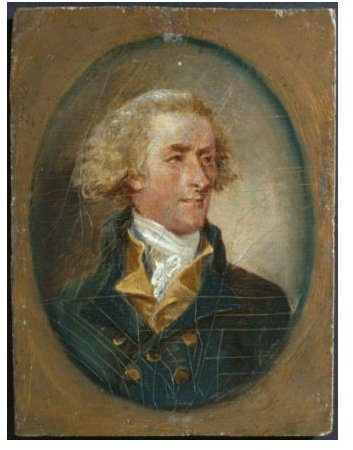
wrote letters to friends in Pig Latin, which dates it to the late 18th century. (Thomas Jefferson on WIne, page 12, by John Hailman )
Some Pig Latin is recognized by almost every native English speaker, because it has become slang. Examples of this are amsacray (scram) and upidstay (stupid), azycray (crazy), umbday (dumb), and of course, ixnay.
Ogay otay ethay extnay agepay siay oremay formationinay on igpay atinlay
There are many variants of an altered dialect popular among children in many countries and languages. Children enjoy having secret languages, and some continue to invent them to this day. L33T is an example of a secret language made by those who, while perhaps childlike in someways, are adults.
Napster offered music files with Band names in Pig Latin for a few day, circumventing the copy protection ruling for a few days.
The first seven verses of Genesis
Someone affiliated with the museum of conceptual art has translated parts of the King James Bible into Pig Latin
Olyhay Ibiblebay
Enesisay Ookbay Oneay
1:1 In-ay e-thay eginning-bay Od-gay eated-cray e-thay eaven-hay
and-ay e-thay earth-ay.
1:2 And-ay e-thay earth-ay as-way ithout-way orm-fay, and-ay
oid-vay; and-ay arkness-day as-way upon-ay e-thay ace-fay of-ay
e-thay eep-day. And-ay e-thay Irit-spay of-ay Od-gay oved-may
upon-ay e-thay ace-fay of-ay e-thay aters-way.
1:3 And-ay Od-gay aid-say, Et-lay ere-thay e-bay ight-lay: and-ay
ere-thay as-way ight-lay.
1:4 And-ay Od-gay aw-say e-thay ight-lay, at-thay it-ay as-way
ood-gay: and-ay Od-gay ivided-day e-thay ight-lay om-fray e-thay
arkness-day.
1:5 And-ay Od-gay alled-cay e-thay ight-lay Ay-day, and-ay e-thay
arkness-day e-hay alled-cay Ight-nay. And-ay e-thay evening-ay
and-ay e-thay orning-may ere-way e-thay irst-fay ay-day.
1:6 And-ay Od-gay aid-say, Et-lay ere-thay e-bay a-ay irmament-
fay in-ay e-thay idst-may of-ay e-thay aters-way, and-ay et-lay it-
ay ivide-day e-thay aters-way om-fray e-thay aters-way.
1:7 And-ay Od-gay ade-may e-thay irmament-fay, and-ay ivided-day
e-thay aters-way ich-whay ere-way under-ay e-thay irmament-fay
om-fray e-thay aters-way ich-whay ere-way above-ay e-thay
irmament-fay: and-ay it-ay as-way o-say.
Pig Latin Translators
The site Wordplays has an English to Pig Latin and Pig Latin to English translator program
eadRay ightBray ubHay’say anguageLay earningLay annelchay otay indfay articlesyay onyay earninglay anymay ifferentday anguageslay, includingyay anyay articleyay onyay ethay istoryhay ofyay igPay atinLay andyay owhay otay eakspay igPay atinLay.
This site moves the capitalized letter to the new place in the word, rather than capitalizing the new beginning letter. They also Pig Latinize both the beginning of a word before an apostrophe and the letter(s) after it.
Ightbray Ubhay
Here is another translator They offer the option of Pig Latin in Learning mode, with a dash between the word and the new suffix, to help interpretation.
Their version uses one convention I learned, which is to capitalize the beginning letter of any capitalized word. However, they add -way to the end of words beginning with vowels. They also move the suffix including the beginning letter to the end of words with apostrophes.
Eadray Ightbray Ub’shay Anguagelay Earninglay annelchay otay
indfay articlesway onway earninglay anymay ifferentday
anguageslay, includingway anway articleway onway ethay istoryhay
ofway Igpay Atinlay andway owhay otay eakspay Igpay Atinlay.
Constructed languages
If you are intersted in learning more about constructed languages, you can learn how Na’vi, Tolkien’s ELvish languages and more were created. We also have information on Esperanto - the most useful of the constructed languages.