Grammatical mood is the expression of modality, which refers to possibility, necessity, and contingency. The subjunctive mood of verbs in English expresses commands, doubts, guesses, hypotheses, purposes, requests, suggestions, and wishes that are contrary to fact at the time of the utterance.
Forming the Subjunctive Mood
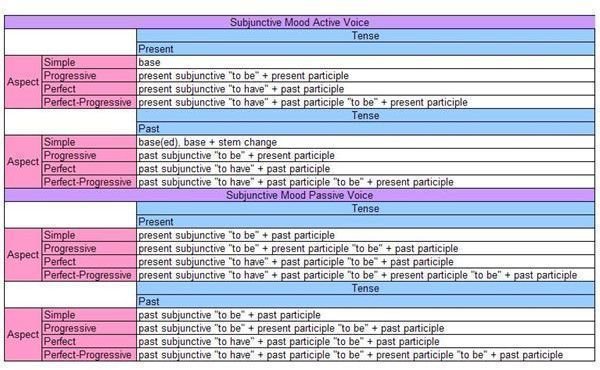
All forms of the subjunctive mood in English closely resemble the corresponding forms of the indicative mood. In fact, the subjunctive is only distinguishable in form from the indicative in the third person singular present tense forms and in forms that require the verb be as the initial verb of the verb phrase. The following verb chart outlines the verb phrase patterns for the subjunctive mood:
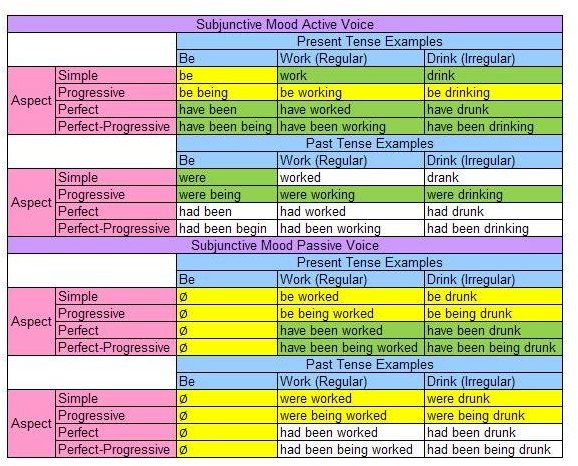
The following chart provides examples of the subjunctive mood for the verb be, regular verbs, and irregular verbs . Note that the verbs highlighted in yellow differ completely from the indicative forms, the verbs highlighted in green differ only from the indicative forms in the third person singular, and the verbs not highlighted are identical to the indicative forms. The verb be and similar intransitive verbs do not have subjunctive passive forms.
For example:
-
It is a good idea that you be a fastidious grammar student. (active simple present subjunctive)
-
The boss desires that all employees be working when she returns. (active present progressive subjunctive)
Advertisement -
It is desirable that she have included references in the report. (active present perfect subjunctive)
-
The parents demand that the child have been cleaning his room for at least an hour before watching television. (active present perfect-progressive subjunctive)
Advertisement -
If I were a rich girl, I would be very lucky indeed. (active simple past subjunctive)
-
The teacher would not have to punish the entire class if the break monitor were behaving. (active past progressive subjunctive)
Advertisement -
If I had eaten all the cookies, then ants would not have gotten into my kitchen. (active past perfect subjunctive)
-
Had the boy been studying as he said, he would not have failed the test. (active past perfect-progressive subjunctive)
Advertisement -
The executives insist that the copier be repaired by a trained technician. (passive simple present subjunctive)
-
It is imperative that alcoholic drinks be being drunk by only adults at this party. (passive present progressive subjunctive)
Advertisement -
It is essential that references have been included in the report. (passive present perfect subjunctive)
-
The committee asks that the final report have been being compiled by the staff today. (passive present perfect-progressive subjunctive)
Advertisement -
Were your car damaged by an uninsured motorist, then you could sue for damages. (passive simple past subjunctive)
-
If the driveway were being resealed, then I would park on the road. (passive past progressive subjunctive)
Advertisement -
Had your windows been destroyed by the storm, then you could have filed an insurance claim. (passive past perfect subjunctive)
-
If the pumpkins had not been being stolen, then we would have had dozens. (passive past perfect-progressive subjunctive)
Advertisement
If Clauses
Unlike the indicative mood, the subjunctive mood often appears in subordinate clauses . Also known as dependent clauses, subordinate clauses contain both a subject and a predicate but cannot function as complete sentences. Many of the verb phrases in the subjunctive mood in the previous examples begin with the subordinating conjunction if. Noun clauses that begin with if are often referred to as if clauses. The subjunctive mood in English most frequently appears in if clauses because such clauses always express possibility, necessity, and contingency. For example, in the sentence If the driveway were being resealed, then I would park on the road, my parking on the road is contingent upon the driveway being resealed.
However, not all dependent clauses that express possibility, necessity, and contingency begin with the subordinating conjunction if. For example, the boy not failing the test was contingent on his studying as expressed in the sentence Had the boy been studying as he said, he would not have failed the test. The noun clause Had the boy been studying as he said is a subordinate clause that contains the subjunctive mood. This noun clause could also be written as If the boy had been studying as he said with an if introducing the clause. However, in English, the if of the if clause can be removed so long as the first auxiliary verb switches places with the subject. Therefore, the if clause If the driveway were being resealed could also be written as Were the driveway being resealed without eliminating the subjunctive mood.
The subjunctive mood also appears in a verb phrase following a modal verb .
Subjunctive Verbs and Phrases
In addition to appearing in if clauses, the subjunctive mood also follows certain verbs and phrases that express possibility, necessity, and contingency. For example, some of the most common English verbs that take the subjunctive mood in the following noun clause include:
- to advise that
- to ask that
- to command that
- to demand that
- to desire that
- to insist that
- to propose that
- to recommend that
- to request that
- to suggest that
- to urge that
- to wish that
Some of the most common English phrases that also take the subjunctive mood in the following noun clause include:
- It is best that
- It is crucial that
- It is desirable that
- It is essential that
- It is imperative that
- It is important that
- It is necessary that
- It is recommended that
- It is urgent that
- It is vital that
- It is a good idea that
- It is a bad idea that
The conjugated verb phrase following a modal verb is also always in a present subjunctive form.
The Decline of the Subjunctive in Modern English
Unlike in other contemporary Indo-European languages such as Spanish and German , modern English is quickly losing distinct verb forms in the subjunctive mood. Take for example the following two English song lyrics:
- If I were a boy, even just for one day, I’d roll out of bed in the morning and throw on what I wanted and go drink beer with the guys. (Beyoncé Knowles)
- If I was a rich girl, see, I’d have all the money in the world, if I was a wealthy girl. (Gwen Stefani)
In the first example, Beyoncé uses the subjunctive mood of the verb be in the if clause If I were a boy. The use of the subjunctive in the clause If I were a boy expresses contingency; if Beyoncé were male instead of female, she would do the things she lists. However, she is not male, so she uses the subjunctive to express an idea that is contrary to fact at the time of the statement. In the second example, however, Gwen Stefani uses the indicative form of the verb be in place of the subjunctive form in two if clauses: If I was a rich girl and if I was a wealthy girl. She is still expressing uncertain modality (she would only have all the money in the world in the event that she were rich) but uses a form of the verb that is identical to the indicative.
Many native English speakers similarly use indicative forms to express the subjunctive mood. For example, a speaker who says His parents insist that he eats all of his vegetables before his dessert is expressing subjunctivity but is using the indicative form of the verb (eats) rather than the subjunctive form (eat). The decline of the subjunctive in English is even more apparent and inevitable considering that about half of the subjunctive forms are already identical to the indicative forms. The subjunctive had been working is indistinguishable in form from the indicative had been working. In fact, the use of subjunctive forms is only required in the most formal registers of English usage. Language change is inevitable, and all distinct subjunctive forms may soon disappear from the English language.
For information on other verb forms in English, please read the article The English Verb System for ESL Students .