Now that you have gone over the parts of the nervous system in class, it is time to review! Learn information about the divisions of the nervous system, such as the central nervous system and the peripheral nervous system.
When studying neuroscience, an essential section is the nervous system, which controls the nerves throughout the body. The nervous system is responsible for three main functions: taking in sensory input (like touch or sight), processing that information, then responding to the sensory input (like moving a limb). Besides the three main functions, each of the divisions of the nervous system have individual responsibilities.
Divisions of the Nervous System
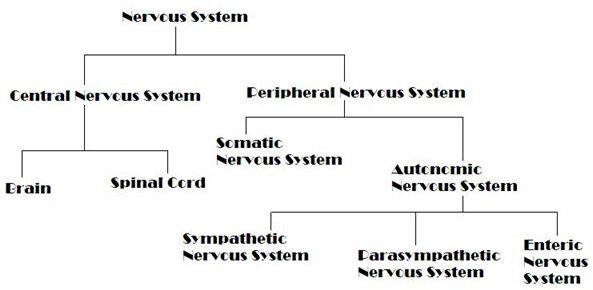
The first step of studying the nervous system is breaking it down to the different divisions. Try making a chart (like the one to the left) to help keep track of the different parts. Let’s start with the two major parts of the nervous system: the central nervous system and the peripheral nervous system.
Central Nervous System
The central nervous system includes the brain and the spinal cord. When studying the brain, review basic brain anatomy and functions , as well as the structure and function of the neurons . The second part of the central nervous system is the spinal cord, which connects the central nervous system and peripheral nervous system. The spinal cord has five sections: cervical (eight segments), thoracic (12 segments), lumbar (five segments), sacral (five segments) and coccygeal (one segment). For practice, get a diagram of the spinal cord and label the different segments.
Peripheral Nervous System
When studying the second division of the nervous system, the peripheral nervous system, remember that it includes all of the nerves outside of the brain and spinal cord. The peripheral nervous system is further divided into two groups: the somatic nervous system and the autonomic nervous system. The somatic nervous system is responsible for voluntary movements, while the autonomic nervous system is responsible for involuntary movements. The autonomic nervous system even has three divisions: the parasympathetic nervous system, sympathetic nervous system and enteric nervous system. The sympathetic and parasympathetic nervous system are part of the fight-or-flight system, while the enteric nervous system innervates the viscera.
Nerve Pathways
In the somatic nervous system, there are two nerve pathways:
- Afferent Pathway: sensory information to the central nervous system
- Efferent Pathway: motor information to the muscles
Note that the names of the pathways indicate their direction. Make a chart for each pathway as practice.
Fight-or-Flight System
A very important function of the autonomic nervous system is the fight-or-flight system, which is the body’s response to stress. When faced with a danger, either physical or psychological, the sympathetic nervous system activates. As a result, the heart rate increases, breathing rate increases, pupils dilate, and gastrointestinal function decreases. When the danger is no longer present, the parasympathetic nervous system activates, and the body returns to a relaxation state. So, heart rate and breathing rate decrease, while gastrointestinal function increases.
References
- University of Washington: Divisions of the Nervous System, http://faculty.washington.edu/chudler/nsdivide.html
- Maricopa Community College: The Nervous System, http://www.emc.maricopa.edu/faculty/farabee/BIOBK/BioBookNERV.html
- MedlinePlus Medical Encyclopedia: Central Nervous System and Peripheral Nervous System, http://www.nlm.nih.gov/medlineplus/ency/imagepages/8679.htm
- Image Credit: Divisions of the Nervous System by Elizabeth Stannard Gromisch. All rights reserved.