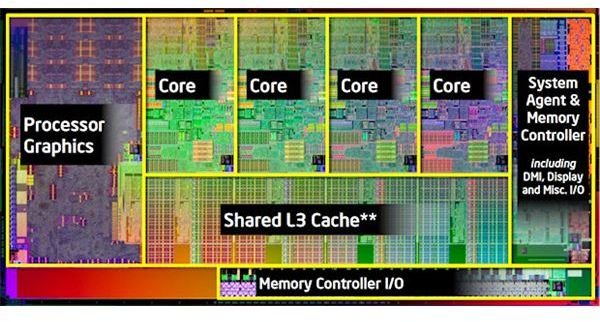
Intel has now released the new Sandy Bridge architecture, and this has resulted in a re-launch of the Core i3, i5 and i7 brands. Thankfully, this means the i3 vs i5 vs i7 battle is no longer such a nightmare.
i3 vs i5 vs i7: A Branding Dream
Intel’s previous Core i3, i5 and i7 branding was a supreme pain in the butt. It was difficult to explain because Intel didn’t really divide features along the brands evenly. Processors in the same brand didn’t even alway use the same socket. This made explaining the differences between processors extremely difficult.
Now Intel has introduced Sandy Bridge, the new architecture for its processor. It has also re-launched its products using the same Core i3, i5 and i7 brands, but with new products inserted. To represent this, Intel has moved to a 4-number naming scheme, with the processors being numbered 2100, 2500, and etc.
Thankfully, this re-launch has cleared up the product line significantly. The features available on different processors are now much clearer. Let’s take a look at what each brand of Intel processor offers you.
Core i3 Series
Intel’s Core i3 processor line has always been a budget option. These processors remain dual-core, unlike the rest of the Core line, which is made up of quad core processors. Intel’s Core i3 processors also have many features restricted.
The main feature that is kept from the Core i3 processors is Turbo Boost, the dynamic overclocking available on most Intel processors. This, alongside with the dual-core design, accounts for most of the performance difference between Core i3 processors and the i5 and i7 options.
Core i3 processors also lack Intel’s vPro technology virtualizaton and AES encryption acceleration technology. These are features unlikely to appeal to your average user anyway, and are instead targeted towards enterprise users. Still, the lack of these features should be kept in mind.
One feature that Core i3 has - and i5 doesn’t - is hyper-threading. This is Intel’s logic-core duplication technology which allows each physical core to be used as two logic cores. The result of this is that Windows will display a dual-core Core i3 processor as if it were a quad-core.
Finally, Core i3 processors have their integrated graphics processor restricted to a maximum clock speed of 1100 MHz, and all Core i3 processors have the 2000 series IGP, which is restricted to 6 execution cores. This will result in slightly lower IGP performance overall, but the difference is frankly inconsequential in many situations.
Core i5 Series
Intel used to split the Core i5 processor brand into two different lines, one of which was dual-core and one of which was quad-core. This was, needless to say, a bit confusing for buyers.
Thankfully, the behavior has stopped (for now). All Sandy Bridge Core i5 processors are quad-core processors, they all have Turbo Boost, and they all lack Hyper-Threading. Most of the Core i5 processors, besides the K series (explained later) us the same 2000 series IGP with a maximum clock speed of 1100 MHz and six execution cores.
In the i3 vs i5 vs i7 battle, the Core i5 processor is now obviously the main-stream option no matter which product you buy. The only substantial difference between the Core i5 options is the clock speed, which ranges from 2.8 GHz to 3.3 GHz. Obviously, the products with a quicker clock speed are more expensive than those that are slower.
NOTE: As of 2/20/2011, Intel has introduced a dual-core Core i5 called the 2390T. The T appears to be what designates it as a dual-core part. It is the only dual-core Core i5 as of yes, so hopefully Intel has introduced this as some sort of exception, as a return to the confusion of the first-gen Core i5 parts would be disappointing.
Core i7 Series
The Intel Core i7 series has also been cleaned up. In fact, it has perhaps been cleaned up too much, because at the moment Intel is offering only two Sandy Bridge Core i7 processors.
These processors are virtually identical to the Core i5. They have a 100 MHz higher base clock speed, which is inconsequential in most situations. The real feature difference is the addition of hyper-threading on the Core i7, which means that the processor will appear as an 8-core processor in Windows. This improves threaded performance and can result in a substantial boost if you’re using a program that is able to take advantage of 8 threads.
Of course, most programs can’t take advantage of 8 threads. Those that can are almost usually meant for enterprise or advanced video editing applications - 3D rendering programs, photo editing programs, and scientific programs are categories of software frequently designed to use 8 threads. The average user is unlikely to see the full benefit of the hyper-threading feature. In the Core i3 vs i5 vs i7 battle, the i7 has limited appeal.
The IGP on Core i7 processors can also reach a higher maximum clock speed of 1350 MHz. As I’ve said before, however, this difference is largely inconsequential when measuring real-world performance.
The K series processor
Late in the lifespan of Intel’s previous Core i branded products, Intel introduced the “K” series. These processors had unlocked multipliers, making them easier to overclock.
Intel has kept this line of products alive with the new Sandy Bridge architecture by introducing a K series Core i5 and i7 processor. As before, these processors have unlocked multipliers. However, they also have a new feature - better integrated graphics processors.
This comes in the form of the 3000 series IGP, which has 12 execution cores instead of 6. The maximum clock speed remains limited by the processor brand - the Core i5 K is limited to 1100 MHz, while the Core i7 K can reach 1350 MHz. The additional execution cores can result in better performance in games, although to honest, the IGP isn’t remotely cut out for desktop gaming.
Sockets and Chipsets
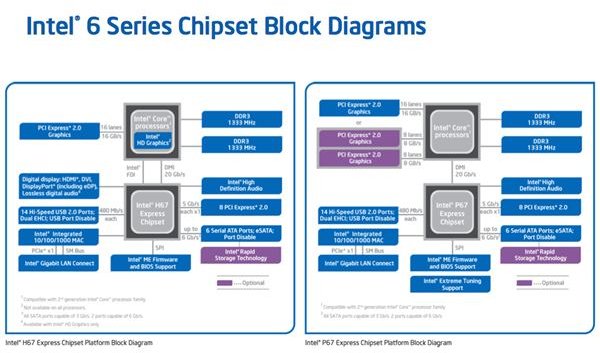
The sockets and chipsets also used to be a stumbling block for those wanting to build a new system with an Intel Core processor. Different processors from the same brand used different sockets.
That’s no longer the case. All of the new Intel processors use the same LGA 1155 socket and are compatible with the new P67 and H67 chipsets. This makes choosing compatible hardware relatively painless. Rumor has it that this state of affairs won’t last forever, as Intel likely intends on releasing an even quicker Sandy Bridge variant on a new chipset later this year. For now, however, choosing the right socket and chipset is a breeze.
Buying Advice
Intel’s Core i5 processor line remains the one to buy. The quad-core i5 processors are extremely quick, and have all of the features that are important, such as Turbo Boost. They’re also reasonably priced, however, with the 2.8 GHz variant starting at just under $180 bucks. That’s not a bargain, but considering the performance - which is far in excess of Intel’s previous Core i5 processors and AMD’s quad-core offerings - it’s a good value.
Still, the i3 processor should be considered if you’re not looking for a performance speed-demon. We reached the point at which a basic processor proved capable of offering adequate day-to-day performance years ago. Tasks such as HD video, basic video transcoding and productivity applications will easily be conquered by the least expensive i3.
Finally, we have the i7. In the i3 vs i5 vs i7 battle, the Core i7 is the hardest to recommend. Hyper-threading is great, but only if you use specific applications that can take advantage of 8 threads. If you don’t, there isn’t much reason to spend the extra dough.
If it were my money, I’d buy the Core i5-2500K. This $216 processor is easy to overclock, has a base clock speed of 3.3 GHz, and offers four cores. This recommendation may change as new processors are introduced to flesh out the line, but I suspect this processor will become the Core i5-750 of the Sandy Bridge line; a reliable pick that remains the best value even a year and a half down the road.
This post is part of the series: Core i3, i5, and i7 Explained
It is often difficult to discern which new processors are the best. This guide to Intel’s new Core i3, i5, and i7 processors gives advice and information about them so that you can decide which processor is best for your needs.