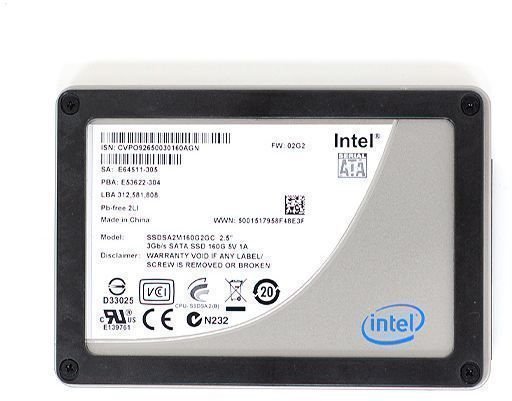
Intel’s X-25M has been cited as being the best solid state drive available today due to its high performance without an extreme price premium. But now Intel has moved to a 34nm manufacturing process, resulting in the X-25M G2. How does the new model compare to the old one?
The X25-M Reborn
The solid state hard drive market is moving at warp speed. Prices have fallen dramatically over the last year, with the Intel X25-M costing a little more than half of what it did a year ago. Technology has also been on the move, with new controllers powering popular new hard drives from OCZ and Corsair. The Samsung controller found in the new Corsair drives and also in the new OCZ Summit drives is quite good in certain benchmarks, occasionally overcoming the stiff competition put up by Intel’s reigning champion.
Intel, not to be outdone, has responded by giving the X25-M a moderate overhaul. So, how does this new drive stack up against emerging competition from other solid state drive manufacturers?
The Move to 34nm
The most obvious and significant change to be found in the new Intel X25-M is the move to a 34nm fabrication process for the memory chips on the drive. Because all solid state hard drives are essentially bundles of flash memory chips coordinated by a controller chip, this move to a more advanced fabrication process is quite significant. The old X25-M 80GB model was made up of flash memory chips which held 4GB of data each. The new chips, however, hold 16GB each. That means Intel is able to provide higher capacity at a lower cost. It is easy to see why this is important. Solid state drives are obviously faster than mechanical drivers in some important ways. It is only their cost and lower storage capacities which prevents solid state drives from becoming the dominant technology for long-term storage.
Besides lower prices, the move to 34nm fabrication is likely to soon have an effect on how large of a drive Intel can offer. While Intel has released no official plans to release a 320GB hard drive, there is certainly enough free space on the Intel X25-M to release such a product now that each individual memory chip has a 16GB capacity, and there would also be room for drives with maximum capacities of 240 or 256GB. A 320GB Intel X25-M would be impressive, but it would probably carry a heavy price premium.
Misc. Improvements
While the move to 34nm was the major improvement over the new Intel X25-M, there are a few other differences. The new controller is basically unchanged, but with twice the cache of the old one. Intel also claims that the controller, while not changed in any significant way, has improved random write performance over the controller found on the older models. There have been some aesthetic changes as well. The new drives come in a fairly plain bare metal casing with only a bit of black trim and the Intel logo on the front.
One thing Intel did not change is the name. The new and old models both retain the same X25-M tag, although the extended model name does include a G2 where the original bore the label of G1. Considering this, it is fortunate that the physical appearance is different, as it would be easy to buy the wrong model otherwise.
Flawless Victory
Intel of course claims that the newer driver is faster than the older one. This appears unlikely at first glance given that the controller has not been significantly changed, but it seems that Intel did manage to work some magic with the denser memory and larger cache. Benchmarks from The Tech Report and Anandtech show some serious performance gains, particularly when it comes to random write performance. The original Intel X-25M was already incredible in this area, and the new model sometimes beats out the Intel X-25E.
Overall, Intel seems to have hit another one out of the ballpark with the new X-25M. It is somewhat faster than its predecessor, which is impressive. But the price drop is what tips things to Intel’s favor. The new X-25M G2 model is available (when it is not out of stock) at $229. That is a very reasonable price for such an outstanding SSD. The drives based on the Samsung controller, like the Corsair P series and OCZ Summit series, are capable of similar performance to the Intel X-25M in some areas. But there are also areas where they are clearly outdone by the X-25M, and there is no real price advantage to buying the Samsung based SSDs. This means that the X-25M is, for now, both the best performing solid state drive and the best value solid state drive.