Computers continue to get smaller and smaller with every passing year. It is incredible to see how small computers have become in such a short time. But who makes the smallest laptop today? What has this trend of miniaturization created for us in terms of usable little laptops? Here’s your answer.
Introduction
Every few months the computer giants put out a newer, better, and smaller computer. The first “portable computer,” the IBM 5100, was put out in 1975, but it was hardly a little machine. It was only portable because it didn’t take up several rooms. However, it was inevitable that these computers would shrink down and give birth to the laptops we know today that seem to shrink with time. In 1965, Thomas Moore, co-founder of Intel, made the prediction about the number of transistors they would be able to place on a processor would double every 18 months. This has continued since that time, uninterrupted, allowing for evermore powerful and smaller computers. So where are we now?
In truth, what is considered the “smallest computer” depends on your definition. Computers exist ubiquitously now, located in everything from watches to microwaves. There are tiny computers in traffic-lights and in your car. It is probably impossible to say who produces the smallest computing machines. When you get in the molecular level the conception of “computer” blurs with the natural processes of molecules like RNA. For instance, researchers at Caltech have built computers that function inside of yeast cells . On another level, there are computers who contain full operating systems, but are too small to be of much use for every day functions, such as this incredibly small Linux computer .
These, however, are obviously not laptops that we can actually use for our everyday use. Therefore, for the sake of the question, we will define a “laptop” as a portable computer that can accomplish basic everyday computing functions, such as email, word processing, and Internet. This definition, however, blurs into the realm of smart phones, which really do function rather like laptops. For all intents and purposes, smart phones and small portable devices are laptops that do not have full keyboards. So in the question “Who makes the smallest laptop,” three assessments can be made: smallest smart phone, smallest portable device running a full, non-mobile operating system, and the smallest computer with a full keyboard.
Smallest Smartphone
The smaller a smart phone gets, the less functionality it has to act like the traditional “laptop.” However, most cell phones that contain a decent operating system can have all the functionality that laptops had previously, running programs that are called “applications” that adapt traditional laptop functions to a phone. Currently the main cell phone operating systems that are app-enabled are Google’s Android, Windows Mobile OS, Apples’ OS X, Palm’s webOS, and Blackberry OS. All of these could, if you wanted, let you use email, do word processing, and browse the Internet through the phone. So who puts out the smallest one?
Here are the size specifications for the contenders for the smallest smart phone:
Here are the size specifications for the contenders for the smallest smartphone:
HTC Diamond: 102 mm (L) X 51 mm (W) X 11.35 mm (T) – V: 59042.7
iPhone: 115 mm x 62 mm x 12.3 mm – V: 87699
Blackberry Pearl: 107 mm x 50 mm x 14 mm – V: 74900
Palm Pre: 100.53 mm x 59.57 mm x 16.5 mm – V: 9881.43
T-Mobile’s G1: 117.7 mm x 55.7 mm x 17.1 m – V: 112105.7
Based on this list the Blackberry Pearl is currently the smallest smartphone on the market. That being said, more are coming out monthly with more compact and innovative designs.
Smallest UMPC
These devices sit in the strange world between smart phones and full laptops, looking similar to a cell phone but running a full OS like Windows XP or Linux. These are most often called Ultra-Mobile PCs, or UMPCs. Currently these are the smallest around:
Mtube : 8.5 cm x 8.5 cm x 2 cm
OQO’s Model 01+ : 12.5 cm x 2.3 cm x 8.4 cm
All other computers considered UMPCs normally have 7’’ screens and some sort of QUERTY keyboard. They are currently manufactured by many companies including Samsung, Asus, Pepper, Amtek, HTC, and Nokia. To get a good list of what is still available take a look at Amazon . Because these occupy an odd place between smart phones and netbooks they haven’t done particularly well within the market and many have been discontinued.
Smallest Full Laptop
Ok, so to be considered a full laptop you are going to want a full keyboard that you can type one with more than just your thumbs. In this case, what you are referring to are mostly notebooks, such as the Asus Eee PC, Acer Aspire One, or HP Mini. However, there are still on the market small computers that are still considered laptops since they try to pack the latest hardware into a small package. Here is a size comparison of these small laptops and netbooks containing full keyboards (just the companies offering 8.9’ or smaller):
Asus Eee PC 8.9’ – 6.7 in x 9.8 in x 1.14 in — V: 74.85
Acer Aspire One 8.9’ – 8.86 in x 6.69 in x 0.79 in — V: 46.82
HP Mini 8.9’ – 10.3 in x 6.56 in x 0.99 in — V: 66.89
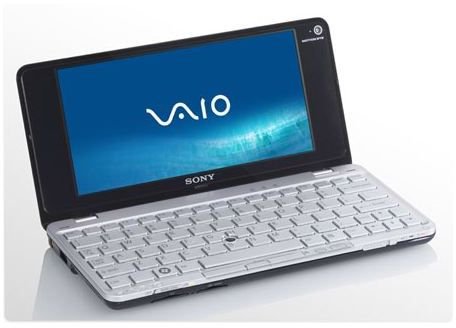
Sony Vaio Lifestyle 8’ – 4.8 in x 9.7 in x 0.8 in — V: 37.248
Fujitsu Lifebook 5.6’ – 6.73 in x 6.14 in x 1.46 in — V: 60.33
As you can see, you shouldn’t merely look at the screen size to determine the smallest laptop here. The Fujistu has the smallest screen but still must maintain a certain width (around 6 in) to maintain the full keyboard and it has a thickness almost double the Vaio and Acer. When look at in terms of the Volume (V) of each laptop, it is clear that the smallest fully functioning laptop is the Sony Vaio Lifestyle PC. This laptop allows for a smaller size by making it longer and more rectangluar than a normal laptop, allowing a full keyboard and full features without the extra bulkiness. Keep in mind that this is a laptop and not a netbook, so it is fully featured and costs around a $1000.
Conclusion
When it comes down to it, the smallest fully featured laptop, excluding cellphones, UMPCs, and netbooks, the Sony Vaio Lifestyle PC is the clear winner at the moment.