
Finally got that powerful laptop you’ve wanted for so long? Surprised that the first time you heard the fan fully cut in it sounded like a jet taking off? Well, jet engines were the inspirations for Intel’s new laminar flow cooling technology for laptops. Here we’ll look at what they’ve announced.
IBM has long favored using the name “notebook” rather than “laptop” because many notebook devices run too hot to actually use in one’s lap. As laptops, such as my workstation-class ThinkPad, with discrete graphics and fast processors have become more powerful, the challenge of providing adequate cooling has been meet in a variety of ways. The trend so far has been toward larger, faster fans and extensive internal ducting, but that trend is nearing the limits of what users will find acceptable.
Compounding the problem of fan-cooling limitations is the increasing trend toward thinner, lighter notebooks. In these ultra-slim devices, the motherboard (aka system board) by necessity has to be mounted close to the external skin. This means that some of the heat generated by the processor, supporting chips, and graphics adapters is dispersed by heating the inside layer of the skin rather than being expelled out the ducting.
Intel’s Mooly Eden thinks he has a better idea, and he demonstrated Intel’s laminar airflow laptop modification on October 21, 2008 at the Intel Developer Forum in Taipei, Republic of China. His address was called “Expanding the Frontiers of Mobility.”
All Images: Intel
For inspiration, they credited the aircraft industry, specifically the design of jet engines.
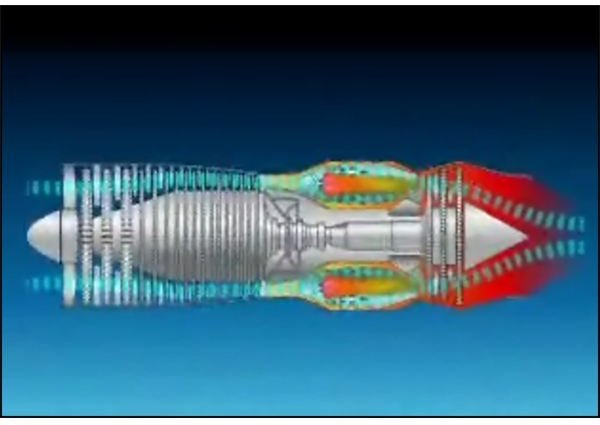
In a jet engine, a very energetic, 1000-degree core of rapidly expanding fuel and air is prevented from transmitting heat to the engine’s skin, and thus to the fuel-carrying portion of the wing, by a highly cohesive, laminar flow of cooler air (shown in blue in the above image) around the hot flow.
An often used example of laminar flow is that of a lit cigarette in a room with no breeze. The smoke leaves the embers smoothly and is coherent, or laminar, for a short distance. Then it changes into a chaotic, non-laminar flow from internal pressures.
Mr. Eden showed that the industry practice of providing simple “holes” or “standard jets” in the bottom of notebooks allows the air flow to strike the bottom of the system board, perhaps under the CPU, and then become turbulently chaotic, trapping the heat and radiating it to the inside skin of the notebook.
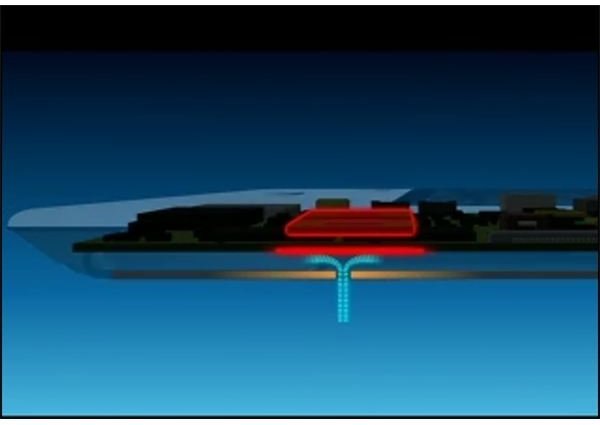
However, when the air flow is directed through a laminar jet, instead of becoming turbulent and chaotic, the airflow can be drawn smoothly away to be expelled through the outer ducting.
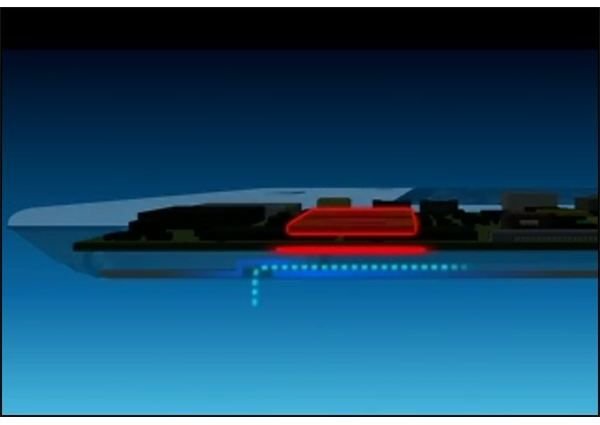
Mr. Eden also brought visual aids. The images below are of a smoke box. The top represents the system board with the CPU and other components on it. The clear area in the middle represents the space between the system board and the notebook skin. The area below represents the notebook’s skin.
Images
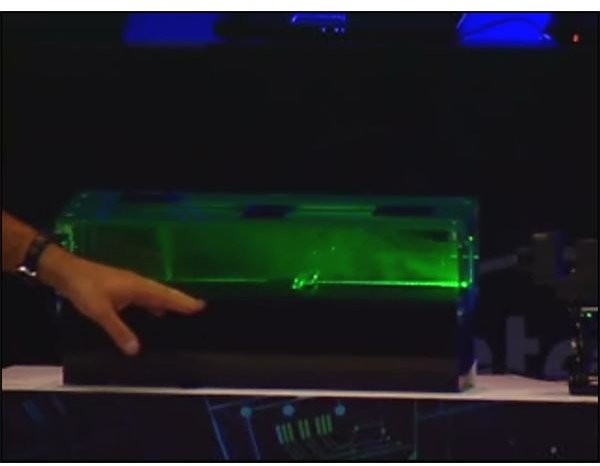
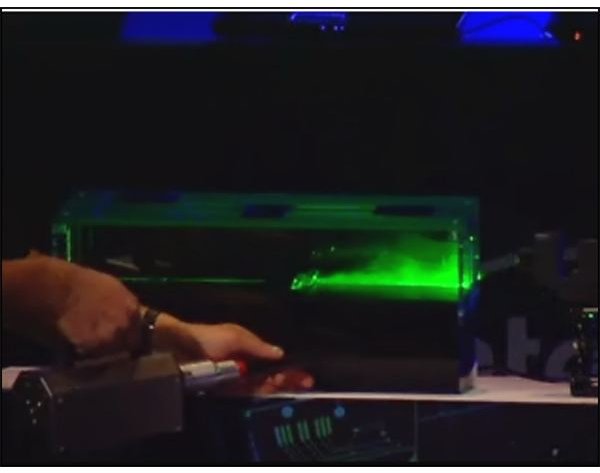
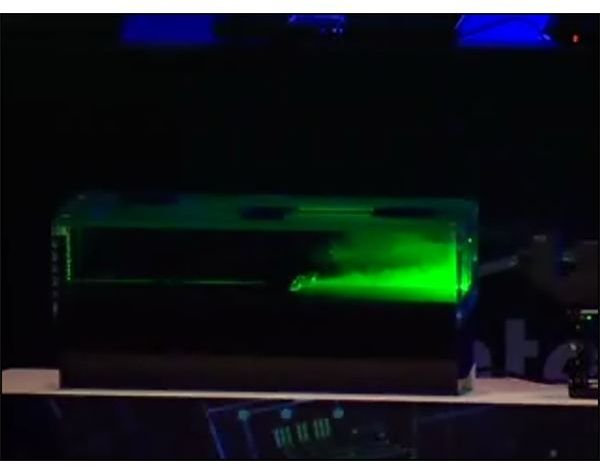
The first image shows the turbulent flow associated with a standard jet. The second and third show the effect of the laminar jet.
My ThinkPad is one of those notebooks that one would not want to use in one’s lap. My previous two ThinkPads were not in the workstation class and ran much cooler. Having both - a cool notebook and a fast notebook - in my opinion will be like having my cake and eating it, too.
Thanks for reading this. We hope you are enjoying reading and learning at the new Bright Hub.
Intel Developer Forum 2008
Details About Intel Nehalem Architecture Emerge - Fresh from the Intel Developer’s Forum 2008 in Taipei, Republic of China come details about the architecture, design, and performance of the forthcoming Nehalem generation of Intel CPUs. In one way, it can be summed up simply as “Quad core comes of age.” Get the essential details here.
Netbook vs. Notebook - from Intel’s Perspective - Interested in a new mini-computer like a netbook? Wondering exactly what a netbook is and what you’d gain and have to give up over a notebook? We can help. At Intel Developer Forum 2008, Intel manager Mooly Eden gave us Intel’s perspective on the question.