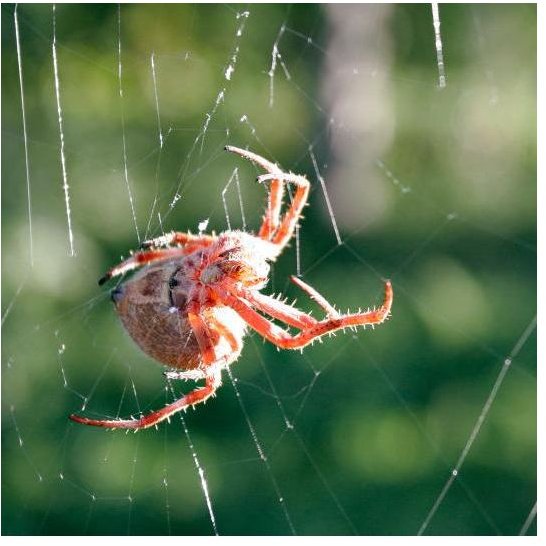
A web is an efficient means for a spider to catch its prey. The arachnid does not have to search too far for a meal as readymade dinners get trapped in the web’s sticky stands. What helps to keep them there is an aqueous solution that is one of the most strongest biological glues on the planet.
What Makes the Web Sticky?
The super strong glue that web spinning spiders secrete onto the central prey-capturing part of the web is a glycoprotein, a complex sugary type molecule.
Although there’s a pile of research on the nature, qualities and formation of webs, there’s a relatively small stack of papers by comparison about the sticky molecule that traps prey.
So scientists at the University of Wyoming in Laramie have been studying the glue made by the golden orb weaving s_pider Nephila clavipes_ to try and find out more about what it is made up of and how these components help it to do its job.
The glue is secreted from the orb weaving spider’s aggregate glands and it contains water soluble compounds that are related to neurotransmitters, small peptides, inorganic salts, glycoproteins, and amino acids. But the Wyoming team wanted to find out more about its molecular structure and function.
Researchers took glue secreting cells and managed to extract messenger RNA from them. Then they created a complementary DNA sequence to identify genes involved in glue creation.
Sticky Findings
The scientists discovered that two genes located on opposite strands of the same DNA sequenc e- Aggregate Spider Glue 1 (asg1) and Aggregate Spider Glue 2 (asg 2) - and they code for two proteins ASG1 and ASG2 respectively. Each protein is 110 amino acids long and the researchers contend that they are key components of the spider glue. Amongst the evidence they cite to support their theory is the fact that these genes are exclusively expressed in the aggregate glands and not in any other spider glands or tissues; they are more than just housekeeping genes.
In addition, non repetitive sequences of the ASG1 protein are similar to chitin-binding proteins which suggests to the scientists that the protein has chitin binding traits that would be useful to keep hold of insects.
Applications
Lead scientist Omer Choresh believes that cloning and amplifying genes from the glue of spiders that make webs could be used to make a new class of biocompatible glues. These could find a use in a number of industrial, medical and home-based applications and would be a ‘green’ alternative to petroleum-based adhesives.
Reference
DOI: 10.1021/bm900681wOmer Choresh, Battuya Bayarmagnai and Randolph V. Lewis.Spider Web Glue: Two Proteins Expressed from Opposite Strands of the Same DNA Sequence. Biomacromolecules, 2009, 10 (10), pp 2852–2856