Facts About Quasars: Definition, Information, and History of Who Discovered Quasars
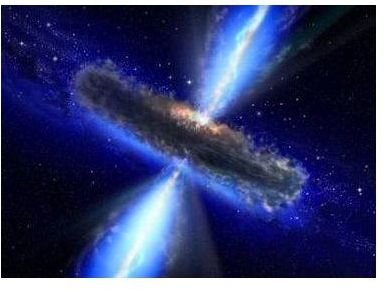
Quasar Facts
1. Definition of a Quasar: A Quasar is the bright centre of a young galaxy believed to be powered by mass falling into a supermassive black hole.
2. Mass: 106 to 109 solar masses (2x1036 to 2x1039 kg, or 4.4x1036 to 4.4x1039 Lbs)
3. Observed Distances: 1.5 billion to 28 billion light years (1.4x1025 to 2.6x1026 km, or 8.7x1024 to 1.6x1026 miles)
4. Observed redshifts: 0.06 to 6.43
5. Average Luminosity: 1040 W OR 1047 ergs/s
6. Speed: about 150,000 km/s OR 93,200 miles/s (half the speed of light)
7. Brightest quasar in the sky: 3C-273 (apparent magnitude 12.8)
8. Closest quasar discovered: PKS2349 (1500 million light years away from Earth = 1.4x1025 km, or 8.7x1024 miles)
9. Most distant quasar discovered: CFHQS J2329-0301 (2.6x1026 km, or 1.6x1026 miles)
10. No. of quasars discovered: about 100,000
Timeline History
Late 1950s: The first quasar was discovered.
1960: By this time, hundreds of quasars were discovered and featured in the Third Cambridge Catalogue.
1962: It was found that object 3C-273 was moving away from us at 47,000 km/s (29,200 miles/s).
1964: Hong-Yee Chiu, a Chinese born US astrophysicist, coined the term quasar in Physics Today to describe such objects.
1979: The magnificent gravitational lensing effect predicted by The General Theory of Relativity, given by Einstien, was verified with images of double quasar 0957+561.
1998: The hyperluminous quasar APM 08279+5255, with an absolute magnitude of -32.2 was discovered.
Interesting Facts
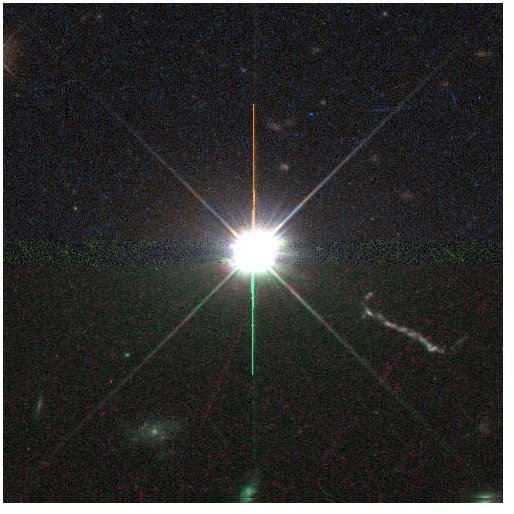
1. The largest known quasars burn out masses equivalent to 1000 Suns every year to produce a huge amount energy. This amounts to eating up 600 Earths every day.
2. Some quasars have been found to move at speeds of about 93% the speed of light.
3. It is believed that most galaxies are quasars in the initial stages of their life. As the amount of matter falling into the central supermassive blackhole reduces, the energy output reduces and quasars become ordinary galaxies.
References
1. https://en.wikipedia.org/wiki/Quasar
2. https://library.thinkquest.org/C005626/Quasars.htm
3. https://csep10.phys.utk.edu/astr162/lect/active/quasars.html
4. https://www.phys.vt.edu/~jhs/faq/quasars.html
5. Images: https://andyxl.files.wordpress.com/2007/06/agn-cartoon.jpg
