Terrestrial Planets, Jovian Planets
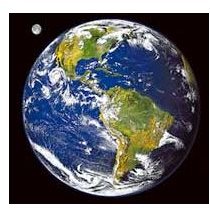
Properties Of Terrestrial Planets and Jovian Planets
The Sun, and the planets which revolve around it, form the Solar System. The planets can be classified into two groups based on the characteristics of their composition, known as the Jovian and terrestrial planets.
Main Constituents of Terrestrial Planets: These planets have a solid structure which contains metals and rocks. Earth, Mars, Venus and Mercury are regarded as terrestrial planets. Due to the presence of metals and rocks, these planets have a very high density and have a solid surface. Their natural satellites are few in number. These planets are nearer to the Sun. The thin atmospheres of terrestrial planets are believed to have originated, either from the volcanic eruptions in their surfaces or from the comets which have collided with them.
Main Constituents of Jovian Planets: Planets which fall under this category are also known as gas planets. Jupiter, Saturn, Uranus and Neptune are grouped into this category. As the planets in this group have a structure similar to Jupiter, they are called Jovian planets. Unlike terrestrial planets, these have only a small core, which is solid in character. They are huge planets, and the massive size is due to the presence of very thick gas atmospheres, which surround a small core. Unlike terrestrial planets, their atmospheres are more representative of the primordial solar nebula. Jovian planets have characteristic rings around them, and their natural satellites are more in number. These planets have a lower density relative to the terrestrial planets due to the presence of lighter gases, like hydrogen and helium in their atmospheres, which dominates the planet’s mass more than the smaller solid core, .
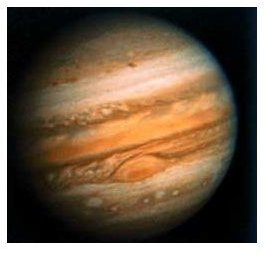
Terrestrial Planets Vs Jovian Planets
The first and foremost similarity between the planets in these two groups is with respect to their origin, that is, they are all part of the same primordial solar nebula.
The second most evident similarity between these two groups is that, planets in both groups move around the Sun in an elliptical orbit with varying eccentricities.
Even though, the Jovian and terrestrial planets differ in structure, all of them have a solid core. But relative to the overall size of each planet, the cores of the terrestrial planets are larger than the cores of the Jovian planets.
Planets in both groups have a gaseous atmosphere, but it is very thin in the case of terrestrial planets. All planets are capable of exerting gravtiational force, but the Jovian planets have larger gravitational fields, which help them hold on to their large gaseous atmospheres and numerous moons.
All the planets are almost spherical in shape, of which the terrestrial planets have less flattened poles due to slower spin.
Storms are a common phenomenon found in most of these planets, but they are more intense in the Jovian planets.
Both Jovian and terrestrial planets have an associated magnetic field, but the Jovian planets have much stronger fields than the terrestrial planets.
Conclusion:
Scientists continue to conduct studies to find out more about each planetary group. As little is known about the planets other than Earth, there are an untold number of differences and similarities yet to be cataloged**.**
Sources:
https://www.livingcosmos.com/celestial.htm
https://nineplanets.org/overview.html
Images:
