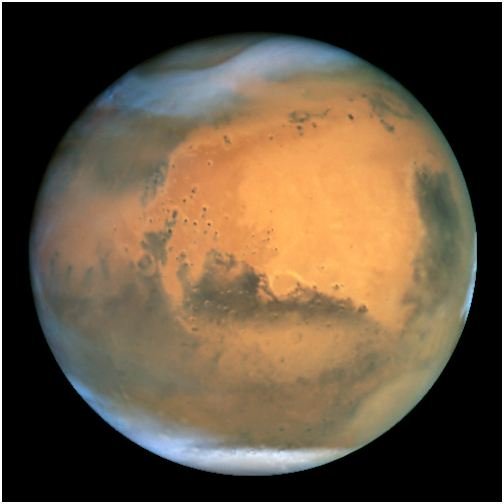
For centuries, Mars’s bloody red appearance has always been associated with war, fire and destruction. But, have you ever wondered why Mars appears red in color? This article explains the scientific reason behind Mars’s red color.
Mars: God of War?
Mars, Earth’s “next-door neighbor” in space, is the fourth planet in the solar system. The 4.6 billion years old red planet is named after the Roman god of war. Due to its reddish appearance, Mars was associated with war, fire and destruction by ancient Roman, Greek and Babylonian scholars. Viewed from Earth, Mars appears as a bright reddish-orange sphere, which is why we always wonder why is mars red? So, what’s the scientific reason behind the planet’s red color?
Why is Mars Red?
The simple reason behind Mars’s reddish appearance is the layer of iron oxide dust covering the planet’s surface. Fine particles of various oxides of iron (hematite) and trace amounts of some elements like chlorine and sulfur on the Mar’s surface is the main reason for its reddish color.
For many years, the oxidation theory was cited as the key reason for the planet’s reddish appearance. According to this theory, warm water flowed on Mars billions of years ago and eroded iron-rich rocks. The iron in the rocks would have combined with the oxygen in the water to create iron oxide. The fine particles of this reddish mineral would then have been scattered all over the planet due to raindrops.
While the oxidation idea was seen as the key reason for Mars’ reddish appearance, it also supported the claims of water and proof of life. However, latest findings revealed several alternatives that did not agree with the “rust” idea.
From Meteorites to Basalt Rocks: New Theories on Why is Mars Red
The data collected from Pathfinder’s 1997 Mars visit suggested that the Martian soil contained more iron than its rocks. According to Albert Yen of NASA’s Jet Propulsion Laboratory , the iron oxide-rich soil covering the surface of the planet was a result of iron meteorite impacts. Another theory suggests that the harder basalt rocks containing feldspar would have eroded the softer basalt to create fine dust particles. The Martian basalt rock has higher concentration of iron than the basalt rocks of Earth.
Scientists believe that fine particles of iron oxide (or red dust, in layman’s terms) cover surface and is present in its atmosphere—often plunging the entire planet into darkness. However, it is very important to have precise knowledge of the mineralogy and composition of the planet. Only then scientists can comprehend the evolution and structure of its surface environment and interaction with the atmosphere.
A question like “why is Mars red” can only be answered with the help of new missions and sophisticated instrumentation. Advanced computer models and earth-bound simulators are also required to pierce through mysteries. Dr. Merrison, of the Aarhus Mars Simulation Laboratory, believes that the dusty nature of Mars can be revealed through “accurate simulating and developing better analogues of the Martian environment.”
References
https://www.nasa.gov/worldbook/mars _worldbook.html
https://www.universetoday.com/guide-to-space/mars/why-is-mars-red/
https://www.slate.com/id/2093779/
https://www.sciencedaily.com/releases/2009/09/090918102022.htm
Image References:
Photo of Mars, captured by NASA’s Hubble Space Telescope, Photo courtesy: NASA/ESA (https://imgsrc.hubblesite.org/hu/db/images/hs-2001-24-a-full _jpg.jpg)


