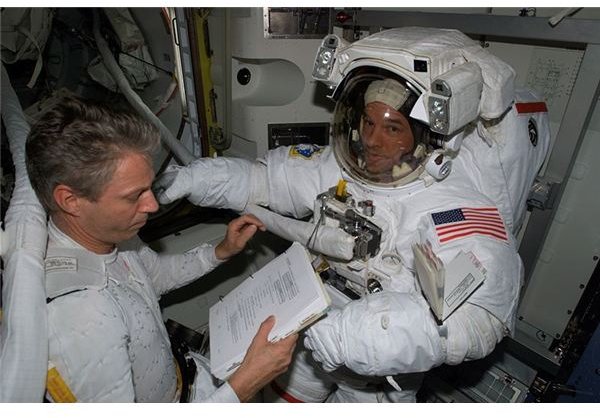
Video and pictures of spacewalking make it look effortless, but getting ready for a spacewalk is an elaborate process that takes quite a bit of time. Find out just how involved the process is by reading on!
Going out for a (space)walk
Getting ready for an extra-vehicular activity is no piece of cake, and neither is the spacewalk that follows. Thanks to engineers who have worked to reduce the size and complexity of spacesuits , NASA’s current generation of “extravehicular mobility unit”, or EMU, for short, is a far easier garment to get into than its Apollo predecessors. only requiring about five minutes to don and requiring no assistance to do so, but it is still far from a science fiction “suit up and fly away”, preparation-free process. The existing EMU is a marvel of design and technology in and of itself- in fact, in all respects, it is the equivalent of a personal spaceship, providing air, insulation against cold and heat, and protection against the occasional small micrometeoroid.
The suit can’t just be put on while wearing shirtsleeves, however; there is a cooling garment worn under the EMU that circulates water and conditioned air throughout the spacesuit. Being comfortable is a major concern, since spacewalkers may well spend 8 hours in it!
Prior to suiting up, the first adjustment is to acclimate to the all-oxygen atmosphere the EMU uses. Since the suits are not fully pressurized, there is the potential for nitrogen in their blood to come out of solution, causing the same “bends”, or nitrogen narcosis, as divers worry about. To avoid this, they pre-breathe oxygen for a period of time beforehand. In the case of the shuttle, the pressure is dropped from a full atmosphere (14.7 pounds per square inch) to about 10 psi, while in the ISS, they sleep overnight, or “camp out”, in the airlock at that lower pressure. In both cases, spacewalkers begin to pre-breathe pure oxygen about a half-hour before putting on the spacesuit.
Putting on the suit itself is rather straightforward- put on the trousers first, then don the upper torso. Before connecting the two, the cooling garment is plugged into the PLSS (portable life support system) permanently attached to the back of the spacesuit. From there, all that remains is to pressurize the suit, then put on the gauntlets, communications carrier, affectionately known as the Snoopy hat, and the helmet. After a leak check, the airlock is depressurized, the suit switched to EVA pressure, and the EVA begins.
Images
Credits
Image by NASA


