The annual Leonid meteor shower is a result of the tiny bits of debris and sand particles blown off from comet Temple Tuttle. This amazing meteor shower forms a spectacular event every year in November. Explore some historical and astronomical facts behind this event.
Meteor Showershave always drawn the attention of human beings. When meteors and other solar system materials enter the Earth’s atmosphere at speeds as high as 158.000 mph, they burn up, frequently leaving glowing trails for seconds or minutes before getting vaporized. The growing trails are what we call meteor showers! They are commonly known as shooting stars.
The Leonid meteor shower is one such barrage of shooting stars which appear from November 16th to November 17th this year. It arises from the astrological area of the constellation of Leo. The event is very regular and makes a spectacular show every 33.3 years when the Temple-Tuttle Comet comes near Earth. Although the frequency is regular the intensity varies from year to year.
Leonid Meteor Shower: The Event!
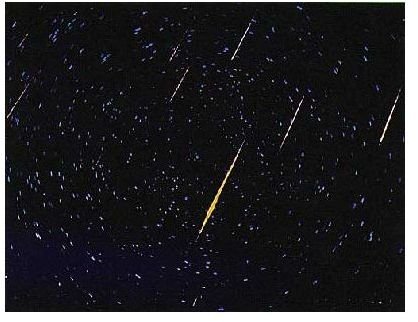
Leonid Meteor showers create a wonderful streaky effect in the sky. The effects were mild in previous years but in 1994 and 1995, many more meteors were noted with as many as fifty per hour reported . When the intensity is high, then each of the shooting star has a long tail surrounded by a blazing vapor trail. Normal colors of the trails may vary from white to green and blue. The Leonid meteor shower starts from the bottom of the “sickle” of the Leo constellation, and then spreads across the sky creating the banded effects of lighting across the sky.
{Image Credit : Leonid meteor Shower :Courtesy NASA: Source : https://static.howstuffworks.com/gif/leonid-meteor.jpg the sky}
Mythology & Lore
Different cultures have different beliefs about shooting stars but almost all cultures associate meteor showers, especially the Leonid meteor showers with nasty and unlucky events. Ancient man believed meteor showers were the result of an angry god raining down wrath on ordinary humans. Another common understanding in the past was that meteor showers were the feces of gods showering down on humans! It may sound silly to us know, but these was very popularly used to describe the events in nearly every culture. In actuality, meteorites are a rich source of metals for humans, but actually finding a meteorite is difficult and rare.
Leonid Meteor Showers of the Past
Chinese astronomers reported the first Leonid meteor shower in the year 902 AD and they described the event as “stars fell as rain.”
A Leonid meteor shower peak was also observed during the death of Johannes Kepler. The event was recorded as a salute from God for the death of the famous personage in 1630 AD. In the year 1799 the next peak was recorded by scientists Humboldt and companion Bonpland.
The native Indians reported the annual event without even knowing what it meant. The Sioux Indians had special records called “winter counts,” preserved by painting on animal skin. There records were deciphered in 1984 by an anthropologist attached to the Smithsonian called Von Del Chamberlain.
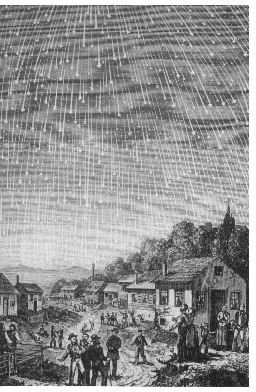
The winter records had 45 references to a meteor shower in the years from 1833 to 1834. Fourteen other local tribes also recorded the same information. The Leonid meteor shower in 1883 was so intense, that thousands of meteors rained down for several hours all across United Sates. The event was so bright that people woke up thinking that the world was coming to an end!
The next few showers decreased in intensity until the late 1990s when the rate and streaks increased in intensity. The entire show could be easily viewed by the naked eye. Astronomers like Peter Jenniskens reported viewing the shower for as much as an hour and a half with bare eyes.
{Image credit: Above: Leonid Meteor Shower of 1883: Courtsey : nightskyhunter.com Source : https://www.nightskyhunter.com/images/Leonid%202.jpg}
Viewing the Leonid Meteor Shower
Best Time to Watch: This year the best time to watch will be between November 16th and 17th. The time may differ depending on the intensity of the meteor shower event.
Location in the Sky: It radiates from the Zodiac constellation Leo and is visible in the area of sky from 30 degrees to 70 degrees in the direction of Leo above the horizon.
Where and How to Watch: In order to achieve the best visibility try to get to a dark place away from city lights. These are clearly visible by the naked eyes and there is no need of telescopes or binoculars.
Other Interesting Facts
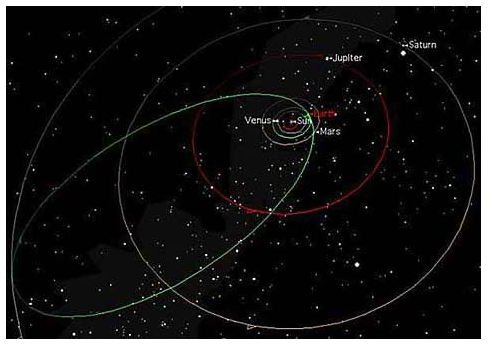
1. Comet Temple - Tuttle spawns the Leonid meteor shower. The comet revolves around the Sun and moves to the outer solar system every 33 years. While passing through the Earth’s orbit, it leaves a trail of dust and debris which forms the Leonid meteor shower.
2. The components of the Leonid meteor shower revolve around the sun in a direction opposite to the Earth.
3. The debris of Leonid Meteor shower: Astronomers have stated that the main reason why the Leonid causes a diffuse appearance is because the debris of Temple-Tuttle is sandy and soft. Even when the meteors enter the atmosphere, they are fluffy in appearance and nature, and as a result, degenerate completely on their way through the atmosphere.
4. Leonid shower causes sound: One really interesting fact is that the Leonids actually cause a recognizable sound when they make their way down. They leave an ionized trail of gas that causes whistling or buzzing sounds.
5. The Leonid shower also strikes the moon which can be seen from earth: Since the position of the moon and earth is almost same in the space, every November, the tiny showers of Leonid also fall on the moon’s surface. However, since the moon lacks an atmosphere as that of earth, these bits of the debris from the comet, explode after slamming the moon’s surface. The seismic records form the moon reveal that such an event occurred in 1970s. Scientists were able to observe such even during 1999 and 2001 Leonid meteor shower.
6. The Leonid power: The Leonid showers hit the Earth’s atmosphere at a speed as high as 72 kilometers per second (more than 160,000 mph). A single grain of debris, from the Leonid shower, of the size 9 millimeter (in diameter), can produce a bright fire-ball. The power it creates is more than one million Joules!
{Image credit: Above left : The orbit of periodic comet Temple-Tuttle : Courtsey : nightskyhunter.com Source : https://www.nightskyhunter.com/images/Leonid%2010.jpg}
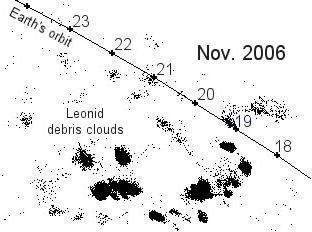
{Image credit: Right: Leonid Debris Cloud Diagram By Jeremie Vaubaillon , Source : https://www.nightskyhunter.com/images/Leonid%2011.jpg}
Leonid Meteor Shower This Year!
Unvortunately, this year the full moon will conflict with the meteor shower, meaning shooting stars may be difficult to spot. If you want to attempt a viewing, the best time will be early morning on November 17th, 2013.
References
- The Leonid Meteor Shower: Historical Visual Observations: http://www.sciencedirect.com/science/article/pii/S0019103598960742
- The Leonids: http://www.jupiterscientific.org/sciinfo/leonid.html
- EarthSky’s Meteor Shower Guide for 2012: http://earthsky.org/astronomy-essentials/earthskys-meteor-shower-guide
- How to See the Best Meteor Showers of 2012: http://www.space.com/14125-meteor-showers-2012-skywatching-tips.html