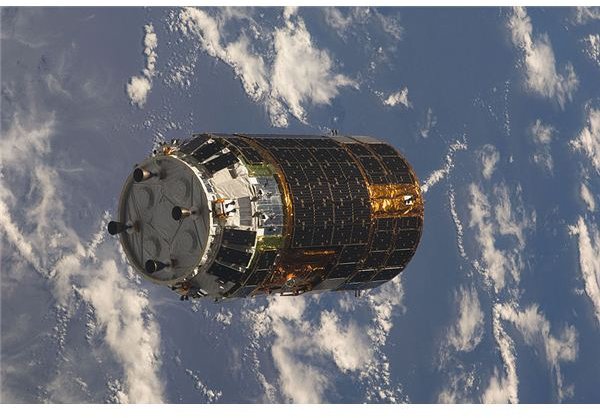
The new Japanese Space Freighter, the H-2 Transfer Vehicle has made its maiden voyage to the ISS. Also known as the HTV, the JAXA spacecraft will be essential to the future of the ISS as the Space Shuttle fleet is retired.
Maiden Voyage of Japan’s Space Freighter
Japan made its first space flight to the International Space Station (ISS) on September 10, 2009. This unmanned spacecraft made its maiden voyage from southern Japan’s Tanegashima Space Center, operated by the Japan Aerospace Exploration Agency (JAXA). Known as the H-2 Transfer Vehicle (HTV), the spacecraft is capable of delivering supplies and experiments to the space station, critical due to the retirement of the Space Shuttle in 2010.
The Importance of the HTV
After the construction of the ISS by 16 different countries at a cost of $100 billion, the largest space structure ever built installed the final components, the Kibo Japanese Experiment Module in July 2009. This facility enlarged the ISS and gave researchers aboard the ability to study space medicine, biology, make observations of Earth , analyze material production and research communications. In order to facilitate these ongoing studies, a spacecraft was needed to sustain astronauts.
Before the launch of the HTV, the station was primarily supplied by a growing fleet of international spacecraft: the U.S. Space Shuttle and Russia’s Soyuz . Additional craft, such as Russia’s Progress space freighter and Europe’s Automated Transfer Vehicles (ATV) also assisted with unmanned supply runs. However, the Kibo was specifically designed to interact with the HTV.
The HTV has the benefit of being able to supply Kibo’s two compartments: an internal experimental facility and a large unpressurized area for external research. At 16 ½ tons, 33 feet long and 14 feet wide, the HTV can haul a stunning six tons of supplies. In addition, unlike the Progress and ATV, the HTV does not directly dock with the ISS. Instead, it flies very close to the station and is captured by the Canadarm2 . It then is linked to the station either via the Kibo or the Harmony modules.
Details of JAXA’s New Spacecraft
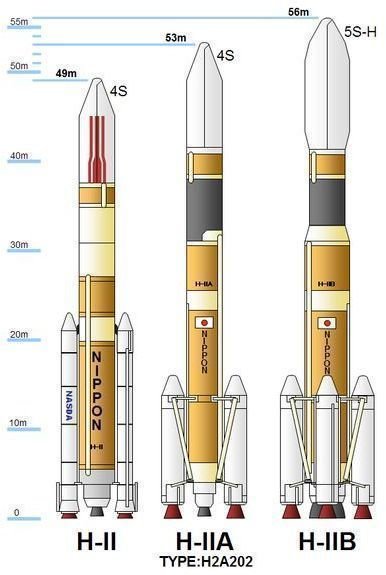
As a solar-powered vehicle, HTV is launched by the H-2B rocket, Japan’s workhorse family of rockets. It then automatically maneuvers for 100 hours to the station. Following docking, the spacecraft is filled with waste materials and put into a decaying orbit where it burns up on reentry. In the event of an emergency, the HTV can hold its position for up to a week and remain docked with the ISS for approximately 30 days.
Development on the HTV began in 1997 at the cost of $680 million as of 2009. Each ship is estimated to be worth approximately $220 million, so each mission is an important and well-planned exercise in space station maintenance. In its maiden voyage, the HTV was packed with only 3 ½ tons of supplies, which included new laptop computers for the astronauts and a small, delicate robotic arm for Kibo. Due to a number of emergency tests and simulated mission scrubbings, JAXA and NASA have both determined that the vehicle may be the most stable spacecraft to make the trip into orbit thus far.
Resources
Japan to Launch New Space Freighter
H-II Transfer Vehicle Arrives at Space Station
Maiden Flight of Japan’s Space Freighter
Image Sources
HTV-1 approaches ISS. (Supplied by NASA; Public Domain; https://upload.wikimedia.org/wikipedia/commons/a/a7/HTV-1 _approaches_ISS.jpg)
H-II Series. (Supplied by ofuku at Wikimedia Commons; Creative Commons Attribution ShareAlike 3.0; https://upload.wikimedia.org/wikipedia/commons/0/04/H-II _series.png)