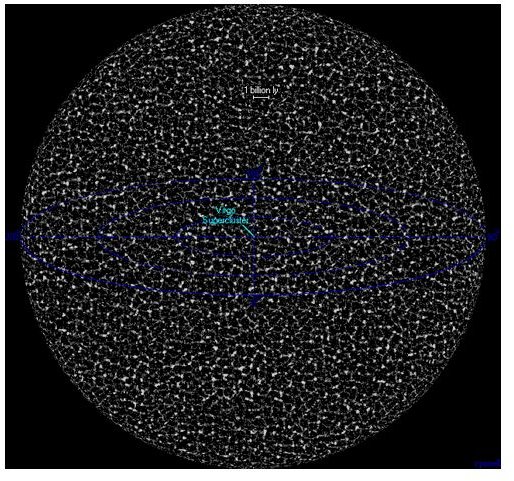
How does our inability to perceive reality completely impact our perception of the shape of the universe?
Introduction
Space has a shape. But what exactly is it? This is a question people have been mulling over for decades. Not just physicists and mathematicians, but amateurs as well. This is a conundrum different from the nature of the world theologians and philosophers have pondered about for centuries. Part of the problem is that the universe is so big, and we are so small. Another problem is that human beings are not optimal detectors. We are simply unable to see reality as it really is.
Human Perception and the Universe
It’s been known for a while that humans have deficiencies in our senses.

We see better than dogs, but do not smell as well as them or sharks. Moles also do not see as well as we do, but their sense of smell and touch is far better than ours. Our sight is inferior to that of eagles, and our hearing is inferior to that of bats and dolphins. Animals furthermore have many natural senses that humans don’t have, such as echolocation, and the ability to detect electric fields.
Our sight difficulties extend to correctly perceiving shapes and distances. We cannot properly see objects that are too small or too large. We know matter is composed of particles such as atoms, but we cannot see them unaided. And of course we are unable to directly see the particles these atoms are composed of, such as protons and electrons. Quantum theory tells us that all matter has wave functions, and that matter is mostly space but feels solid due to repulsions between electrons. We can’t tell any of this by sight alone. (Read, What’s Really Out There in the Night Sky , for a comparison of how celestial objects appear in different parts of the electromagnetic spectrum.)
We are also unable to discern the actual size and appearance of extremely large objects. Large objects that are far away appear to us to be small, such as airplanes, mountains, and the Moon. The Earth is round, but we cannot perceive this without instrumentation. This is a problem mathematicians divide into local versus global geometry. It is directly relevant to our inability to see what shape the universe is.
Local Versus Global Geometry
The Earth does appear to us to be flat, and most of us will never be able to see this otherwise without the use of instrumentation or other external help. The exception is astronauts, who are able to see the Earth while they are in space.
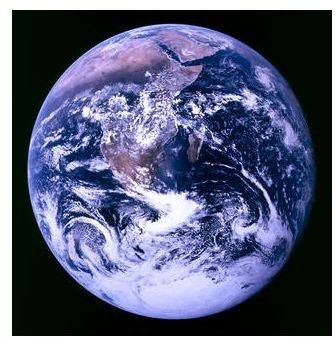
Our ability to experience the Earth as being flat is an example of a local property. Local properties are what we observe on a small surface of an object. Global properties, on the other hand, are when we are able to see the entire surface of the object. This is what the astronauts see when they leave the Earth and are able to observe all of it.
You should now be able to see one of the difficulties cosmologists have figuring out the shape of the universe. We only ever experience the universe locally. It is incredibly large - about 156 billion light-years wide. We are unable to escape from it the way astronauts can do with the Earth, and so we cannot see its shape directly. We need to rely on theory and instrumentation to help us figure it out.
How do gravity and the expansion of the universe add to our difficulties in figuring out its shape? How are these related to the Big Crunch or the Heat Death of the Universe? We will look at these questions in part two.
References
The Shape of Space by Jeffery R. Weeks
Universe Might be Bigger and Older than Expected by Ker Than
I_mage Credits_
The Universe Within 14 Billion Light Years by Richard Powell
Visual Hallucination by Mohamed Osman, MD
Earth as seen from Apollo 17 from NASA Goddard Space Flight Center
Resources
BBC’s Human Body and Mind Survey and Psychology Tests
Neuroscience for Kids: Amazing Animal Senses
Hard to Believe, But You’re Mostly Empty Space
Nothing But the Facts About Cosmology