What is Edmund Halley Famous For?
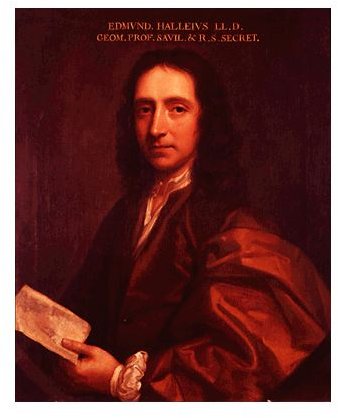
Edmund Halley Biography
Birth: November 8, 1656
Birth Place: Haggerston, Shoreditch, London, England
Nationality: British
Fields: Astronomy, geophysics, mathematics, meteorology, physics
Schooling: University of Oxford, Royal Observatory in Greenwich
Notable Honors: Halley’s Comet was named after him
Death: January 14, 1742 in Greenwich, London, England
Notable Achievements in the Field of Astronomy and Science
-
In 1676, Edmund Halley used a 24-foot long aerial telescope on the south Atlantic island of St. Helena to observe stars of the Southern Hemisphere. In 1678, he published Catalogus Stellarum Australium, which detailed 341 newly-discovered stars.
-
In a study published in 1686, Halley defined a number of trade winds and monsoons near St. Helena. He determined that atmospheric motion was caused by solar heating. In addition, he found that barometric pressure was related to sea level.
-
Halley published Sir Isaac Newton’s Principia Mathematica Philosophiae Naturalis in 1687 after discussing the relationship of gravity and planetary motion.
-
In 1690, Halley developed a device that allowed people to dive to 60 feet under water. It used a series of weighted barrels to deliver air underwater. Eventually, he was able to expand its use to four hours.
-
While working with the Royal Society, Halley developed a working magnetic compass housed in a liquid-filled case. He demonstrated the compass in 1690.
-
Halley studied life annuities in 1693 and created a scientific formula for the British government to sell life annuities at appropriate prices adjusted for the age of individuals. This helped establish the principles of actuarial science.
-
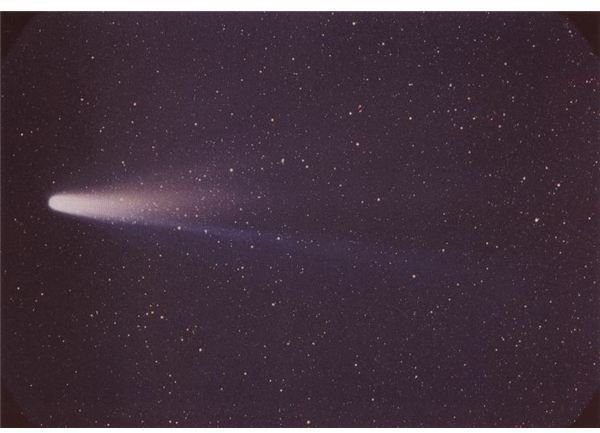
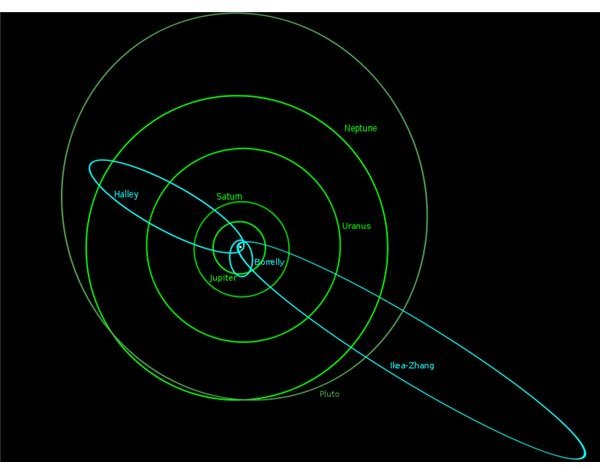
In 1705, Halley postulated that the comet that appeared in 1456, 1531, 1607 and 1682 was the same and would return in 1758. Posthumously, the object was named Halley’s Comet after his prediction.
-
Halley attempted to measure the distance between the Earth and the Sun by finding the rate of the transit of Venus in 1716. This helped him discover the proper motion of the “fixed” stars two years later.
Amazing Facts About Edmund Halley
One of Halley’s theories also included the concept of a hollow Earth. In 1692, he postulated that the Earth’s shell was 500 miles thick and also included two more shells and a core inside the planet. Each shell was separated by an atmosphere. When the gas was released, it caused the Aurora Borealis.
In 1698, Halley conducted the first purely scientific voyage aboard the Paramour, a 52-foot boat. During his studies aboard the vessel, he observed terrestrial magnetism and helped further develop compass technology.
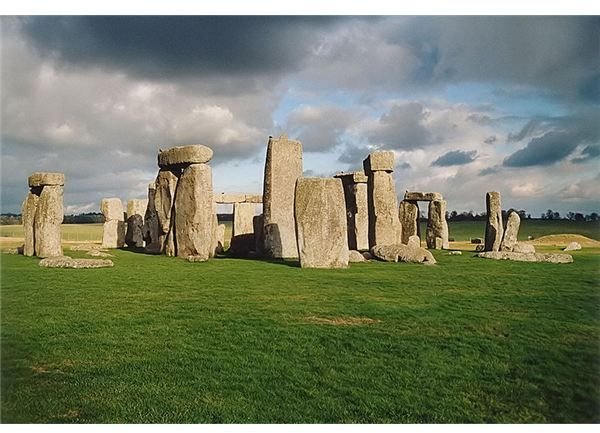
One of his final studies was conducted in 1720 with William Stukeley. Halley attempted to date Stonehenge. After studying magnetic records, the duo suggested it was constructed between 460 BC and 920 AD. (Current research places the age of Stonehenge in the range of 3000 - 2200 BC.)
References
BBC, https://www.bbc.co.uk/history/historic_figures/halley_edmond.shtml
University of St. Andrews, https://www-history.mcs.st-and.ac.uk/Biographies/Halley.html
Image Sources
Edmund Halley. (Supplied by Lumos3 at Wikimedia Commons; Public Domain; https://upload.wikimedia.org/wikipedia/commons/7/77/Edmund_Halley.gif)
Halley’s Comet. (Supplied by NASA; Public Domain; https://upload.wikimedia.org/wikipedia/commons/2/2a/Lspn_comet_halley.jpg)
Orbits of Periodic Comets. (Supplied by Morgan Phoenix at Wikimedia Commons; Creative Commons Attribution ShareAlike 3.0; https://upload.wikimedia.org/wikipedia/commons/a/ac/Orbits_of_periodic_comets.svg)
Stonehenge. (Supplied by Frédéric Vincent at Wikimedia Commons; Creative Commons Attribution ShareAlike 2.0; https://upload.wikimedia.org/wikipedia/commons/d/da/Stonehenge_back_wide.jpg)
This post is part of the series: Famous Astronomers
There are a number of famous astronomers from history. People ask “what is Neil Degrasse Tyson doing today?” or “when did Galileo discover Jupiter?” While becoming an astronomer can be a challenge, the accomplishments of Edmund Halley and the IQ of Stephen Hawking are important.
