There is a strong possibility that oceans exist currently and have existed in the past on other objects in our solar system besides Earth; if you were not aware, or if you are, read on for a summation of the current thinking.
Introduction:
It is strange how forgettable our dependence on water can be. No matter how technological, complex and convenience-oriented our societies become, each one of it’s members needs water to survive. The point is that life, as we know it, requires water to exist. The human race is searching for habitable planets for many reasons, but self- and life-preservation and the search for extraterrestrial life are the main ones. One of the basic requirements for habitability–if not the most basic requirement–is water. Water itself is pretty common throughout the universe, it’s just usually frozen. However, recent studies and observations are showing that liquid oceans most likely do exist on astronomical bodies other than Earth, and this is especially evident on bodies in our own solar system.
What follows is a survey of the astronomical objects known or thought to have liquid oceans on them in our solar system, with Earth being a given and thus excluded.
Europa
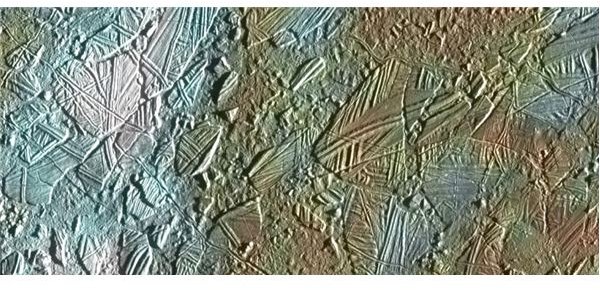
It is thought that Jupiter’s moon Europa does indeed have liquid oceans completely covering the moon under its frozen crust. It is also thought that Europa has an iron core like Earth. The friction from tidal changes during its orbit of Jupiter is thought to be enough to keep the temperature high enough to allow for a liquid ocean. It is also thought that the cracks we see in the surface of the moon are caused by the tidal swing due to the elliptical orbit of Europa around Jupiter. Also detected are what are thought to be “cyro-volcanoes.”
It is also currently estimated that the amount of liquid water on Europa might double the amount of water in all the oceans of Earth added together.
Mars
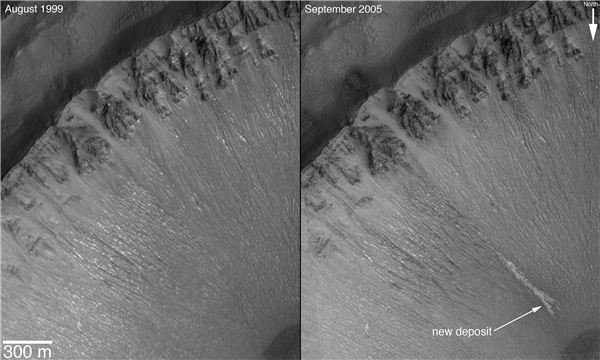
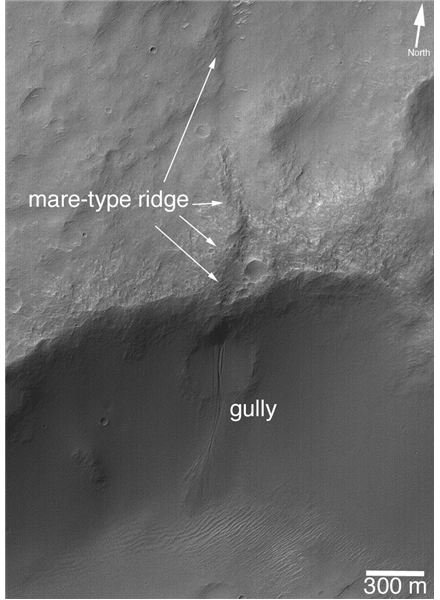
It is thought that at one point during its history Mars did house liquid oceans, and did resemble an Earth-like appearance on the surface, with large bodies of water, land continents and rivers. The majority of water that has been discovered to be now existing on Mars is in the form of ice and water vapor (sublimation dominates most state transitions). Mars does have a very thin atmosphere, which houses the vapor, while the ice is massed mostly at the poles and has actually been discovered scattered throughout the surface and has been confirmed by NASA’s Phoenix Mars Lander to be water ice, which was melted by the lander. As for liquid water, in the last several years NASA has found evidence that there may be some below the surface of Mars. The evidence astronomers are looking at is the periodic deposits of new sediment to the surface terrain (see Image 1 Mars, below), that appear to have been brought to the surface by liquid water, indicating that liquid water may indeed be able to exist briefly and periodically on the surface, and these brief appearances may be sourced by underground liquid reservoirs. Beyond these deposits astronomers have observed other geological disturbances to the surface of Mars that could likely have been caused by liquid water, such as gullies formed near faults (see Image 2 Mars, below), which is consistent with an occurrence on Earth where springs tend to pop up near faults; these disturbances are relatively recent as well, within the time since Mars has generally become a “dry planet.”
Titan
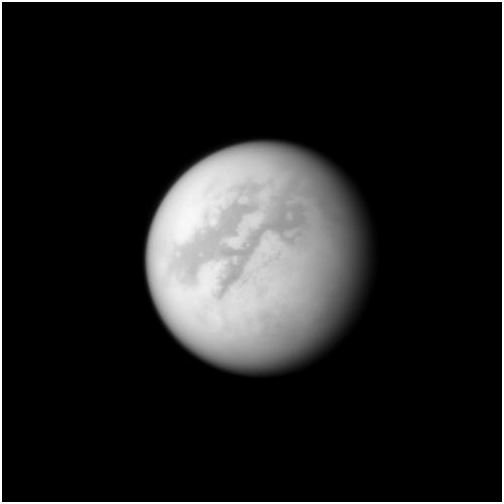
Another moon of Saturn, and the largest moon of Saturn, Titan is thought to also have a vast ocean beneath its icy crust. The ocean of Titan is thought to possibly be liquid methane. The reason this is thought to be so is that Titan has a thick atmosphere with traces of methane that should be destroyed relatively quickly by sunlight, but the fact that we are observing this amount of methane means that most likely the amounts are being resupplied by a liquid methane ocean (or liquid methane lakes) on the surface or perhaps from the interior of Titan. Another plausible suggestion for the type of liquid substance on Titan is ethane, a biproduct in the burning of methane, which should be liquidized at the temperatures existing on the surface of Titan. Recent images from the Hubble telescope and radio images from the Arecibo radio observatory show hints of dark, smooth surface areas on Titan, implying that there might be lakes of ethane or methane on the surface.
Enceladus
The Cassini Huygens mission has possibly discovered evidence for a salty ocean under the surface of Saturn’s moon Enceladus . This evidence was obtained by the Cosmic Dust Analyzer (CDA) onboard Cassini, which picked up traces of salt which are thought to be ejected along with dust and water vapor from a plume located on Enceladus’ south pole. Theoretically there would be not salt ejected with the water vapor if the process taking place were sublimation; thus the water vapor should be coming from liquid, not frozen, water. There have been conflicting reports published as to whether or not salt was detected in the debris shout out from the plumes, although even the report that said there was no salt detected doesn’t rule out the possibility of a very deep ocean.
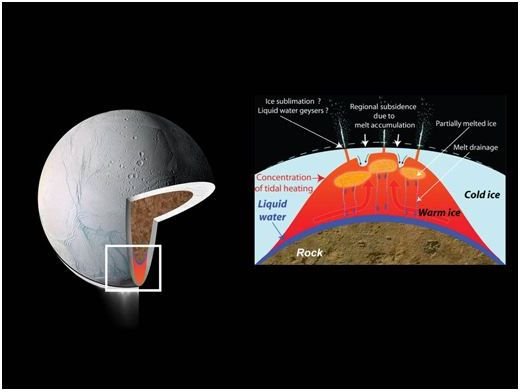
Ganymede
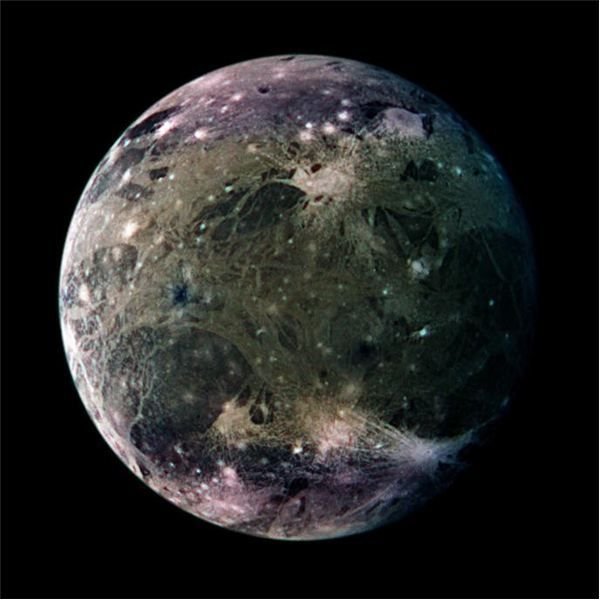
This moon of Jupiter’s also may have oceans of saltwater under its icy crust. The evidence for this comes from detection of a magnetosphere coming from Ganymede , the only moon in the solar system to possess a magnetosphere. Additional evidence for liquid water existing on Ganymede are the many ridges thought to have been caused by tidal heating which have formed on the surface of the moon.
Callisto
Another moon of Jupiter, Callisto is thought to have a liquid saltwater ocean beneath an ice-covered surface because of disturbances it causes in the electromagnetic field of Jupiter while it orbits; the magnetic field of Jupiter cannot penetrate the interior of the Callisto, suggesting that Callisto might have a highly conductive liquid beneath its ice and rock surface. The ocean may contain small percentages of ammonia.
This ocean may have formed during the slow convection of the interior of the moon during its formation.
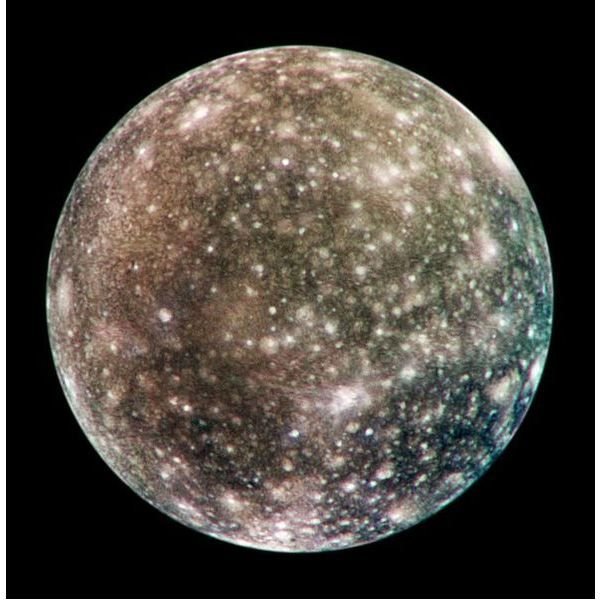
Image Credits
1. Titan: https://saturn.jpl.nasa.gov/photos/imagedetails/index.cfm?imageId=3601
2. Enceladus: https://www.nasa.gov/mission _pages/cassini/multimedia/pia12080.html
3. Europa: https://antwrp.gsfc.nasa.gov/apod/ap980102.html
4. Callisto: https://en.wikipedia.org/wiki/File:Callisto.jpg
5. Ganymede: https://www.jb.man.ac.uk/~slowe/moons/ganymede.jpg
6. Image 1 Mars: https://www.nasa.gov/mission _pages/mars/images/pia09028.html
7. Image 2 Mars: https://www.nasa.gov/images/content/163764main _PIA09031_b_full.jpg


