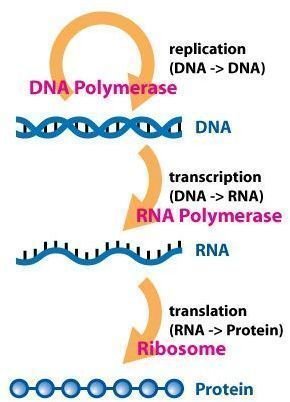
The second article in the Astrobiology series examines the “genes first” model of the origin of life, and in particular the “RNA world” hypothesis.
Introduction
Let’s begin with the “genes first” model. The name of this model is a bit of a misnomer, given the fact that scientsits are not claiming that actual genes, in the modern sense, arose before true life began. What this model actually claims is that a precursor to modern nucleic acids, which are DNA and RNA, was the chemical basis that jump-started life.
When scientists first tried to tackle the origin of life, they kept coming up against a problem. Today, proteins are the fundamental “workers” inside all living things, building things up and more importantly, catalyzing essential reactions. The information to build proteins is encoded in genes, in the form of DNA sequences. Proteins, however, are needed for the proper expression of the DNA information.
So what came first, DNA or proteins?
The RNA World
Enter RNA, the second nucleic acid in living organisms. Today, RNA helps in expressing the DNA information, passing the encoded message along so that it can be translated into proteins, and, until the 1980s, scientists thought that was all that RNA did.
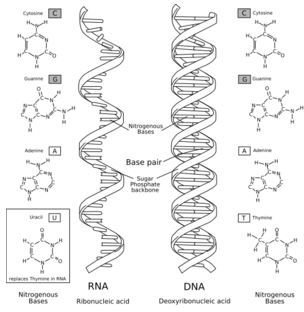
However, it was discovered that RNA can actually act as a catalyst, called a ribozyme, to speed up chemical reactions while not being changed itself in the process. This is what enzymatic proteins do. So RNA can act as both an information storing system AND a protein. Scientists now believed they had the answer to the infamous “chicken and egg problem”: nucleic acid, in the form of RNA, came before true proteins. This hypothesis became known as the “RNA world” hypothesis.
But today’s RNA, and presumably any RNA that could act as a ribozyme, is actually a long chain of nucleotides, which are the subunits of nucleic acids. Indeed, all organic molecules (like sugars and proteins) are made up of smaller subunits, generically referred to as “monomers.” How would a set of monomers link together to form such a complex molecule in a prebiotic world? Even more importantly, where would these monomers come from?
The Miller-Urey Experiment
Before the 1980s, and more specifically in the 1950s, a famous experiment by Miller and Urey, at the University of Chicago, had already led scientists to believe that the basic building blocks of molecules such as nucleic acids and proteins could have been made on the early Earth. Expanding on Oparin’s and Haldane’s ideas, the Miller-Urey experiment combined water, hydrogen, ammonia and methane, believed to be present in the atmosphere of the primitive Earth, in a container and passed an electrical charge through the mixture. The electrical charge was meant to simulate lightning, what Miller and Urey believed to be a source of energy needed to fuel the reaction among the gases.
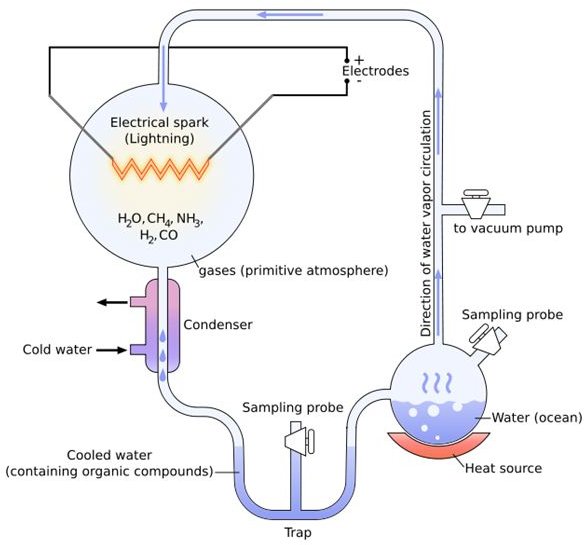
In a short while, they found that the building blocks of organic molecules (like nucleic acids and proteins) had formed in the mixture. Since this classic experiment, other scientists have re-visited the conditions and equipment used by Miller and Urey; whether or not the specific mixture of gases used was actually present in the early atmosphere of our planet, more modern experiments have confirmed that the conditions on early Earth could have very well produced the building blocks of important molecules. Further experiments done with hydrogen cyanide have specifically led to the creation of nucleotides, while experiments done with formaldehyde have specifically led to the creation of simple sugars.
Beyond Miller-Urey
So now we know how to get nucleotides, problem solved, right? Well, not quite. The issue with nucleotides is that they themselves are composed of different subunits: there is a sugar joined to a phosphate group at one end and a base at the other end. The bases are able to form from the hydrogen cyanide, but for quite a long time scientists did not have any success in getting the base to combine with the sugar. Proponents of the “RNA world” hypothesis were worried that they would have to abandon their model. Along came chemist John Sutherland, however, who showed that under the right conditions, the sugar and the base could actually be created together, instead of having to be combined individually.
What about linking the monomers together into a long chain? The primitive RNA could probably copy itself in chunks, rather than by being strung together one individual monomer at a time, like today; research that demonstrates this is being done by biochemist Andy Ellington. But whatever the details of the copying method, how on earth did the molecule start copying itself in the first place? Chemistry professor James Ferris has an hypothesis; on the surface of a particular type of clay, called montmorillonite, RNA nucleotides will actually come together to form chains. Jack Szostak has further found that from a random group of these linked nucleotides, some will eventually possess catalytic properties.
But the basis of life isn’t a “naked” molecule of nucleic acid; the basis of life is a cell. How did the cell originate? According to scientists, once there were amino acids on the primitive Earth (remember the Miller-Urey experiment), this would not have been so difficult. Amino acids in solution actually form proteinoids, molecules that are similar to modern proteins, when they are exposed to cycles of heating and concentration and subsequent re-hydration, such as would have happened to shallow pools left behind by receding ocean tides. These proteinoids, when re-hydrated, form structures called microspheres, which look superficially like membrane-enclosed cells.
The idea of the “primordial ribozyme” and the “proteinoid proto-cell” have been criticized by some scientists, though, as we’ll see in the next article. These critics have put forth other models, one of the most complete being one that places basic biochemical processes as the first true “spark of life.”
References
Life on Earth (Audesirk et al., 2006)
New Views on an Old Planet (Van Andel, 2000)
The Changing Earth: Exploring Geology and Evolution (Monroe and Wicander, 1997)
https://www.talkorigins.org/faqs/abioprob/originoflife.html
https://www.accessexcellence.org/WN/SUA03/RNA _origins_life.php
https://www.independent.co.uk/news/science/found-the-origin-of-life-1684584.html
https://evolution.berkeley.edu/evosite/evo101/IIE2aOriginoflife.shtml
https://www.nytimes.com/2009/06/16/science/16orig.html?pagewanted=all
https://www.plosbiology.org/article/info:doi/10.1371/journal.pbio.0030396
Seven Clues to the Origin of Life: A Scientific Detective Story (Cairns-Smith, 2008)
Images courtesy of Wikipedia
This post is part of the series: Astrobiology: Origins of Life on Earth and in the Cosmos
This multiple part series will explore the theories on the origin of life on earth, what these theories could mean for the presence of extraterrestrial life and how astrobiologists are searching for life on other planets.