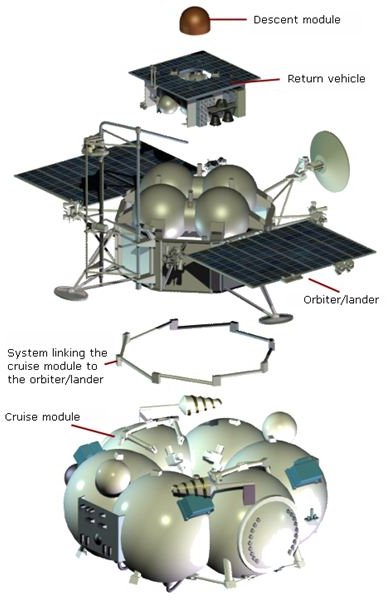
The Russian Phobos-Grunt Mission will visit Phobos, one of Mars’ moons to collect surface data. Included in the mission will also be a Chinese Mars orbiter called Yinghuo-1, which will orbit Mars for a year, taking photos and other data to study Mars’ magnetic field.
Introduction
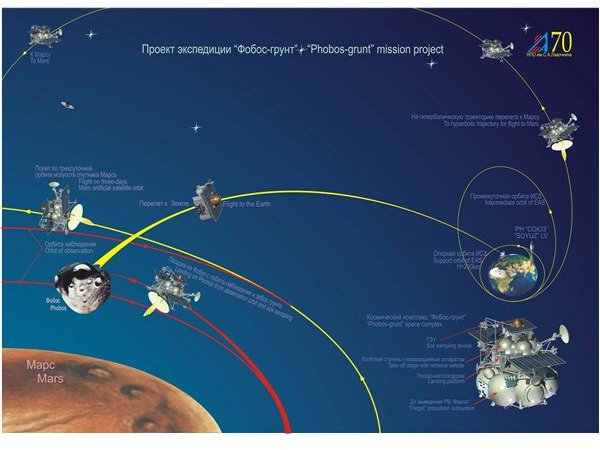
The Russian Phobos-Grunt mission starts with a 10-month trip from Earth to the red planet beginning in either 2009 or 2011. Assuming a 2009 launch date, the mission will orbit Phobos for several months collecting data, then land on Phobos, and send a return vehicle with soil samples that will return to earth in 2012. This mission will mark the first extraterrestrial sample from a planetary body brought to earth since the end of Luna 24 back in 1976.
While a number of publications announced an impending announcement by Russia delaying the Phobos-Grunt mission until the next launch window after October 2009 (which is in 2011), Russian head of NPO Lavochkin (the Russian manufacturer that builds the core module, Fregat and is otherwise heavily involved in aeronautical engineering), Georgy Poleshyuk, continues to say that they will meet the October 2009 launch date. (As of September 23, 2009 the mission has been postponed to 2011. - Ed.)
The Vehicle
The launch vehicle is a Zenit liquid-fueled rocket booster that uses RP-1 (highly refined kerosene) and liquid oxygen as its propellant, and that carries a Fregat upper stage. The Fregat has been used as an upper stage on the Soyuz rocket. It uses kerosene and oxygen as the fuel and oxidizer.
Onboard Equipment
Carried aboard will be the Chinese Yinghuo-1, mounted atop the spacecraft. According to Chinese media reports, it is a 750 x 750 x 600 mm box weighing 110 kg, equipped with solar panels that will span 7.85 meters when deployed. There will also be a second Chinese contribution, the Soil Offloading and Preparation System, a microgravity grinding tool developed in Hong Kong.
The U.S. is sending an experiment called Living Interplanetary Flight Experiment (LIFE), which will include a natural colony of soil microbes. This experiment is to answer questions about whether microbes riding on meteorites can spread life throughout our solar system by surviving the trip to Mars and back, exposed to the extreme temperatures and radiation in interplanetary space. It is sponsored by the U.S. based Planetary Society.
If the mission is delayed until 2011, two MetNet Mars Landers developed in Finland will be included. The objective of MetNet is to eventually set down a widespread surface observation network on Mars to collect data on Mars’ atmosphere, physics, and meteorology. If the launch takes place in 2009, however, the MetNet landers won’t be ready in time.
Mission Objectives
Russia has numerous objectives in studying Mars’ moon Phobos. The mission should answer some of the mysteries around Phobos’ origin and composition. While studies have been done with telescopes or quick fly-bys from other Mars orbiters, showing that Phobos is made of a dark, non-reflective material, this mission should allow scientists here on Earth to determine the age of the material that Phobos is made of. Physical samples of the material will allow comparison of isotopic signatures to those of Martian meteorites that have fallen to Earth. Scientists would like to determine if Phobos is a large, asteroid-like chunk of rock, or if it is a pile of rubble bound together by gravity. Scientists would also like to find out if Phobos has water ice, which may be valuable information for future manned missions to Mars.
https://ru.wikipedia.org/wiki/%D0%A4%D0%BE%D0%B1%D0%BE%D1%81-%D0%B3%D1%80%D1%83%D0%BD%D1%82 (Russian)
https://www.laspace.ru/rus/phobos.php (Russian)
https://www.russianspaceweb.com/phobos_grunt.htm
https://www.spectrum.ieee.org/aerospace/space-flight/russia-to-delay-martian-moon-mission
https://www.aerospaceguide.net/mars/phobos_grunt.html
https://www.collectspace.com/ubb/Forum31/HTML/000253.html
https://www.msnbc.msn.com/id/30498759/ns/technology_and_science-space/wid/11915829/