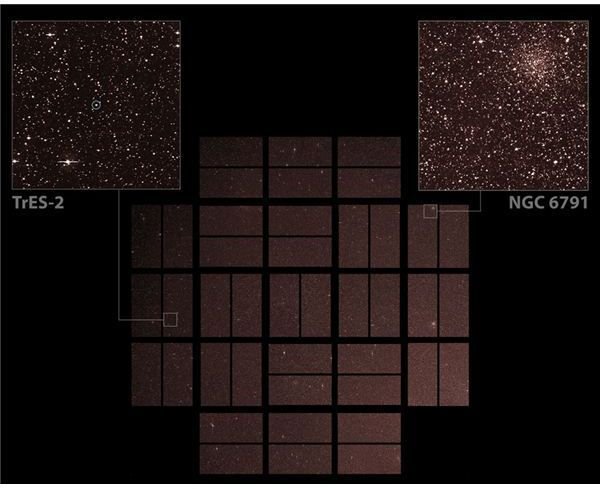
The Kepler satellite has taken and sent back the first images of its prodigious mission; and it has done so with its huge photometer.
First Light
On April 9th of this year, the Kepler spacecraft took its first images of the general area it is aimed at, while in its solar orbit_,_ looking for habitable planets. The spacecraft is as close 8.4 million kilometers from Earth and appears to be in very good condition and all seems on course. There are daily checkups of the functions of the spacecraft, daily collection of such data, and reaction wheel desaturations every three days.
The image itself could be described as magnificent. Showing roughly 14 million stars, there is a definite sense of vastness to the image (below), and yet because of the photometric specifications we are closing in on the data we are after; this is not some blasé, spectatorial image, some simple admiration; there is a goal.
The spacecraft is searching for Earth-sized planets in the habitable zone of certain stars. The images will be exposing planets that are eclipsing stars and from that data scientists can put together the size of the planet and the distance from the star it is orbiting, given the frequency of its orbit and amount of light distortion at each eclipse. The photometer has been aimed toward the Cygnus-Lyra area of our Milky Way galaxy for it’s search, in an Earth-trailing solar orbit.
The Photometer
The photometer is big: a single instrument composed of 42 CCD’s (Charge Coupled Devices), each CCD measuring 50 by 25 mm, with each CCD containing 2200x1024 pixels. It takes 30 minutes to collate the data taken by the CCDs, and the images are deliberately defocused to improve photometric precision. In other words, the images are actually deliberately blurred to decrease the amount of saturation from bright stars, and are calibrated to focus on a range of stars, roughly 100,000 in number. This 95-megapixel camera, the largest ever launched into space, can detect changes in a star’s brightness in the range of 20 parts per million. It also has a 105 deg² field of view. In the image above, the bottom right of the image is brighter because it is closer to the plane of our galaxy, while the upper left is farther away from us.
The data from the images is stored on board the spacecraft and is transmitted back to ground about once a week.
The power for the photometer comes from the solar arrays on the spacecraft, which has no moving parts except for a few reaction wheels which maintain the pointing, and served in ejecting the dust cover.
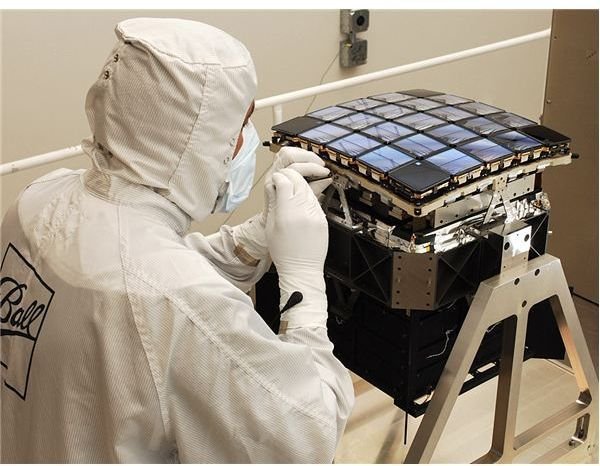
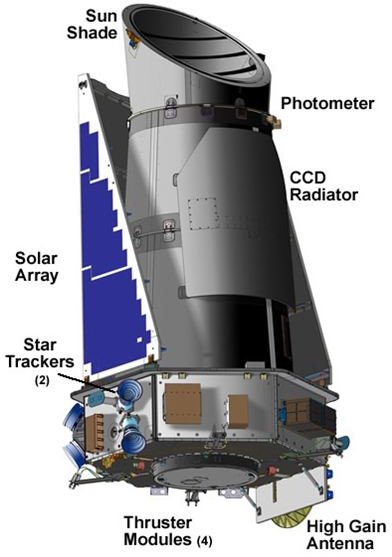
Image Credits
First Light image: https://kepler.nasa.gov/about/1stlight/zoomingin.html
Kepler spacecraft: https://kepler.nasa.gov/sci/design/spacecraft.html
CCD panel: https://kepler.nasa.gov/media/images/07-3344d-Kepler.JPG