How Black Holes are Formed, What the Singularity Point is, and Interesting Properties of a Black Hole
What is it?
A Black Hole is a highly dense region of space with an enormous concentration of mass from where nothing can escape from its gravity: not even light. The term “Black Hole” comes from the fact that, at a certain point, even light is unable to break away from the attraction of these massive objects. This renders the hole’s interior invisible or, rather, black like the appearance of space itself. An area surrounding a black hole, inside which events cannot affect an outside observer is called the event horizon. It means anything crosses event horizon towards a black hole will obviously never be able to get back. If you’re still confused, checkout “What is a Black Hole” for more information.
How Does a Black Hole Form?
A black hole forms when any object reaches a certain critical density, and its gravity causes it to collapse to an almost infinitely small pinpoint. In principle, black holes can have any mass; black holes formed by stellar death have at least twice the mass of our sun. Stellar-mass black holes form when a massive star can no longer produce energy in its core. Without the radiation from its nuclear reactions to keep the star “puffed up”, gravity causes the core to collapse. The star’s outer layers may blast away into space, or they may fall into the black hole to make it heavier. The theories for supermassive black holes are still growing. According to current theory they may be formed by gravitational collapse of highly massive gas cluster and the creation of supermassive black holes may be related to the birth of galaxies.
Images of Black Holes
What is a Black Hole Singularity?
The singularity is the point of infinite density thought to exist at the center of a black hole. In a non-rotating black hole the singularity is a point, in other words it has zero length, width, and height. The singularity of a rotating black hole is smeared out to form a ring shape lying in the plane of rotation. The ring still has no thickness and hence no volume.
To understand singularity properly we need a theory of quantum gravity, because General Relativity and Quantum Field Ttheory break down at a singularity. (Quantum Field Theory works very well to describe the observed behavior and properties of elementary particles. But the theory itself only works well when gravity is so weak that it can be neglected. On the other hand General Relativity explains gravity. It explains the orbits of planets, the evolution of stars and galaxies, black holes and gravitational lenses. But the two theories can not work together. That’s why we need quantum gravity.) Currently Loop Quantum Gravity and String Theory are the two major candidates for the theory of quantum gravity.
How Large Can a Black Hole Be?
The size of black hole does not have any limit. It can be of any size. I mean, it may be a black hole of any radius and any mass. But only one thing we can say is its mass has to be a minimum two times our sun’s mass. Recently, astronomers found the largest black hole ever detected, with a mass 18 billion times the mass of the Sun.
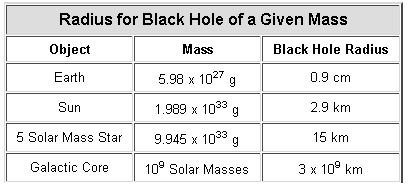
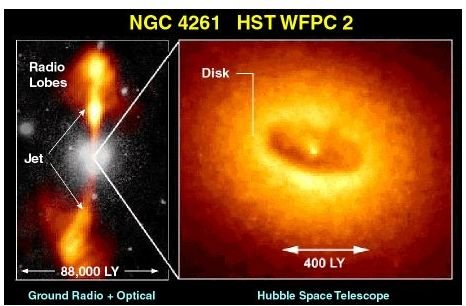
Black holes are commonly classified according to their mass. The size of black hole as determined by the radius of the event horizon, which is is proportional to the mass . According to this mass/size criterion then, black holes are commonly classified as: Supermassive black holes, Intermediate-mass black holes, Stellar black holes and Primordial black holes. Supermassive black holes are millions of times more massive than our sun. The have been detected in the center of galaxies. Intermidiate-mass black holes are thousand of times more massive than the sun. Stellar black holes have mass that is ten times that of our sun and the Primordial black holes have masses equivalent to our moon. They are also called mini or micro black holes. Current theory has predicted their production during the early stages of the evolution of the universe. Look at gallery 2 carefully . There is chart for the mass versus radius of black holes in the first image and second one is showing a supermassive black hole detected by Hubble Space Telescope.
Find out what would happen if you fell into a black hole and how black holes are detected on the next page.
What’s Our Destiny After Falling into a Black Hole?
Suppose an astronaut in a space ship has crossed the event horizon. He can still see things on the outside the event horizon: after all, the light from the objects on the outside can still reach you. But no one on the outside can see him, because the light from his ship can’t escape past the horizon.
Just after crossing event horizon the astronaut will not feel any gravitational forces at all. He will have the same feeling that astronauts feel when they are orbiting the earth. He will feel weightless because he is falling freely. But as he gets closer to the center of the black hole, he will start feeling the gravitational force increasing. This is called the ’tidal’ gravitational force. This tidal force arises because his feet are closer to the black hole than his head. So the closer he gets, the more his feet feel a stronger attraction than his head. The tidal force will keep increasing until it tears him apart. He is doomed!
Gallery 2
How Do We Detect Black Holes?
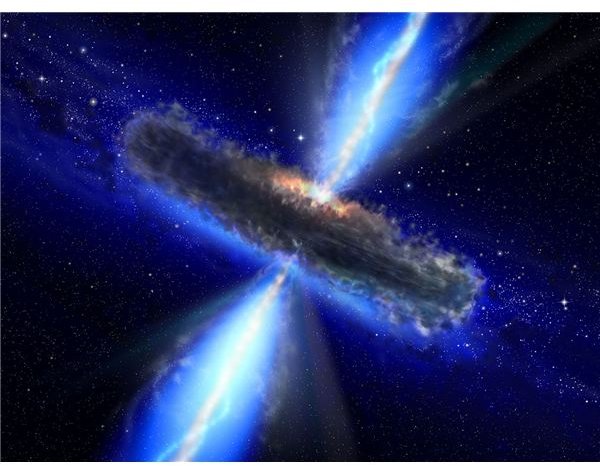
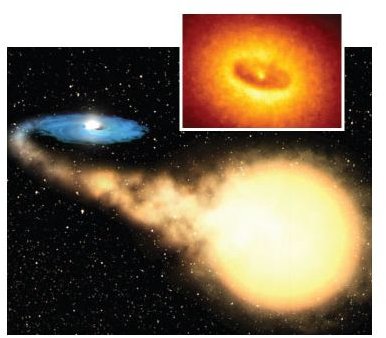
Black holes don’t radiate light, and an object that falls inside a black hole doesn’t emit light either, so detecting them is really not easy and is obviously challenging. If a black hole is in a binary star system and it pulls gas from its companion, we can detect X-rays from the resulting accretion disk (an accretion disk is a structure formed by diffuse material in orbital motion around a central body, in this case a black hole. For example see the 3rd image in Gallery 1. “Black Hole sucking gas from a star”. The gas is falling into the black hole in a spiral orbit and being heated to millions of degrees and radiating x-rays (To learn more about x-ray you can also see “Whats really out there in the night sky”). The spiral blue disk is accretion disk.). Some black holes also produce deadly jets which comes out from their poles, as you see in the first image. This is another sign for a black hole. They can also be detected in the center of some galaxies. This is done by observing stars near the center of the galaxy. If the stars are moving very rapidly around some unseen object, Kepler’s laws can be used to estimate the mass in the center. In some cases the mass must be at least a hundred million times our Sun’s mass, in a region only a few light years across. Check out the second figure in Gallery 2. Don’t be confused with the diameter of 400 light years. Its the diameter of the accretion disk of that black hole, not the radius of the black hole.
Another way to detect black hole is gravitational waves. Gravitational waves are disturbance in curvature of space-time caused by the motions of matter and they propagate as a wave, traveling outward from a moving object or system of objects. With the help of gravitational waves astronomers can also detect Black Holes.
The Chandra X-ray Observatory has discovered many black holes. It is a satellite launched by NASA on July 23, 1999. It was named in honor of Indian-American physicist Subrahmanyan Chandrasekhar who is known for determining the mass limit for white dwarf stars to become neutron stars. “Chandra” also means “moon” or “luminous” in Sanskrit. You can see the images of those Black Holes in Chanda’s photo album .
As much as I learn about black holes, I become astonished. Which word should I use to define it? Strange, exotic, enigmatic or weird ?
Credits
Gallerly 1 :
1. Supermassive Black Hole
https://www.spacetelescope.org/images/large/heic0409a.jpg
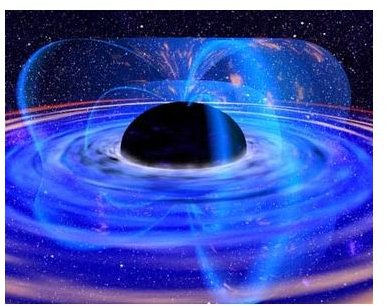
2. Artist’s rendition of a black hole.
https://www.astro.ucla.edu/planetarium/graphics/st_images/BlackHole.jpg
3. Black Hole is sucking a star.
https://www.llnl.gov/str/JulAug07/gifs/nif5.jpg
Gallery 2:
1. Mass vs radius - Created Myself.
2.Size of the supermassive Black hole at the core of galaxy NGC 4261
https://imgsrc.hubblesite.org/hu/db/1992/27/images/b/formats/web.jpg
