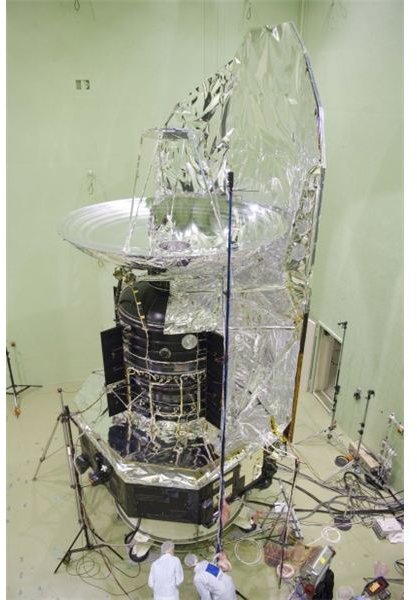
The Herschel Space Observatory has been in the pipes for a long time, and it’s only just been launched, promising to be the premier infrared space observatory. Here’s an overview of Herschel’s past, present and future in this critical field.
The Herschel Space Observatory is no longer just a promised, much-needed telescope for some unknown time in the future, but a fully fledged infrared observatory already speeding its way to its final orbit in space, in the very near future ready to provide us with pictures of the very distant past. Here’s an overview of the development of Herschel, what its doing now, and how it will function in the future.
Images
Herschel’s Past…
Herschel was first proposed way back when in 1982 as FIRST, the Far Infrared and Sub-millimetre Telescope, as the very first telescope to—you guessed it—cover both the full infrared and submilletre frequencies. That isn’t exactly the catchiest name, so it was renamed to the Herschel Space Observatory, named after Sir William Herschel, discoverer of the planet Uranus and, appropriately enough, the infrared spectrum.
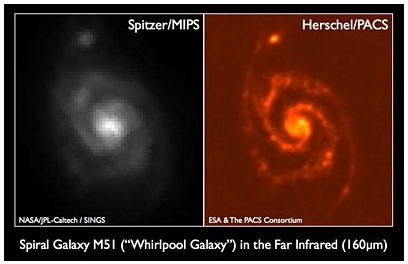
Herschel is an ESA mission—an acronym seen more and more in the field of astronomy otherwise dominated by NASA, standing for the European Space Agency . It will function as the fourth cornerstone of its space observatory program, ESA’s answer to NASA’s own Great Observatory program, consisting of Hubble, Chandra, Compton, and Herschel’s equivalent, Spitzer. Spitzer itself recently ran out of coolant and is no longer able to function at full capacity, making room for Herschel to replace it as the premier infrared space observatory.
…Present…
What’s Herschel doing now? Well, it’s not observing quite yet. It was only launched this last May 14th! Just a few days ago Herschel opened its eyes for the first time—so to speak. The crycover that protected its sensitive equipment during launch was opened only this last June 14th.
Sometime this July 2009, Herschel is expected to enter its final “Lissajous” orbit. As simply put as possible, a Lissajous orbit is a natural, if somewhat loopy orbit that is made within a two body system, such as that between the Sun and the Earth, made around the second Lagrange point of the system.
Having Herschel so far out yet so close will allow it to function with both a minimum of interference from both stray light and heat from the Earth while still keeping a strong connection to its Earthbound audience. While this orbit isn’t entirely stable, it is more energy efficient to correct it using on-board propulsive systems than some of the alternative orbits Herschel could follow and have the similar levels of non interference. Check out this page from ESA for more details of Herschel’s Lissajous orbit . (Learn more about orbits and orbital mechanics here .)
Spitzer versus Herschel: the future of infrared astronomy
…And Future Mission
Herschel promises to bring in spectacular images from a variety of sources. Its mission qualifies four very different, very important fields: galaxy formation in the early universe, star formation and how it interacts with the interstellar medium, chemical composition of a variety of bodies within our own Solar System, and molecular chemistry in general anywhere in the universe where it can peer. Check out this page from Herschel’s ESA site for more on the Herschel’s key programmes .
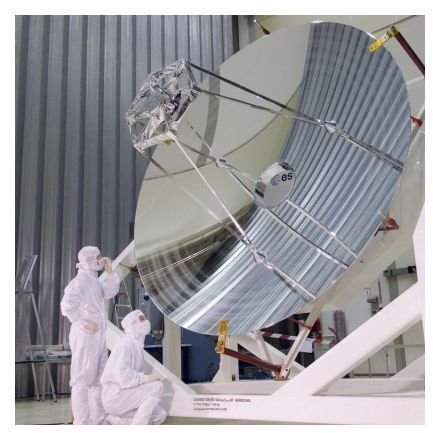
To accomplish this, Herschel is outfitted with the largest mirror ever to be deployed in space, feeding into three different detectors. The first of these is the PACS, or Photodetecting Array Camera and Spectrometer, which will cover wavelengths from 55 to 210 micrometers. Next up is the SPIRE, or Spectral and Photometric Imaging Receiver, which covers 194 to 672 micrometers. Third and finally is the HIFI, Heterodyne Instrument for the Far Infrared, which will operate from the 157 to 212 and the 240 to 625 micrometers wavelength. Some of these wavelengths have never been observed before, bringing new depth to the field of infrared astronomy.
All of this is cooled by liquid helium—which dictates the length of Herschel’s mission. Herschel is due to run out of this coolant in approximately four years, and due to its complex, hard-to-reach orbit, there will be no astronauts replacing that coolant anytime soon. The current Herschel observing mission is planned for three years. Maybe not the longest time for a telescope—but scientists are hoping to make the most of it.
For more information Herschel, from the latest news to the technical nitty gritty to the future home of its infrared photographs, check out ESA’s Herschel homepage .