Low Long Would it Take to Get to the Moon? Space Travel Times to Get to the Nearest Planet, Star or Galaxy
Let’s Take a Trip
In the wonderful world of astronomy, or maybe more appropriately, in the wondrous universe that we call home, we often hear about enormous distances to the stars and galaxies but may not really appreciate just how far they really are. I would like to help you get a better feel for how big our universe is by taking you on a tour using several methods of transportation: a typical family car; the fastest passenger plane ever to fly—the supersonic (and retired) Concorde; the fastest space probe ever launched, the Helios-2 space probe, launched into solar orbit on January 15, 1976, and lastly, a starship that is capable of traveling at the speed of light.
What We Will Be Taking
First let’s set some speed limits for our vehicles:
1) The Family Car: 65 mph or 105 km/h
2) The Concorde: Average speed – 1330 mph or 2140 km/h
3) The Helios 2 Space Probe: 150,000 mph or 241,500 km/h
4) Starship: 6.71x10⁸ mph or 1.08x10⁹ km/h (More commonly the speed of light is usually written as distance per second: 186,282 mps or 299792 km/s)
Where Are We Going?
Now let’s set some destinations. We will travel to some very well known celestial bodies:
1) NYC to LA: Just for a reality check let’s start with a terrestrial trip, say from New York City to Los Angeles, which is about 2440 miles or 3930 kilometers, as the crow flies.
2) The Moon: Average distance from Earth – 238,827 miles or 384,400 km
3) Mars: At closest approach – about 35 million miles or 56 million kilometers
4) Saturn: At closest approach – about 7.94x10⁸ miles or 1.28x10⁹ kilometers
5) Nearest star: Proxima Centauri of the Alpha Centauri system: 2.53x10¹³ miles or 4.07x10¹³ kilometers. (At these distances we usually convert to light years (ly), which is the distance light will travel in one year: 5.88x10¹² miles or 9.46x10¹² kilometers.)
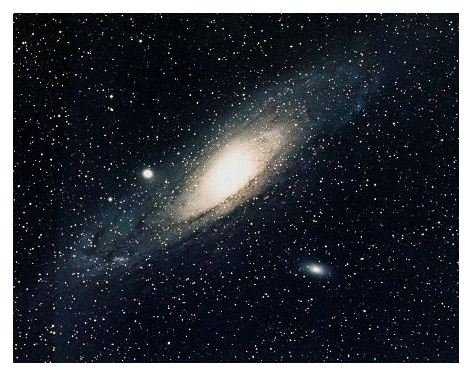
6) Our nearest spiral galaxy – Andromeda (M31): 2.56x10⁶ ly or 1.5x10¹⁹ miles, 2.4x10¹⁹ km. (Keep in mind as you read this article that one of the most distant galaxies observed is about 12.9 billion light years away!)
Now that we’ve got our transportation and our destinations we are ready to apply a simple formula to calculate time of travel knowing distance and speed:
Time = Distance/Speed
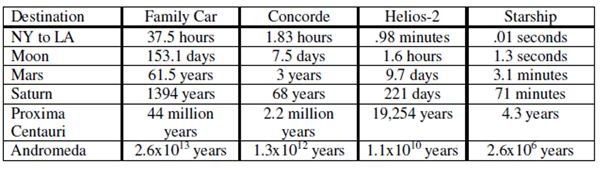
How long will our trips take? Click on the chart below to see the travel times.
Lots of Big Numbers!
Well, the family car doesn’t seem to be much good for anything beyond a trip to LA, and there are those that would contend that 37.5 hours in a car, non stop, would seem like an eternity anyway! Traveling to the moon in the car would be doable if one had places to stop for rest and supplies. It’s not too much longer than some of the voyages early explorers experienced discovering the new world.
The Concorde would definitely be doable to the moon, provided they had sleeping arrangements for everyone - kind of like a cross-country train ride. (Note that it took the Apollo missions about 2.5 days to transit from the Earth to the moon.) Beyond the moon, though, the Concorde is of little use.
The speedy Helios-2 would make a very nice ride to Mars but a bit of a stretch to get out to Saturn, and it’s beyond question to use it to get to the nearest star! For that trip, one really needs a starship capable of traveling at light speed. A little over four years is possible if one can carry all the necessary provisions and protect the crew from the radiation hazards of open space. But once again, looking to cross the void to the Andromeda galaxy one quickly realizes that they need some other form of transportation. Wormholes might do, but as of this time they are just theory, so we have to content ourselves with looking at these wonders of the universe, so close, yet so far away.
As a closing thought, look at the numbers in the Starship column again. These values indicate how long the photons of light have been traveling before reaching your eye. We see Proxima Centauri, as it appeared 4.3 years ago and the Andromeda galaxy, in all of its glory, 2.6 million years ago! I wonder what it looks like today?