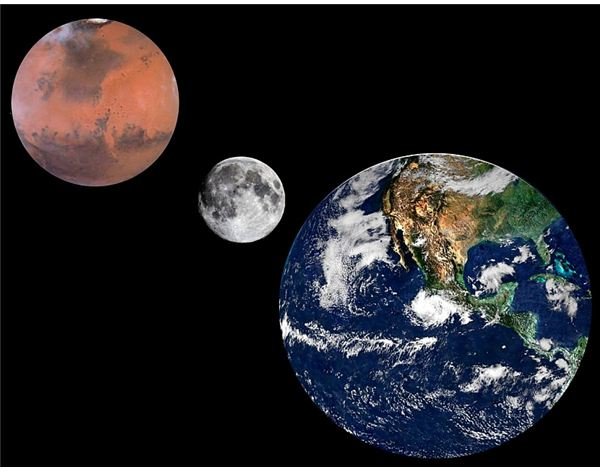
The emails exclaim: Mars, close enough to be as big as the full moon in the night sky! No one alive today will ever see this again!! Don’t you believe it!!!
Mars’ New Myth
The Internet is a wondrous place: Almost infinite amounts of information available at your fingertips—some of it good and some of it bad. It seems that the more amazing the information being presented, the higher the risk that it is bogus. Consider the email currently circulating the globe: “Mars Spectacular!”
This is not a new email but one that surfaced back in 2004, which actually referred to an event that occurred in the summer of 2003 when Mars and Earth’s orbital mechanics brought the two planets closer than they have been in 60,000 years. This meant that they would be 34.65 million miles (55.76 million km) apart. Not quite close enough for the planet Mars to look like anything but a bright reddish dot in the night sky! Understand that during a typical Martian year, which lasts about 1.88 Earth years, the distance separating Mars and Earth will go from about 36 million miles (57 million km) when the two planets are on the same side of the sun (called opposition) to over 255 million miles (408 million km) when they are on opposite sides of the sun (know as conjunction). Also, the orbits of the planets are not circular but are elliptical. Combine that with the knowledge that Mars and Earth’s periods of rotation around the sun are not even-multiples of each other and one can see that these points of minimum and maximum separation will keep changing over time: hence, the figure of 60,000 years since the last closest approach. (Here is a link that discusses this is more detail and includes a nice animation of Mars and Earth’s orbital motion.)
Since Mars is a bit closer, it will appear a bit brighter, and a bit bigger in a telescope, but in no way will it be as big or as bright as the moon! Mars is going to stay put, in its orbit, just as Earth is going to stay in its orbit for billions of years to come, unless something were to come by and knock it out of its orbit…Hmmm?
What If…
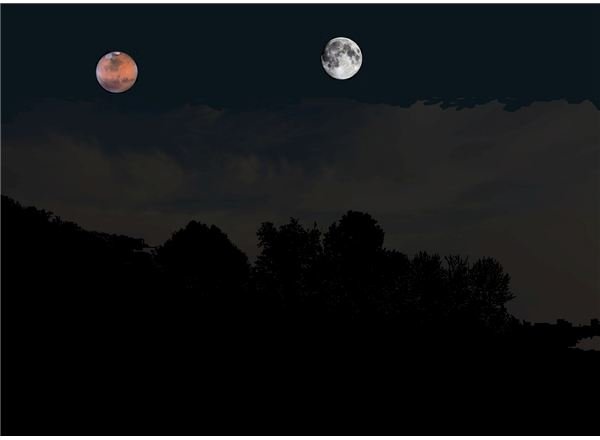
For the sake of argument: Let’s say that a small, rogue black hole came blasting through our solar system and it unceremoniously tossed Mars out of its orbit. Let’s also imagine that Mars is heading towards Earth so that as it passes by it appears to be as big as the full moon. Other than presenting a really nice view in the night sky, what would be the consequences? (We’ll ignore the effects of that rogue black hole, which is probably going to really ruin everybody’s day and just consider Mars for the moment.)
Mars is almost 9 times as massive as the moon is, and at its closest approach to Earth it contributes a tidal force that is about .00003% that of the moon’s. Very small, indeed! For the planet Mars (diameter – 4076 miles/6794 km) to appear as big as a full moon, which is about .5 degrees wide, it would have to be about 467,000 miles (747,200 km) from us. That’s almost twice the distance between the earth and the moon. At that distance Mars would exert a tidal force (which is a function of 1/R3, where R is the separation of the two bodies) on the earth that is about 1.1 times that of the moon. So depending on the location of the moon relative to Mars, the tides could be more than twice as big if the moon and Mars were aligned on the same side of Earth, to almost nothing if they were on opposite sides of our planet, where the two forces would balance out. This tidal force would change direction as Mars swept by Earth, affecting the magnitude and duration of the tides. Mars would also tug on the Earth-moon system and could cause the moon’s orbit to change by some amount depending on the timing of the event.
We would have a beautiful view in the night sky for sure, but more importantly, we would probably have some very high tides and more seismic activity that we would not have had otherwise! This would also apply to the moon, as Mars would play a tug-of-war with Earth over it.
In Conclusion
So, go out before sunrise for the rest of May, through June and into July, 2009, and enjoy the ruddy red dot that is Mars (along with brilliant Venus!). While you are looking at Mars rejoice in the fact that it is happily in orbit about our sun, and will be for many, many, many years to come. Oh! And the next email you receive, or Internet story you read that sounds way too amazing to be true—be a bit skeptical and check it out, do a bit of detective work on your own. After all, you have the Internet at your fingertips!
Credits
Carroll, Bradley, W and Ostlie,Dale A. (2007). An Introduction to Modern Astrophysics, San Fransisco, Ca: Addison Wesley, pg 719-723.