Interesting facts about constellations - Lepus constellation
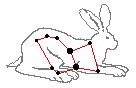
The Facts
1. Image of: A hare
2. Right ascension: 4H 50m to 6H 07m
3. Declination: -20 degrees
4. Quadrant: SQ1
5. Latitudes visible at: Between +63 degrees and -90 degrees
6. Time best visible: At 21:00 in January
7. Area of sky covered: 290 square degrees
8. Rank in constellation size: 51st
9. Notable and named Stars: Alpha Leporis (Arneb), Beta Leporis (Nihal, Nibal), Epsilon Leporis (Sasin, Sassanka), Mu Leporis (Neshmet, Khaemhet), R Leporis (Hind’s Crimson Star)
10. Other objects in the constellation: M79, Messier Object
11. Brightest star: Alpha Lepus (Arneb), with an apparent magnitude of 2.58
12. Nearest star: GI 229 , about 19 light-years away
13: Meteor showers: None
14. Mythology: As the Lepus is positioned right under the Orion canstellation, it is sometimes represented as the hare, chased by the hunter Orion.
15. Historical significance: Discovered by Audectus Methonidas in the 4th century BC, and later included by Ptolemy as early as the 1st century as one of the 48 constellations in his book “the Almagest”.
16. Name Meaning: Lepus is the Latin term for Hare or a jackrabbit. Should not be confused with the Lupus constellation.
17. Position in the Zodiac: Not Part of the Zodiac.
Contellation Lepus Images
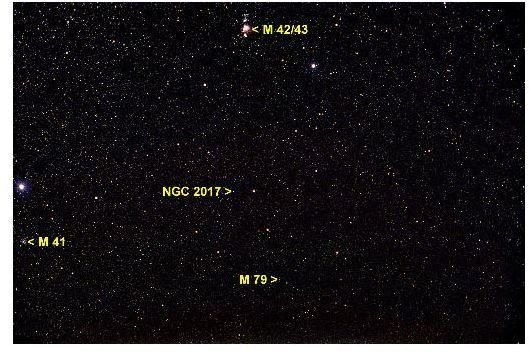
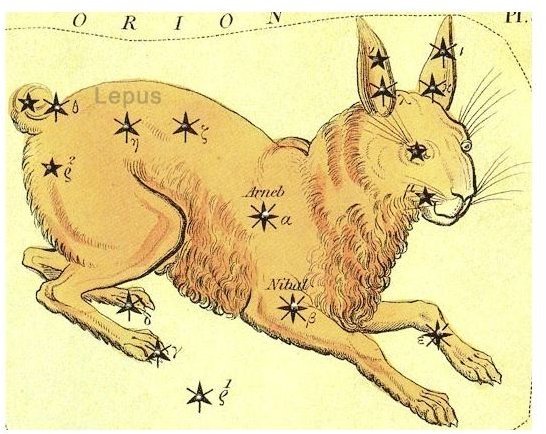
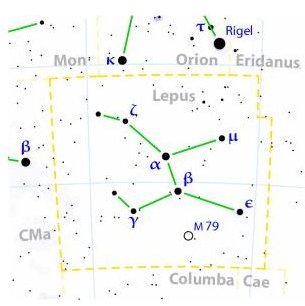
Other Interesting Facts
In 1845 a star of distinctively red color was observed by British astronomer John Russel Hind. Being a carbon star, Lepus can be observed in variations of the color red. When the star is the dimmest, it is believed to be the reddest star in the sky, though as the definition is not universal, some argue.
Gamma Leporis is a either a double or a triple star, and there are at least 2 stars which have planets, HD33283 and Zeta Leporis – the latter supposedly having an asteroid belt.
The ancient Egyptians associated the Lepus constellation with the boat of Osiris (the Orion).
References
Content:
https://www.allthesky.com/constellations/lepus/
https://www.eastbayastro.org/articles/lore/lepus.htm
https://www.coldwater.k12.mi.us/lms/planetarium/myth
Pictures:
https://www.allthesky.com/constellations/lepus/
https://www.coldwater.k12.mi.us/lms/planetarium/myth/Lep-myth.gif
