Planetary Nebula Facts to Help on Your Next Project
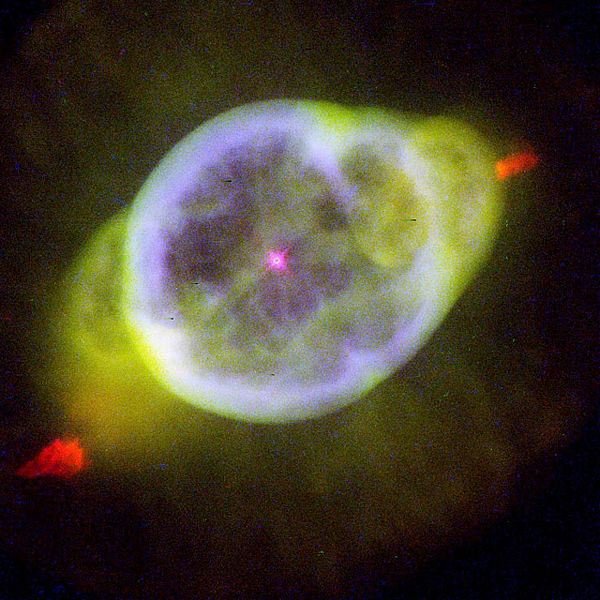
- Origin: Small to medium stars (like the Sun) at the end of their lifespans
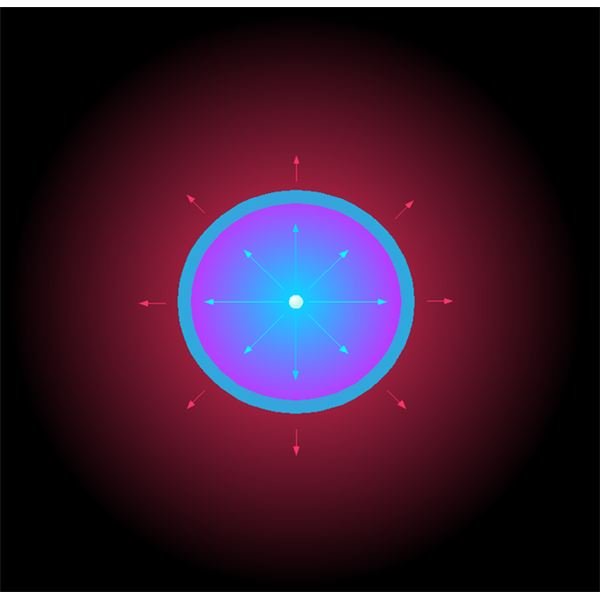
- Description: The star’s core is at the center, surrounded by a cloud of gas or plasma which pulses as fusion comes to an end
- Composition: Mainly carbon, oxygen, nitrogen, neon, and similar weight elements; small amounts of helium and metals
- Temperature: 8,000K - 23,000K (gas cloud); 100,000K (star surface)
- Size: About 0.3 - 2.5 light years in diameter. The gas cloud is small at first, but expands until the gas is lost to space, leaving the stellar core, now a white dwarf, behind.
- Mass: 4 solar masses (about 4 x 10 tons) or less; decreases with time as gas cloud is lost to space
- Density: 10^3 to 10^6 particles/cm in the gas cloud; density decreases with age
- Rate of expansion: 20-30 km/s^2
- Spectrum: 90-95% of their light is 500.7 nm (green) due to oxygen ions in a particular energy state called “forbidden lines”
- Stage of stellar evolution: At the end of a star’s life, after the red giant stage and before the white dwarf stage
- Lifespan: A few tens of thousands of years, very short by astronomical standards
- Number of known planetary nebulae: About 2,000
- Number that are Messier objects: 4
- Number in the Milky Way: About 10,000 estimated
- First discovered on: July 12, 1764
- Discovered by: Charles Messier
- Named by: William Herschel, because they resembled Uranus, which he had just discovered. Later, Herschel discovered that stars, not planets, are at their centers.
- First planetary nebula discovered: Dumbbell Nebula, M27 (1764)
- Nearest planetary nebula: Helix Nebula, about 700 light years away
More Planetary Nebulae
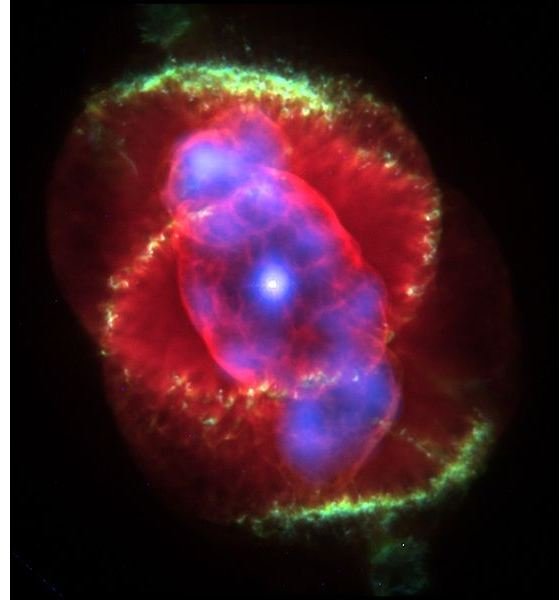
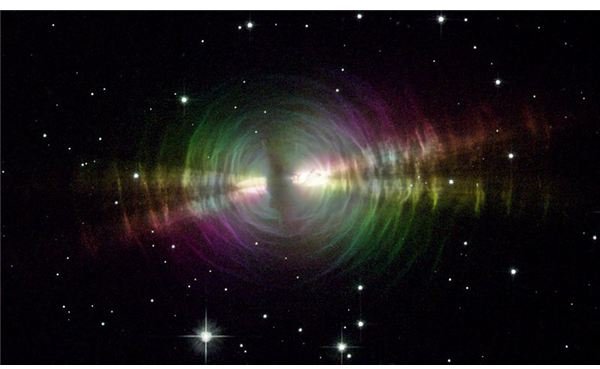
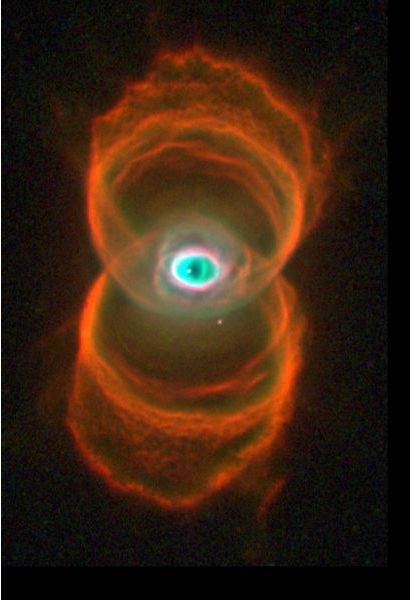
Above, from left to right (click on any image to englarge):
Cat’s Eye Nebula, one of the most complex planetary nebulae. Hubble Space Telescope image courtesy NASA and ESA.
Egg Nebula, one of the most recently discovered planetary nebulae (1996). Hubble Space Telescope image courtesy NASA.
Hourglass Nebula, a young planetary nebula whose central star is very obvious. Hubble Space Telescope image courtesy NASA.
Planetary Nebulae: Astonishing Facts
At right: Diagram of the formation of a planetary nebula. Image by Kurgus, Wikimedia Commons.
Wild Morphology
Planetary nebulae come in many different shapes. Common shapes include spheres, disks, and double-ended (bipolar) forms. Many planetary nebulae, especially young ones, have complex shapes that are hard to describe, and some are asymmetrical.
The wide variety of shapes has been a puzzle for astronomers. Bipolar nebulae may be the result of companion stars. The gas cloud is ionized, so magnetic fields from the core star may affect the shape. Other possibilities are “interactions between material moving away from the star at different speeds [and] multiple ejection events.” (Internet Encyclopedia of Science)
Universe’s Recyclers
In the early universe, the only abundant elements were hydrogen and helium. The gas cloud of a planetary nebula is made of heavy elements that are the result of helium fusion during the red giant phase. As a planetary nebula “evaporates” into space, it adds these heavy elements to the interstellar medium. Later stars that are born out of this material will have more heavy elements than the first stars had. Evaporation of planetary nebulae is thought to be the source of the heavy elements in the universe, including those on Earth.
Sources
“Planetary nebula.” Internet Encyclopedia of Science article.
“Planetary Nebulae.” Students for the Exploration and Development of Space website.
