Fast Facts About Jupiter: Size, Mass, Density, Orbit, and Temperature Information Along with Interesting Facts About the Largest Planet in the Solar System
Quick Facts About Jupiter
- Position in the solar system: 5th planet from the sun
- Closest distance to the sun: Perihelion is 740,500,000 km (460,000,000 miles)
- Farthest distance from the sun: Aphelion is 816,600,000 km (507,000,000 miles)
- Minimum distance to Earth: 588,400,000 km (366,000,000 miles)
- Jovian day: 9.926 hours
- Jovian year: 11.86 Earth years
- Axis tilt: 3.13°
- Orbital Inclination to ecliptic: 1.305°
- Orbital Eccentricity: .0489
- Diameter (equatorial): 142,984 km (88,800 miles), about 11.2 times the diameter of Earth
- Mass: 1.899 x 1027 kg (863 x 1024 tons), about 318 times the mass of Earth
- Gravity: 2.53 times Earth’s gravity at 1 bar pressure
- Escape velocity: 59.5 km/s, about 5.3 times the escape velocity of Earth
- Temperature: At 1 bar pressure, 165 K (-108° C or -162° F)
- Mean surface pressure: »1000 bar
- Atmospheric composition: Mostly hydrogen (89.8%) and helium (10.2%) with trace amounts of methane, ammonia, “heavy hydrogen” (hydrogen deuteride), ethane, and water
- Number of moons: 63
- Ringed system? Yes
- Magnetic field? Yes
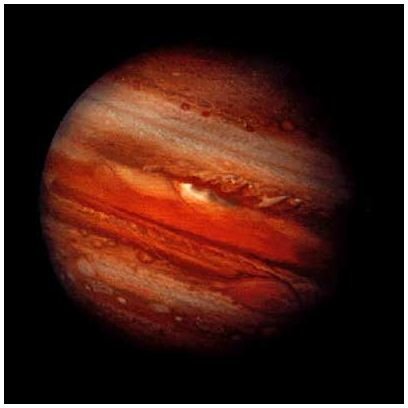
Image, above right: This color-enhanced image of Jupiter was taken by Voyager 1 spacecraft. https://pds.jpl.nasa.gov/planets/captions/jupiter/jupiter.htm
Images of Jupiter
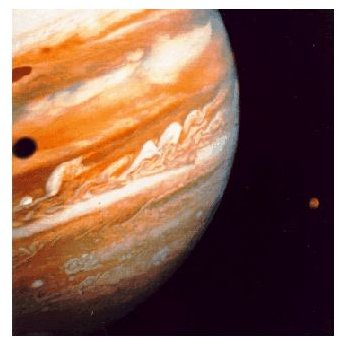
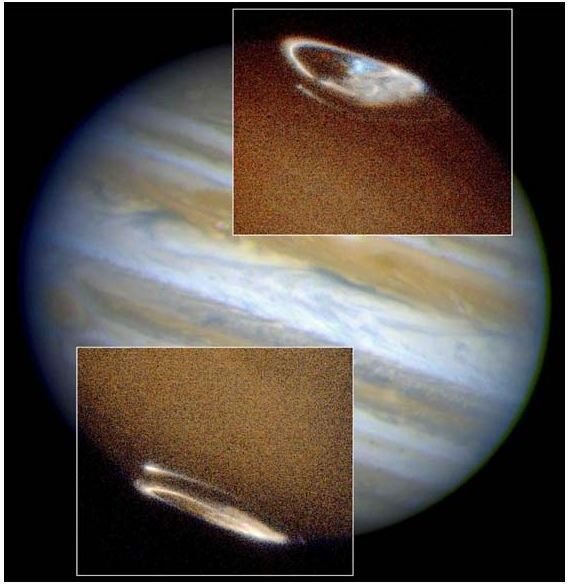
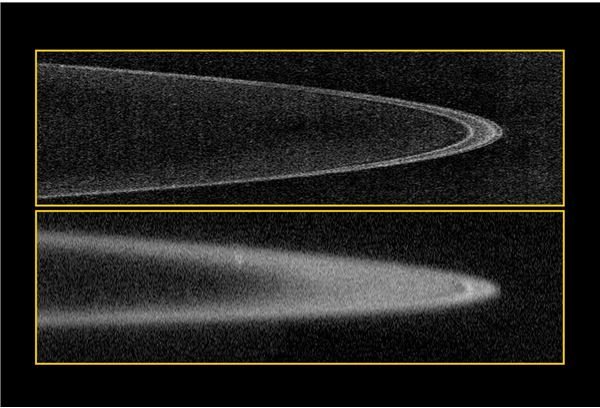

Left to right:
Jupiter with its moon Io and shadow of its moon Ganymede: This photograph, taken by the spacecraft Voyager 2, shows the Galilean moon Io to the right of the planet. On the planet’s surface on the left side of the image is the shadow of Ganymede, another Galilean moon. https://apod.nasa.gov/apod/ap951013.html
Jupiter’s auroras: Northern and southern auroras, caused by Jupiter’s strong magnetosphere, taken by the Hubble Space Telescope in ultraviolet. https://nssdc.gsfc.nasa.gov/photo_gallery/photogallery-jupiter.html
Jupiter’s Rings: These images were taken by the New Horizons spacecraft on approach (top) and looking back (bottom). https://www.nasa.gov/centers/ames/multimedia/images/2007/jupiterflyby.html
Amazing Facts About Jupiter
Jupiter is a planet of extremes. It is the largest planet in the solar system, both in terms of diameter and mass. It has the strongest magnetic field of all the planets in the solar system. It has the shortest day of all the planets. As a result, it rotates so fast that it appears noticeably squashed: it is 7% longer across its equator than between its poles. Most of the time, Jupiter is the third brightest object in the night sky, outshone only by the Moon and Venus. Its name comes from the mythical Roman god Jupiter, or Jove, the head of the pantheon, called in Latin “Father God the Best and Greatest.”
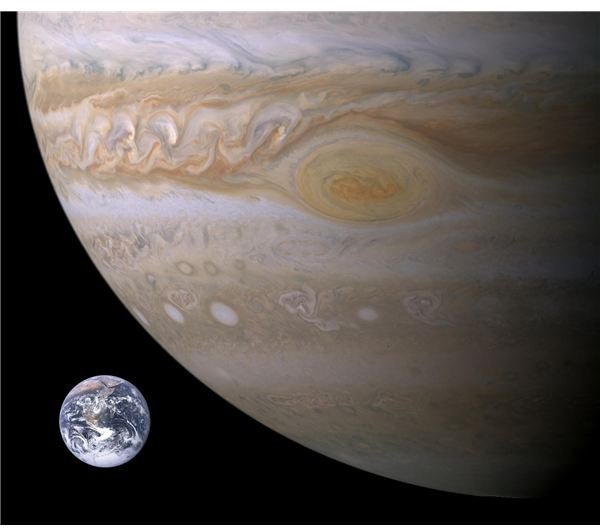
Jupiter’s famous Great Red Spot is an enormous hurricane-like storm that has persisted for at least 400 years. Large enough to swallow the Earth three times over, many aspects of the Great Red Spot remain to be explained by science.
Jupiter has 63 known natural moons, and the four largest are the most famous. Io, Europa, Ganymede, and Callisto were the first moons discovered in the solar system orbiting a planet besides Earth. They are called the Galilean moons after their discoverer, Galileo Galilei. The discovery of objects orbiting a body other than Earth was one of the observations that later led to the acceptance of the heliocentric theory of the solar system.
The moon Europa has a special claim to fame: its rocks are similar in composition to the Earth (silicate rocks on the surface and an iron core), its atmosphere contains oxygen, and it likely has an ocean of water beneath its surface. Many astrobiologists believe it is possible that extraterrestrial life exists on Europa.
Image, above right: Jupiter’s Great Spot compared to Earth. This composite shows an approximate size comparison between the Earth and Jupiter and its Great Red Spot. https://commons.wikimedia.org/wiki/File:Jupiter-Earth-Spot_comparison.jpg
References
- NASA’s Jupiter Fact Sheet. Available at https://nssdc.gsfc.nasa.gov/planetary/factsheet/jupiterfact.html
- University of Tennessee Department of Physics and Astronomy. “The Great Red Spot.” Available at https://csep10.phys.utk.edu/astr161/lect/jupiter/redspot.html
