Taurus Constellation Facts for Study and Research
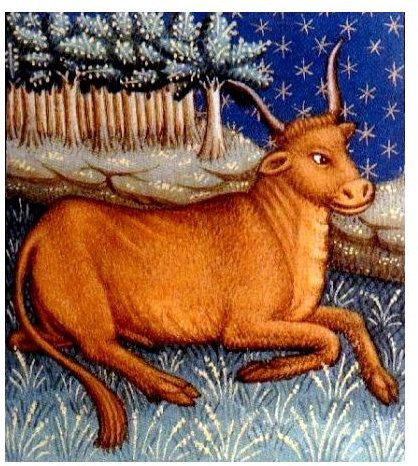
Left: The constellation Taurus represents a bull, a figure with ancient mythological significance. This illustration is taken from a 15th-century medieval astrology text. Source: https://commons.wikimedia.org/wiki/File:Taurus2.jpg
About The Taurus
1. Image of: A bull
2. Right ascension: 4 h
3. Declination: 15°
4. Quadrant: NQ1
5. Latitudes visible at: Between +90 degrees and -65 degrees
6. Time best visible: At 21:00 in January
7. Area of sky covered: 797 square degrees
8. Rank in constellation size: 17th
9. Stars: Alpha Tau (Aldebaran), Beta Tau (Alnath), Gamma Tau (Hyadum I), Delta Tau (Hyadum II), Epsilon Tau (Oculus Boreus), Eta Tau (Alcyone)
10. Other objects in the constellation: the Pleiades star cluster and the Crab Nebula
11. Brightest star: Aldebaran
12. Nearest star: 10 Tau, 44.7 light years away
13: Meteor showers: Taurids (late October - early November) and Beta Taurids (early June - mid July, a “daytime shower” peaking after sunrise)
14. Mythology: In Greek mythology, Taurus represents the white bull that sired the Minotaur with king Minos’ wife, Pasiphaë. The Minotaur was a monster with the head and tail of a bull and body of a man. It was kept in a labyrinth where it devoured Athenian youths given as sacrifice, until it was killed by Theseus.
15. Historical significance: The identification of the constellation Taurus with a bull may date back to prehistoric times. A cave painting at the Lascaux caves Hall of Bulls may be of the constellation Taurus.
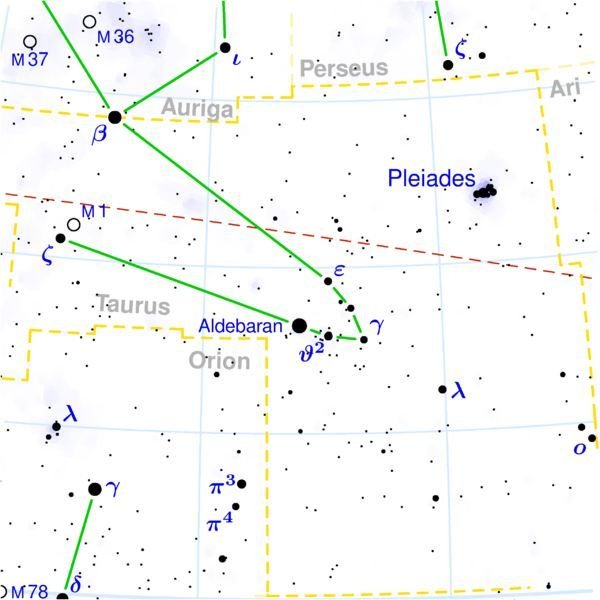
16. Symbolic significance: Aldebaran (Alpha Tau) represents the bull’s eye, while Beta Tau and Gamma Tau represent the tips of its horns.
17. Position in the Zodiac: Second.
18. Traits associated with Taurus in astrology: Stubborn, loyal, practical, strong.
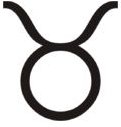
Above right, top: Zodiac symbol for Taurus.
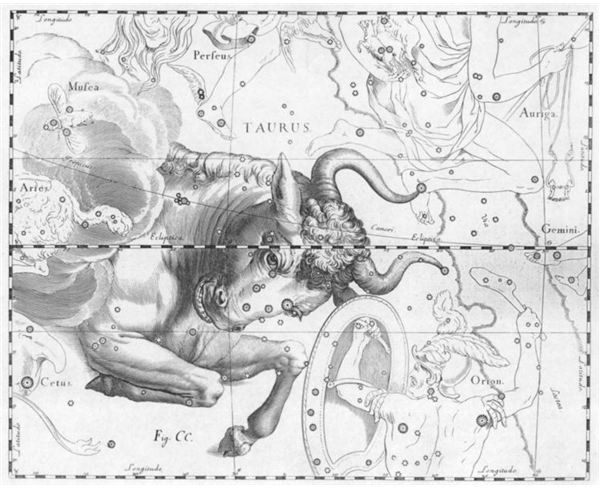
Above right, bottom: 17th-century illustration of Taurus by Johannes Hevelius
Below left: Map of the constellation Taurus by Torsten Bronger. Licensed under the GNU Free Documentation License. Source: https://commons.wikimedia.org/wiki/File:Taurus_constellation_map.png
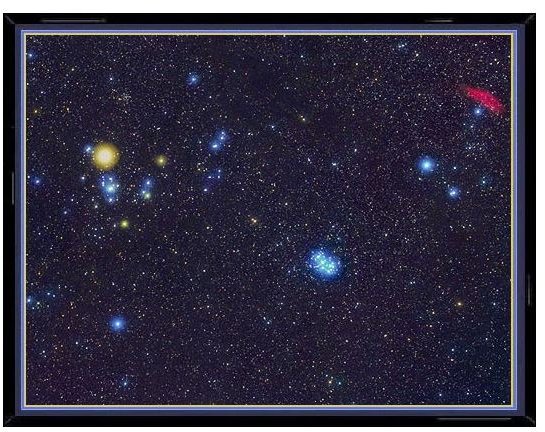
Below right: This photo of the constellation Taurus shows, enlarged in their true color, the main “naked eye” stars that make up the shape of the constellation. Image courtesy of https://www.scienceandart.com
Amazing Things to Learn About Taurus
Taurus in other cultures: The Chinese called this constellation the White Tiger of the West, one of the four great Chinese constellations. The Chinese also call it the Great Bridge. To the ancient Egyptians, it represented the god Osiris, the god of the dead and of the afterlife and father of Horus, the god of the living.
Not just singleton stars: Taurus contains two Messier objects, catalogued by the 18th-century French astronomer, Charles Messier. M1, also known as the Crab Nebula, appeared in the sky after a supernova in the year 1054 A.D. M45, the Pleiades or Seven Sisters, is an easily visible open cluster of seven stars. Taurus also contains the Hyades, a spherical cluster of 300 to 400 stars all of the same age, located behind Aldebaran, the bull’s eye. They form a V shape that represent’s the bull’s head in the constellation. Three of the stars in Taurus are known to have exoplanets.
