How Galaxies are Created: Required Hydrogen, Baryons, and Dark Matter to Form and Grow a Galaxy
What’s Necessary for a Galaxy to be Created?
After the Big Bang, the primordial soup that was created began to coalesce into three main ingredients:
• Hydrogen atoms
• Baryons—these are the heavy subatomic particles, protons, neutrons and others generally made up of three quarks (the basic building blocks of the subatomic world).
These ingredients were equally distributed throughout the universe. But shock waves from the Big Bang still coursed through the soup, and at about 300,000 years the shock waves began to cause the ingredients to clump together. As the clumps grew in size, their gravity pulled in more matter. Then their gravitational forces pulled them together and they formed ‘proto galaxies,’ although they contained no stars at this time. While this is the time frame we currently understand, recent discoveries by the Hubble Space Telescope indicate all this might have occurred as early as 100,000 years after the big bang.
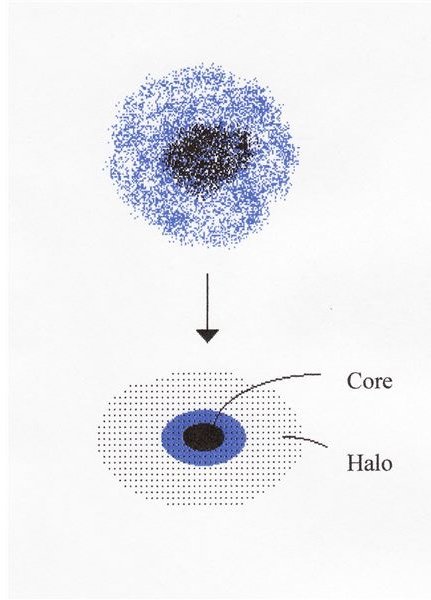
The dark matter separates from the hydrogen and forms a halo around the core. The baryons, being heavy particles, fall into the core. Here, they collide with the atoms of the gas and cause the core to heat up. The image below illustrates how the cloud of CDM, hydrogen and baryons coalesce to create the halo and core.
So far, the core consists of separate gas clouds rotating around each other. But as they heat up, the rotation slows, and eventually,
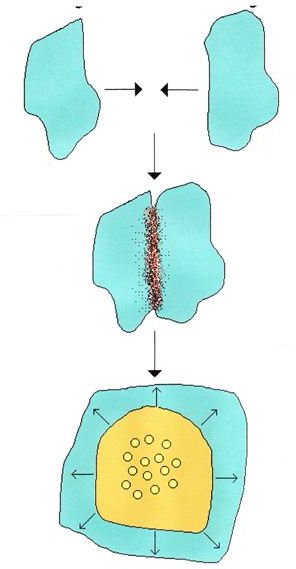
the clouds begin to bang into each other. They become so massive they collapse to become a black hole. The remaining gas begins to rapidly rotate around the bllack hole and more colllisions occur.The collisions create high density shock fronts that cause the gas to coalesce into proto stars. These then accrete more hydrogen and become young stars. The process is exactly the same as occurs today in star forming regions of our galaxy.
The illustration to the right shows the clouds encountering each other, creating the shock front, and forming a cluster of new stars.
Because the new stars formed in a relatively compact gas cloud, the heat from the new stellar residents pushes the remaining gas away, as shown in the illustration. The mutual gravitational attraction of the new residents pull them into orbits around each other, and the end result was a globular star cluster. Each gas cloud in the proto galaxy produced a globular cluster.
A galaxy was being born.
How Galaxies Grow
As the baby galaxies formed, gravity pulled many together. If two with black holes merged, the black holes may have merged and sucked stars into their nether regions, increasing their mass and making the stars around them spin more rapidly. It appears it is possible many baby galaxies with black holes could have merged into one. In such a case, some of the black holes would have merged, but others would have been thrown out into space.
From views from the Hubble Space Telescope of the very early universe, it appears that merging of the young galaxies was like a rush of lemmings to the sea. Some astronomers refer to the phenomenon as a ‘conveyor belt’ bringing young galaxies together.
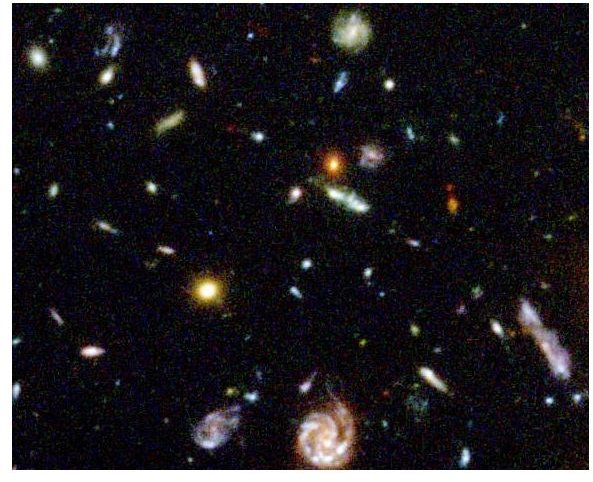
At the end of this formative process, which may have seen numerous mergers, the dark matter halo became more massive and bloated, and the normal matter quickly formed new stars. If the stars formed very quickly, and used all the hydrogen available, the result was an elliptical galaxy.
If the star formation was slow, due to the gas molecules colliding with each other as they fall toward the core, then the conservation of angular momentum forms a disk, and a spiral galaxy is created.
In fact, the mergers continue even to the present day. Telescopes reveal galactic collisions throughout the universe. Our galaxy and our neighbor Andromeda are hurtling at each other at astronomical speed. In 10 gigayears, the two will collide, and perhaps create a single elliptical.
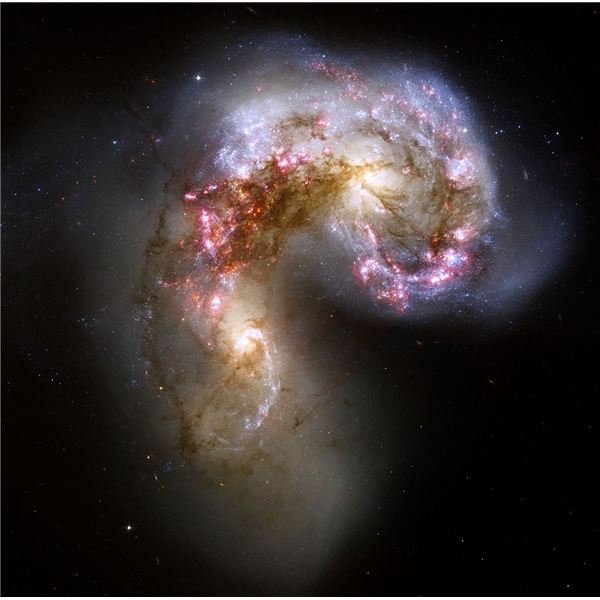
It appears that ellipticals developed the most massive black holes. Our Milky Way, for instance, has a relatively small black hole of only about 4 million solar masses. Ellipticals have black holes with masses of hundreds of million solar masses, or more. This may explain why star formation in ellipticals occurred so quickly. The stars near the black hole’s discontinuity were immediately swallowed up, so star formation in the outer regions proceeded quickly as the gas swirled around the black hole.
Once galaxies fully form, they evolve and cluster. We will discuss that next.
Credits
Proto Galaxy: University of Oregon
Early star formation: University of Oregon
Galactic conveyor belt: NASA Hubble Space Telescope
Colliding galaxies: NASA Hubble Space Telescope
This post is part of the series: All About Galaxies
Specific details about the formation, development, evolution, and death of galaxies. The types of galaxies, how they group together, form clusters and super clusters.
