History of the Saturn V Rocket: The Original Moon Rocket
History of the Saturn V Booster Rocket
The Apollo program and the Saturn V booster that made it possible will forever be inseparable; the Saturn V stands as one of the engineering marvels of the 20th century. Though the approach it took may be straightforward, the technologies that needed to be perfected in order to turn concept into reality were far from simple. In large part, the development of the Saturn V, and, indeed, the entire US space effort during the push to the moon, was the work of German scientists from the Nazis’ Peenemunde rocket facility, most notably Wernher von Braun, the technical director of the facility who later in the war surrendered to the Allies and eventually became head of NASA’s Marshall Space Flight Center.
3-Stage Configuration for Launching Heavy Payloads
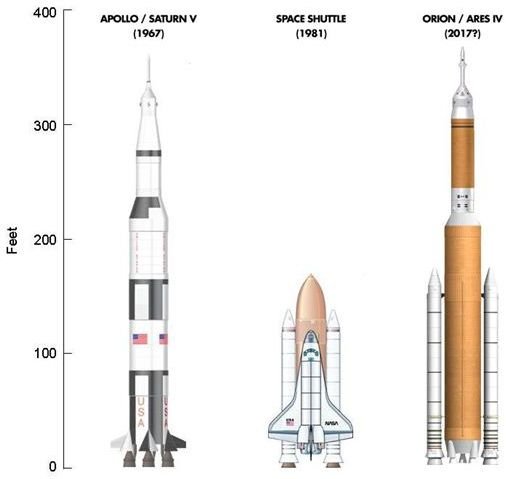
The assembled booster stands some 26 stories tall and masses 6.7 million pounds in launch configuration. To achieve the performance required, it employed a staged configuration; this allows jettison of dead weight, thus increasing performance. Three stages were used- you will see them referred to as the Saturn IC, II, and IVB. The first stage relied on 5 F-1 rocket engines, while the second and third stages used five and a single J-2, respectively. The F-1 relied on kerosene fuel (RP-1) and generated about five times the thrust of one of the SSMEs [Space Shuttle Main Engines] - 1.5 million lbs. The J-2 used liquid hydrogen as a fuel (a major development in technological terms, since all previous manned boosters employed RP-1) and produced ~200,000 lbs. of thrust. Combined, all three stages could manage to place 130 tons into low Earth orbit (LEO) or 50 into lunar orbit (in comparison, the Shuttle can ferry 26 tons into LEO). While the rocket was the largest we’ve built to date and sported over seven and a half million pounds of thrust at launch, this only gave it a thrust-to-weight ratio of 1.14:1 at launch. Put into perspective, this equates to an acceleration on the order of four feet per second!
Larger variants were envisioned in order to reach Mars and uprated versions of the rocket engines were on the drawing boards, but these died at the end of the Apollo program. Now, thirty-six years after its final flight, the J-2 is being used as the basis of a new push to the Moon; one has to wonder where we would be now, had that push continued as Von Braun so fervently wanted.
Credits
Saturn V- Shuttle- Ares V comparison courtesy of NASA
