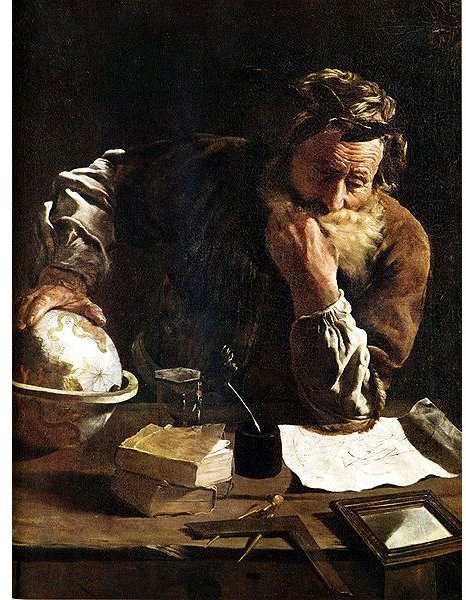
The Archimedes Palimpsest Project is using modern technology to read the Ancient Greek science of Archimedes himself. The US Department of Energy’s Stanford Linear Accelerator Center is working with X-ray vision and other imaging technology to decipher ancient text on papyrus.
Archimedes - A Great Ancient Greek Scientist
More than a thousand years ago, Archimedes was the greatest mathematician in the world. His brilliant concepts were written down for posterity and the education of generations to come. Unfortunately, his work was not copied in sufficient quantity and was lost over the past millennium. Now, with the modern technology of X-ray vision, compliments of the US Department of Energy’s Stanford Linear Accelerator Center (SLAC), scientists are able to read the last pages of documents that have been considered lost. We can now read, in Archimedes own words, all the calculations he made and the conclusions he drew back in ancient times. Modern technology has come to the rescue of history!
The Archimedes Palimpsest Project
The requirements for making the project work were, data and image collection, data and image processing, data validation and storage, information access and academic analysis and study. It’s called the Archimedes Palimpsest Project, and Michael B. Toth is the manager.
The new imaging technology is capable of capturing and enhancing even faded images on old parchment. Documents of scientific and historic value can now be viewed and used as reference material by scientists, educators and historians.
Palimpsest is defined as one manuscript being written over another. This applies to everything from old texts to maps. The term means literally “scraped again” (Greek). The original text was washed off so that new writings could go on it. This started when Muslim caliph Umar I cut off the supply of Egyptian papyrus and the scribes of the day needed to record what they considered more important than what was on the originals. They erased writings from Homer, Euclid and even part of the Gospel of St. Luke.
The Department of Energy’s Stanford Linear Accelerator Center (SLAC) has now made it possible to retrieve all the lost writings of the great thinkers of old. There is a wealth of scientific knowledge to be garnered from the old words that will now be available to us again.
References
The Archimedes Palimpsest Project: https://www.archimedespalimpsest.org/programmanage1.html
Image Source
Archimedes Thoughtful. (Supplied by Domenico Fetti at Wikimedia Commons; Public Domain; https://en.wikipedia.org/wiki/File:Domenico-Fetti _Archimedes_1620.jpg)