Atmospheric Re-entry for Spacecraft - Advanced Concepts
Introduction
Since humans first began to travel into space, returning safely to the Earth has been both a concern and a challenge; despite the intervening years and the definite strides we have made in re-entry materials, avionics, and other areas, the basic principles practiced have remained the same. All space vehicles have returned on an un-powered re-entry profile; all utilize either ballistic or aerodynamic principles during their return; and all have had either ablative or reusable thermal protection systems to protect their human and non-human cargoes. While it may yet be years before we see any appreciable change in space vehicle design, there are technologies on the horizon that could significantly alter this technological détente.
The Current State-of-the-Art
Ballistic re-entry vehicles consign their fate to gravity, but vehicles such as the Shuttle can manage their re-entry profiles to trade off velocity, altitude, descent rate, and heating rate. Even though they are far more flexible than their capsule cousins, like gliders, they are still limited by the amount of energy they started with; the Shuttle decelerates as much as possible in the upper atmosphere where the density is lowest, but too much deceleration would leave it with insufficient lift to reach its destination. If it were possible to use engines during re-entry, it would be possible to lengthen this high-altitude deceleration without stalling the vehicle. One of the main reasons for not doing this is that a lighter vehicle can carry more fuel (and payload), allowing it to achieve a higher velocity, and thus a higher orbit. Yet another is that a heavier re-entry vehicle descends faster (unless compensated for by some means), thus negating some of the advantage of a powered re-entry. Granted, having thrust helps, but the additional mass of the required fuel can definitely be a handicap.
Powered Re-Entry?
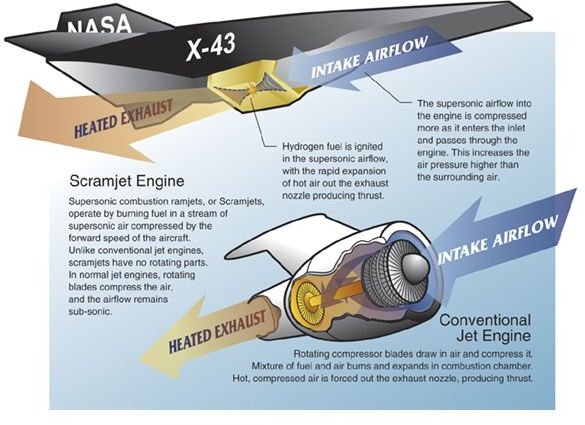
A powered re-entry requires a specific propulsion system, as well. Rockets perform well in low-oxygen environments, but they suffer from a need for an oxidizer as well as propellant. Air-breathing engines can operate at much higher specific impulses but require a minimum density of air to operate. Since the density of air is altitude-dependent, the engines might not work (or might be extremely inefficient) at the desired deceleration altitude. Further, combustion can occur in supersonic air, but it is quite a lot more difficult to establish and sustain, as is evidenced by NASA’s multi-decadal research into supersonic combustion ramjets (SCRAMJETs). Even if supersonic combustion is used, very high flow velocities (in excess of Mach 15) would likely cause a problem in terms of the temperatures the engine would experience. Enter a magnetohydrodynamic (MHD) generator, a device that exploits the right-hand-rule to recover energy from an ionized “fluid”. This device could be used to slow down the incoming air while simultaneously generating power in the process, power that could at least theoretically be used to reduce aerodynamic drag on the vehicle via advanced techniques such as plasma-based drag reduction, MHD/EHD (electrohydrodynamic) flow control, or energy deposition (adding energy to an airstream in order to reduce its density/drag). By definition, techniques that reduce drag will reduce aerodynamic heating, which makes the job of the thermal protection system easier.
(Re-entry profiles and fuel are addressed in part 2.)
Credits
X-43 image courtesy of NASA Dryden Flight Research Center
This post is part of the series: Atmospheric Re-Entry: Advanced Concepts
Re-entering the earth’s atmosphere has been done either ballistically, like the Apollo capsules or under more controlled, glided flight like the Space Shuttle. There is cutting-edge technology that may provide some alternatives to these tried and true methods.
