How Were Galaxies Discovered? Beyond the Milky Way
Detective Story
The astronomical community was certain the Milky Way was “the universe” when the 20 century began. They knew there were ghostly, amorphous objects they could see through telescopes—they called them nebulae. They were thought to be bright gas clouds similar to those in the Orion nebula, and definitely within the Milky Way. They had even been cataloged by the French astronomer Charles Messier in the 18 century, and were called Messier objects. Messier gave them numbers—he cataloged 103 objects—and these numbers are still used today. For example, what was then the great nebula in Andromeda was, and is M31.
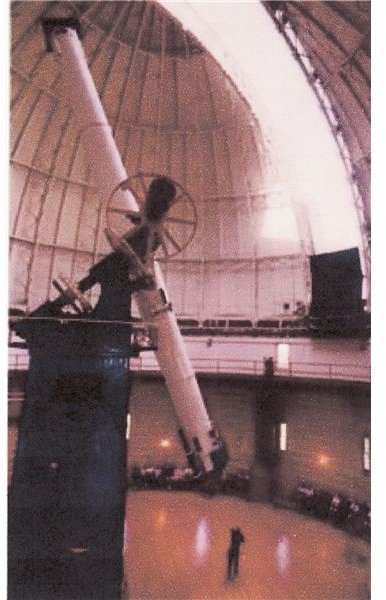
As the 19 century came to a close, the largest viable telescope available was the 1.02 meter (40 inch) refractor at the University of Chicago’s Yerkes observatory. Due to its extremely long focal length, it was not suited for truly deep sky observation. Mirror grinding technology had not developed sufficiently for a viable large reflector to be produced—until an amateur in Yorkshire, England persevered and produced a 36-inch silvered glass mirror. Andrew Common sold his telescope to professional astronomer Edward Crossley, who donated it to the Lick observatory in California after his retirement, because he knew its tremendous light gathering power could only be fully utilized on a mountain top.
He was right.

The Lick built an observatory housing for the instrument, and astronomer James E Keeler began a series of nebular photographs. He found the nebulae had spiral structures, and could not be within the Milky Way.
In 1908, Edward Fath used the Lick reflector to collect spectral data on the nebulae, and determined none had continuous spectra. The only conclusion—they had to be clusters of individual stars, and very far away.
Just a few years later, in 1912 and 1913, Herbert Curtis made more extensive observations with the Lick reflector, and concluded the “island universes” as he called them, were far more distant than originally thought.
Going to the MountainTop
The success of the Lick reflector sealed the fate of refracting telescopes forever. The superior light gathering power of reflectors were known, now astronomers just needed larger mirrors.
George Hale had an idea.
Hale had been director of the Yerkes observatory, but he now saw that the future of astronomy lay with large reflectors. He had a 60-inch mirror produced in France, and chose 5700-foot Mt. Wilson overlooking Los Angeles as the site of the new observatory (LA in early 1900s was smog free). His 60-inch was actually in operation by 1908, at the time the Lick instrument was still making major discoveries.
Harlow Shapley was the chief astronomer at Mt. Wilson when the 60-inch went into service. He used it to find bright variable stars called Cepheid variables (after the star Delta Cephei). With them, astronomers can determine the distance to extremely distant objects. Because their exact period of variation is known, their apparent luminosity at their brightest and dimmest can be measured. Then there is a direct correlation between this ratio and their distance. Shapley used them to determine the size of the Milky Way. He came up with a figure of 300,000 light years (ly). That has since been proven far in excess.
Still, George Hale wasn’t done. He wanted an even larger reflector. He persuaded the Carnegie Institution to donate money to build the world’s largest telescope—a 100-inch reflector. This massive instrument was ready for use in 1919, and a young new astronomer was ready to make use of it.
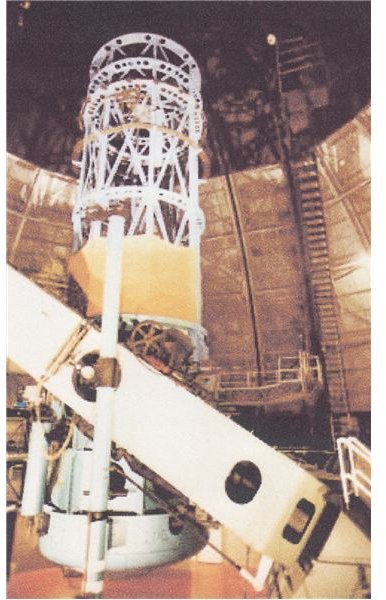
Edwin Hubble would turn our concepts of the cosmos upside down.
The Hubble Legacy
Edwin Hubble and Harlow Shapley immediately butted heads when Hubble began his work with the 100-inch. Hubble had studied Fath’s and Curtis’ work, and was convinced they were correct in their assessment of the nature of the “island universes.” Shapley, on the other hand stood stoically with the traditional view that the Milky Way was “the universe” and all the nebulae, while perhaps huge star clusters, resided within it.
Edwin Hubble was not to be swayed, however, and he was convinced he knew how to prove Fath’s and Curtis’ theories. One of the first objects he turned the giant 100-inch on was M31—the great nebulae in Andromeda. The big telescope easily resolved the “ghostly cloud” into its collection of stars. But that didn’t prove it was not within the Milky Way. To do that, Hubble had to measure the distance to M31.
Shapley himself had paved the way for Hubble to do that.
Hubble searched for Cepheid variables in Andromeda, and found one. With that, he could measure its distance. His figure was one million lys. We now know that’s less than half the actual distance. Both Hubble’s and Shapley’s measurements were off because they did not know at the time the light they were measuring was being filtered and dimmed by dust and gas clouds in the Milky Way. Still, it was clear the “nebulae” was far outside the Milky Way. It was, without question, a separate collection of stars in itself.
With that evidence, Hubble turned the 100-inch on other Messier objects. They, too, were separate collections of stars, each further away than Andromeda.
The universe had suddenly become much larger.
As the evidence compounded, even Shapley had to grudgingly accept it. In the end, he coined the term “galaxy” for the giant collection of stars previously called nebula. But Hubble, still chaffing from Shapley’s long resistance to his theories about the universe, refused to use the word, and continued to call them nebulae.
Hubble noticed something else as he continued to look at galaxies further away. The further away they were, the redder their light was. It was known as red shift. Just as a train whistle seems to sound lower as it moves away from you, light seems to shift lower in frequency—towards red—when an object is moving away. The faster the object is moving, the greater the shift towards the red. That could mean only one thing—the galaxies were moving away from us, and the further away they were, the faster they were moving.
And that could mean just one thing. The universe was expanding.
But expanding from what?
It would take other astrophysicists to unravel this puzzle. Using Hubble’s data, Georges Lematres posited that the universe began from a tiny “atom” that exploded outward. Hubble agreed. Years later, Fred Hoyle, a well respected astrophysicist who totally rejected this theory, sarcasticly called it the Big Bang theory. His term stuck.
It would take another generation of astrophysicists to prove Lematres and Hubble right on this, but today they have, and the Big Bang is the basis of any and all theories on the origin of the universe.

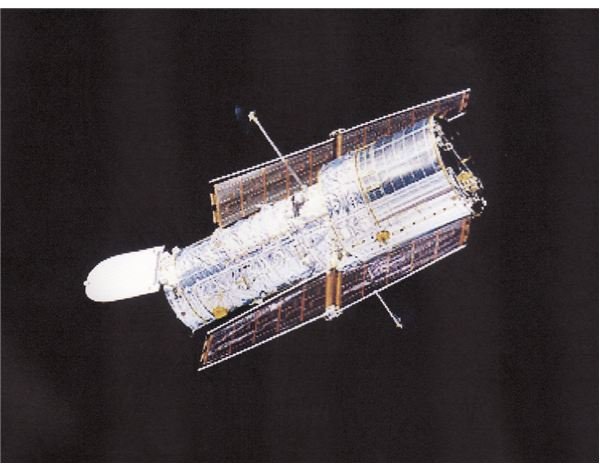
Edwin Hubble discovered galaxies, and his legacy continues today, 220 miles above the Earth, with his namesake, the Hubble Space Telescope. It, like the man throughout his lifetime, continues to make discoveries that change the face of astronomy.
Credits
Yerkes refractor: Yerkes observatory, https://astro.uchicago.edu/vtour/40inch/40inchtour.jpg
36-inch observatory building: Lick observatory, https://www.nps.gov/history/history/online_books/butowsky5/astro4c.htm
100-inch telescope: https://www.mtwilson.edu/vis/
Edwin Hubble: Mt. Wilson Institute
Hubble Space Telescope: Hubble Site, https://hubblesite.org/gallery/spacecraft/
This post is part of the series: All About Galaxies
Specific details about the formation, development, evolution, and death of galaxies. The types of galaxies, how they group together, form clusters and super clusters.
