Nothing But the Facts About the Constellation Cancer, One of the Constellations of the Zodiac
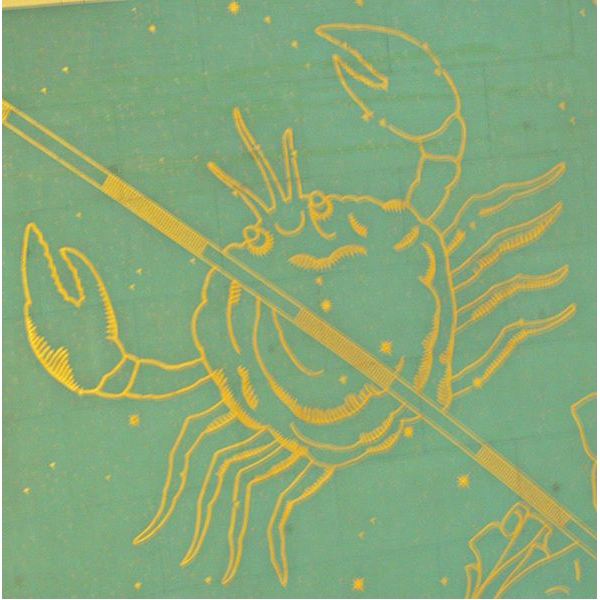
Left: A mythological image of Cancer the crab. (Image credit: David Shankbone at Wikimedia Commons under a GNU Free Documentation license, https://commons.wikimedia.org/wiki/Image:Cancer_Crab_Grand_Central_by_David_Shankbone.jpg)
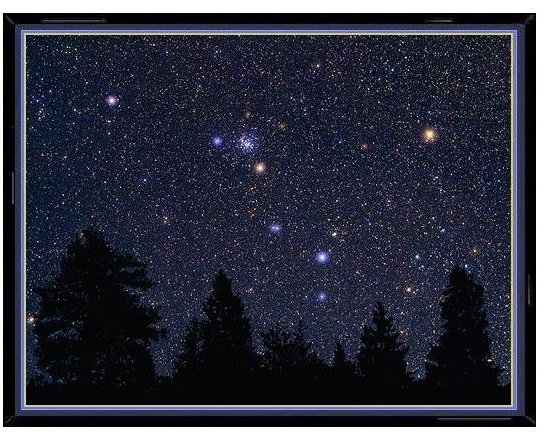
Below right: This photo of the constellation Cancer shows, enlarged in their true color, the main “naked eye” stars that make up the shape of the constellation. (Image courtesy of https://www.scienceandart.com)
The Facts
1. Image of: A crab

2. Right ascension: 8 h 38.96 m
3. Declination: +19 degrees 48.35 m
4. Quadrant: NQ2
5. Latitudes visible at: Between +90 degrees and -60 degrees
6. Time best visible: At 21:00 in March
7. Area of sky covered: 505.872 square degrees
8. Rank in constellation size: 31st
9. Stars: Alpha Cancri (Acubens), Beta Cancri (al-Tarf), Gamma Cancri (Asellus Borealis), Delta Cancri (Asellus Australis), Zeta Cancri (Tegmine), Lambda Cancri (Kwan Kei) and Xi Cancri (Nahn)
10. Other objects in the constellation: M44 (also known as Epsilon Cancri, NGC 2632, Praesepe or the Beehive Cluster) and M67 (NGC 2682)
11. Brightest star: Beta Cancri (al-Tarf, with an apparent magnitude of 3.50)
12. Nearest star: DX Cancri, about 11.82 light-years away
13: Meteor showers: Delta Cancrids (Dec. 14 to Feb. 14, with a peak of four meteors per hour on Jan. 17)
14. Mythology: In Greek mythology, the crab appeared while Heracles (Greek for Hercules) was battling the many-headed Hydra. Heracles crushed the crab after it bit him on the foot. The goddess Hera, no fan of Heracles, immortalized the crab by putting it up among the stars.
15. Historical significance: Long ago, Cancer might have been associated with the Akkadian (Mesopotamian) Sun of the South, as it once occupied the winter solstice. As its position moved through the sky, it later became known as the Northern Gate of the Sun.
16. Symbolic significance: The star Alpha Cancri has the Arabic name Acubens (for “the claw”).
17. Position in the Zodiac: Fourth.
18. Traits associated with Cancer in astrology: tenaciousness, indecisiveness, imaginativeness, moodiness
Above right: The symbol for Cancer (Image credit: Tlusta at Wikimedia Commons, https://en.wikipedia.org/wiki/Image:Cancer.svg, public domain.)
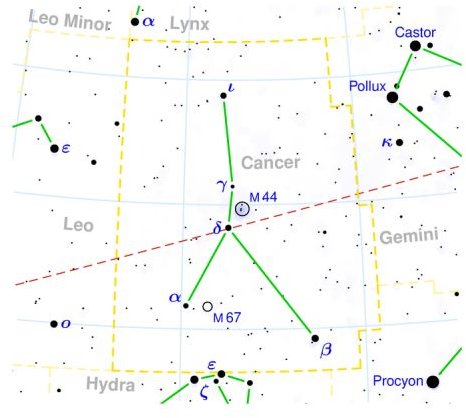
Below: A constellation map of Cancer (Image credit: Torsten Bronger at Wikimedia Commons, https://commons.wikimedia.org/wiki/Image:Cancer_constellation_map.png, GNU Free Documentation license.)
Other Cool Facts
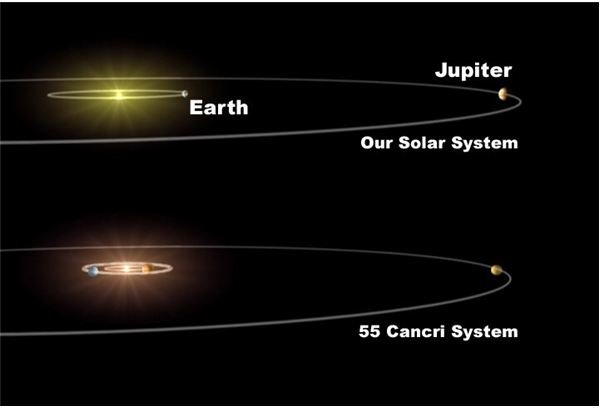
A solar system sibling. The star Rho Cancri, also known as 55 Cancri, is a binary star system with five confirmed planets. They include 55 Cancri e, a terrestrial, “super-Earth” planet with a mass similar to Neptune’s that orbits the star once every 2.817 days; 55 Cancri b, which resembles Jupiter; 55 Cancri c, which has a mass similar to Saturn’s; 55 Cancri f; and 55 Cancri d.
Multiple personalities. While we know Cancer as the crab, the constellation has had other identities in the past, including a water beetle, crayfish, lobster and possibly even a scarab and tortoise.
A few stragglers. With an estimated age of about 4 billion years, the open cluster M67 is one of the oldest in our galaxy. It’s a frequent target for scientists seeking to study stellar evolution because most of its stars are all the same age, with the exception of about 30 stars known as “blue stragglers” because they’re bluer and hotter than their neighbors.
Above right: The planetary system of 55 Cancri (bottom) compared to the solar system (top). (Image credit: https://origins.jpl.nasa.gov/library/extrasolar/images/061302-a-01.jpg)
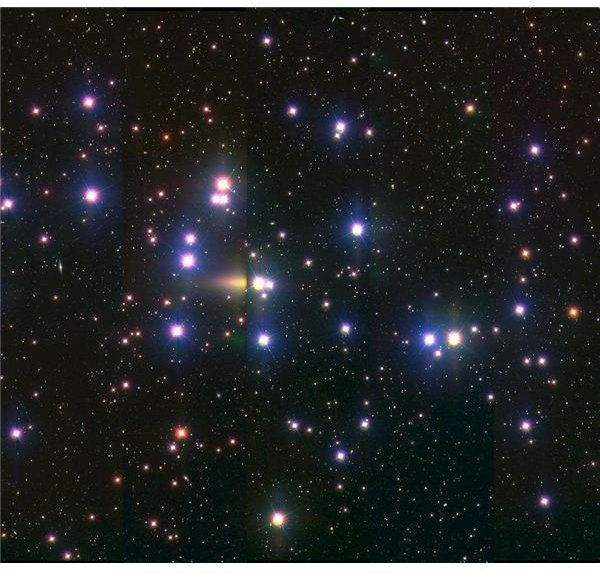
Below: The Beehive Cluster in the constellation Cancer. (Image credit Sloan Digital Sky Survey, https://www.sdss.org/iotw/beehive.jpg)
Read a review of all the constellations of the zodiac.
