Facts on the Aries Constellation: The Brightest Star of Aries, Size, Visibility, Mythology, and Astrology
_
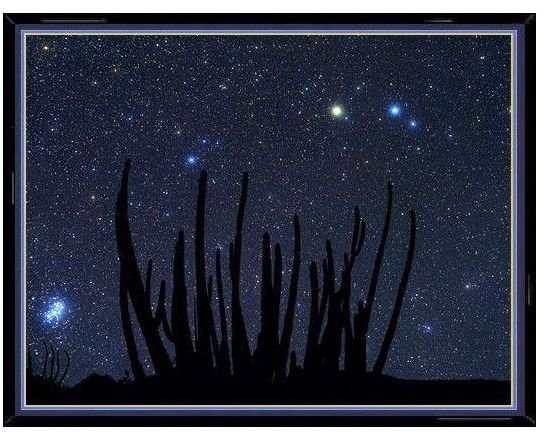
Right: This photo of the constellation Aries shows, enlarged in their true color, the main “naked eye” stars that make up the shape of the constellation. (Image courtesy of https://www.scienceandart.com)
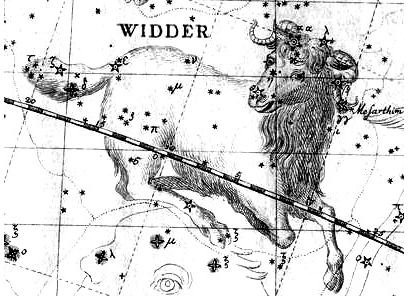
Below: An old German illustration of the constellation Aries. (Image credit: Wikimedia Commons, https://commons.wikimedia.org/wiki/Image:Ari_bode_edited.jpg, Public domain)
The Facts
1. Image of: A jumping or running ram
2. Right ascension: 2 h 38.16 m
3. Declination: +20 degrees 47.54 m
4. Quadrant: NQ1
5. Latitudes visible at: Between +90 degrees and -60 degrees
6. Time best visible: At 21:00 in December
7. Area of sky covered: 441.395 square degrees
8. Rank in constellation size: 39th
9. Stars: Alpha Arietis, Lambda Arietis, Beta Arietis, Eta Arietis, Epsilon Arietis, 41 Arietis, 35 Arietis, 39 Arietis, Gamma Arietis and Delta Arietis (Alpha, Lambda and Beta comprise the ram’s head; Alpha, Eta, Epsilon, 41 and 35 comprise the body; 35, 41 and 39 comprise the tail; Gamma represents the front foot; Delta represents the back foot)
10. Other objects in Aries: The galaxies NGC 697, NGC 772, NGC 972 and NGC 1156
11. Brightest star: Alpha Arietis, also known as Hamal or El Nath, with an apparent magnitude of 2.0.
12. Nearest star: Teegarden’s star (SO025300.5+165258), about 12.6 ± 0.2 light-years away
13: Meteor showers: May Arietids, Autumn Arietids, Delta Arietids, Epsilon Arietids, Daytime-Arietids, Aries-Triangulids
14. Mythology: In Greek mythology, Aries was a flying ram that saved the brother and sister Phrixus and Helle from being sacrificed to stave off famine (it was a setup by their stepmother, who hated the two). Helle fell off during the flight and drowned, but Phrixus made it to safety. Phrixus then sacrificed the ram to show his gratitude … to Zeus, rather than to the ram. The sacrificed ram’s fleece might also have been the golden fleece sought by Jason and the Argonauts.
15. Historical significance: Aries was once the constellation through which the sun passed at vernal equinox. While the vernal equinox has since moved into the constellation Pisces, it’s still sometimes called the “First Point of Aries.”
16. Symbolic significance: In ancient Greek culture, the horn (such as the one on a ram) was a symbol for fertility or renewal, which Aries once ushered in during the vernal equinox.
17. Position in the Zodiac: First.
18. Traits associated with Aries in astrology: Confidence, stubbornness, generosity, impulsiveness
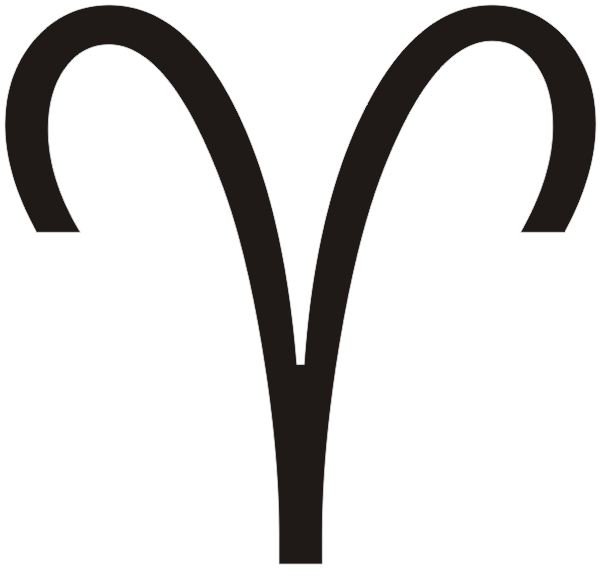
Above right: The symbol for Aries (Image credit: SeLarin at Wikimedia Commons under a GNU Free Documentation license)
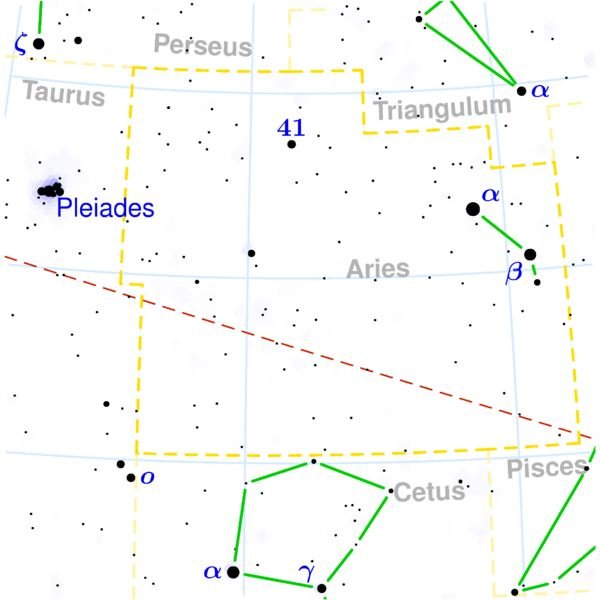
Below: A constellation map of Aries (Image credit: Torsten Bronger at Wikimedia Commons under a GNU Free Documentation license.) [Here is a link to a night sky photograph of the constellation.]
More Fascinating Facts About Aries
1. Aries includes a new, near neighbor. Aries includes Teegarden’s star, discovered in 2003 by a team led by astrophysicist Bonnard Teegarden. At a distance of about 12 light-years away, Teegarden’s star is one of the sun’s closest neighbors.
2. Three stars in one. The star in Aries known as Gamma Arietis, or Mesarthim, is actually three stars: a binary star system orbited by a third star, all about 204 light-years away. Gamma Arietis was one of the first double-star systems ever discovered, first identified as such by the English scientist Robert Hooke in 1664.
3. A ram to many. While past cultures might have had different names for other constellations, many agreed that Aries was the ram, including the Babylonians, Egyptians, Persians and Greeks.
4. Home to a planetary system. HD 20367, a star at the edge of Aries, is a class G dwarf star with an orbiting planet. Slightly larger than Jupiter, the planet completes a circuit around HD 20367 once every 500 days at an average distance of about 117 million miles or 187 million kilometers (a distance about 25 percent greater than Earth’s distance from the sun).
To read more about other constellations of the zodiac follow this link.
