History of the Kepler Space Mission: A Giant Leap in Extraterrestrial Planet Detection

Space: Endless Possibilities
For many years the curiosity of exploring different planets with Earth-like characteristics has intrigued many scientists and astronomers. Every new discovery of a planet or star far beyond our own solar system has raised some baffling questions such as:
Are there other plants, orbiting other stars having characteristics similar to Earth?
Or,
Is Earth the only habitable planet in the universe?
Or,
Are there any chances of an extraterrestrial contact?
The third possibility may be a far-fetched one, but for the first two, scientists are confident in finding a concrete answer. Well, NASA has always been in the forefront to discover new and interesting facts about the solar system, the Milky Way and far-off galaxies. With the Kepler Mission, it will certainly shed light on extra-terrestrial planets or Earth-size planets that orbit around stars like our sun.
Artist’s Impressions of the Kepler Mission
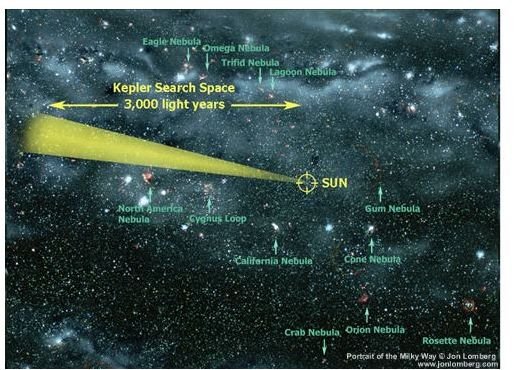
History of the Kepler Mission:
The Kepler Mission spacecraft, named after Johannes Kepler, who is known for his laws of planetary motion, was launched on March 7 2009, from the Cape Canaveral Air force Station. Being NASA’s tenth Discovery mission, it is designed to explore the structure and diversity of planetary systems in our galaxy and will emphasize more the detection of Earth-size planets. For four years it will monitor 100,000 stars similar to our sun and if it detects any planets, which can be determined to be in a habitable zone about the star, the possibility of life in the universe cannot be negated. But if the results are inconclusive, it may mean we are alone in the galaxy.
What Are the Objectives of the Mission?
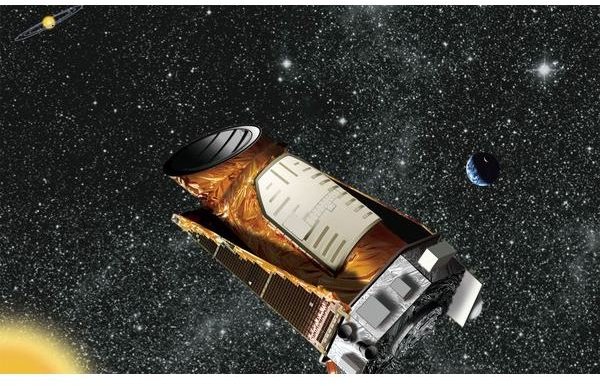
The scientific objective of the mission is to explore the planetary systems, their structures and range. The main focus will be to detect and characterize Earth-size planets by surveying beyond our solar system. The survey will help to detect hundreds of large and terrestrial planets in or near the “habitable zone” of a star. The “habitable zone” is defined by NASA scientists as “the distance from a star where liquid water can exist on a planet’s surface”.
Important Objectives of the Kepler Mission
The following are the six important objectives or goals explained in brief (Courtesy: NASA’s Kepler Mission Website). The Kepler Mission will try to determine:
1. The frequency of large and earth-type planets near the habitable zone of various stars
2. The approximate orbital distribution of the planets as well as the number of planets in the multiple-stellar system
3. The range of orbit size, mass, brightness and density of short-period extrasolar giant planets
4. The properties of those stars that shelter planetary systems. Properties that are to be determined include the luminosity class, spectral type, the rate at which the star rotates, surface brightness and stellar activity.
5. The distribution of shapes and sizes of orbits of terrestrial and large planets
The Kepler Spacecraft and Photometer
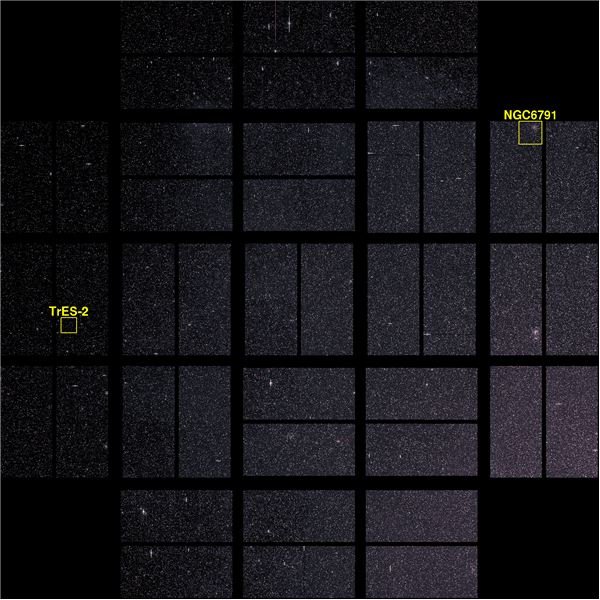
The estimated mass of the spacecraft is 1,039 kilograms (about 2,290 lb). The photometer mounted on the spacecraft is a device that measures the brightness of light. It has a 0.95-meter aperture and a 105 square degrees (about a 12 degree diameter) FOV (field-of-view). With a 37-inch (95 cm) diameter lens, the photometer will function like a giant camcorder and measure the brightness of 100,000 stars continuously and simultaneously. With the help of sensors, the photometer will record the “transit” of planets across the faces of the star (A “transit” occurs when a planet moves in front of a star and the star gets dimmer for hours, indicating that a planet has passed by). This will provide the raw data, which will help scientists to determine the planet’s size and the orbital period.
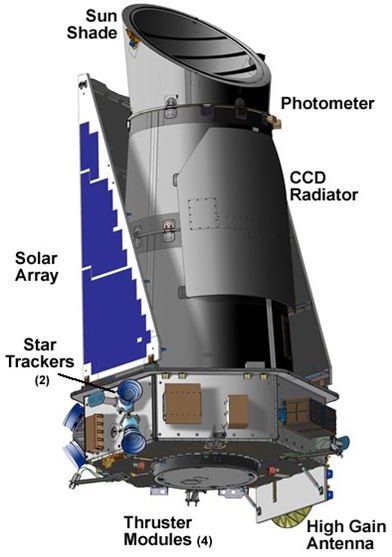
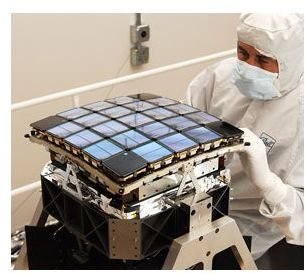
The photometer is made up of just one “instrument”. This “instrument” is actually an array of 42 Charge Coupled Devices (CCDs), each measuring 50x25 mm. Each CCD has 2200x1024 pixels. CCDs are not only used to take pictures but also are deliberately defocused to 10 arc seconds to improve the photometric precision.
Our past experience says that planets much smaller than Jupiter cannot be detected. But the need to conduct a search for small or terrestrial planets is considered important to detect Earth-like or habitable planets. The Kepler mission is designed to detect such planets and may be it will prove that we are not alone in this universe. Keep your fingers crossed!
Kepler Mission Update: New Exoplanets Discovered
On August 6, 2009, it was revealed that Kepler has confirmed exoplanet HAT-P-7b’s existence. This earth-like planet was discovered very close to the yellow white dwarf star GSC 03547-01402. The size of the exoplanet is larger than Jupiter and is within the FOV (field of view) of the Kepler spacecraft. The confirmation by the Kepler spacecraft also revealed that the planet may have a retrograde orbit.
New exoplanets detected by the Kepler spacecraft on January 4, 2010 include:
Kepler-4b: In constellation Draco, larger than Neptune. With an orbital period of 3.2 days, it is the smallest exoplanet discovered in the constellation Draco by the Kepler Spacecraft.
Kepler-5b: In constellation Cygnus, larger than Jupiter. Orbital period of 3.5 days
Kepler-6b: In constellation Cygnus, the exoplanet is larger than Jupiter. Orbital period 3.2 days
Kepler-7b: The first exoplanet discovered by the Kepler Mission spacecraft. It has an orbital period of 4.8 days.
Kepler-8b: the hottest exoplanet discovered by the Kepler spacecraft
References
https://kepler.nasa.gov/about/
https://kepler.nasa.gov/sci/design/spacecraft.html
https://discovery.nasa.gov/kepler.html
https://en.wikipedia.org/wiki/Kepler_Mission
https://kepler.nasa.gov/Mission/QuickGuide/
https://kepler.nasa.gov/Mission/discoveries/
Image references:
All Images, courtesy Kepler Nasa (https://kepler.nasa.gov/multimedia/Images)
This post is part of the series: Kepler Mission - The Search for Habitable Planets and New Discoveries
This series presents the history of the Kepler mission and discusses the latest information released from the Kepler mission team.
