Not content with polluting the Earth and its atmosphere we are now cluttering up space with dead, useless satellites and other assorted space junk. In our quest for self-gratification our ability to pollute knows no bounds.
What Goes Up…
I spent most of September 23rd waiting for a bus. No ordinary bus, you understand. This one was special. It was apparently going to fall out of the sky. Even in these days of congested highways such a detour seemed a little drastic, but it must be true because it was on the breakfast news. I wish I could say that I waited all day and then three came along at once but, in fact, the bus never materialized.
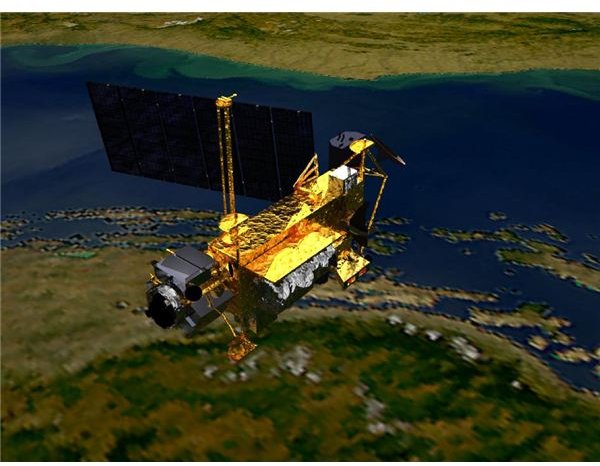
When I got back home I turned on the news only to discover that I’d picked up on the back-end of a story. It wasn’t a bus at all, it was a satellite the size of a bus. That made a lot more sense. And, the good news is, it was not going to land in my back garden. The latest prediction was that it was likely to come down on some South Pacific islanders. Phew! That’s lucky! But how much of a threat is space junk?
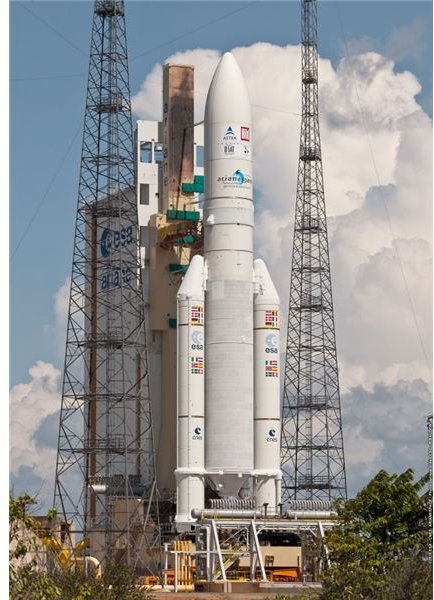
Satellites, rockets and bits of spacecraft fall to Earth all the time. Mostly they come to a spectacular fiery end high in the atmosphere and are a thrill to watch, should you be lucky enough to see one. Every now and then, however, a huge satellite decides to come home and some of it makes it all the way. Last September it was, somewhat ironically, the turn of UARS, NASA’s Upper Atmospheric Research Satellite, which eventually made a harmless splashdown near the islands of Samoa. Back in 1978, Canada was not so lucky. On January 28th the Soviet RORSAT satellite crashed near Great Slave Lake scattering radioactive material over 124,000 square kilometers – an areas about the size of the state of Mississippi. The bulk of it was never recovered, nor was most of the $15 million clean up bill: the Soviets reimbursed Canada less than half the amount. Other notable falls have included parts of NASA’s 85 ton Skylab landing in Western Australia in 1979, a spent fuel tank from a Russian Zenit 3 rocket ending up in Colorado last March, the nose cone of an Ariane 5 rocket found washed up on the beach at Corpus Christi, Texas in 2000 and fragments of the 40 ton Salyut 7 space station scattered over the town of Capitan Bermudez in Argentina.
And then there was Lottie Williams of Tulsa, Oklahoma. Lottie was walking with friends early one morning in January 1977 when she felt a tap on the shoulder. It wasn’t one of her friends but a fragment of a Delta II rocket launched the previous year, according to a report by CORD, the Center for Orbital and Re-entry Debris Studies. Fortunately, it did no harm to Lottie.
Strange as it may seem, satellites crashing to Earth are the least of our worries. Nowadays about 200 bits of spacecraft bigger than a basketball re-enter the atmosphere each year, well down on 1989 when the figure peaked at more than 1,000. Better spacecraft design and management, including a greater use of “graveyard” orbits high above the Earth have resulted in fewer objects plunging into the atmosphere. But it is the stuff that’s left up there that is causing headaches for the space agencies.
Dangers in Orbit
Satellites decay. They expand and contract as they move in and out of the Earth’s shadow, loosening nuts and bolts which sometimes come adrift. They are continuously bombarded by natural debris – interplanetary dust particles released from comets and collisions between asteroids – which chip away at the paintwork and tear holes in the fabric of unprotected areas. And, they spin out of control, sometimes colliding with other satellites. There are thousands of satellites in orbit around the Earth and 95% are now dead. Couple this with around 600,000 fragments including nozzle slag from launch vehicles, bits of exhaust cones and motor liners and you suddenly come to realize that the space just above the atmosphere is becoming very crowded. Some would say dangerously so.
We all remember the horror of the Challenger space shuttle disaster in 1986, but just three years earlier, in June 1983, one of its windows had to be replaced after it was badly chipped during a collision with a wayward satellite fragment. Then, just one month later, cosmonauts aboard Salyut 7, heard a loud “crack” and discovered a pit in one of their windows 4 millimeters deep. Harmless on Earth such damage can prove fatal in the more hostile environment of space.
Junk in Low Earth Orbits (LEOs) typically travels at about 8,000 meters per second. That works out to about 18,000 mph. At these speeds the energy levels are dangerously high – remember how Einstein linked energy to the square of the velocity? A fleck of paint impacting with a spacecraft at 8,000 meters per second will turn into a plasma, the electrical charge capable of shorting out any vital components it comes into contact with. A small screw just a few millimetres across will often cause a sizeable craterlet while something bigger, say a bolt half the size of your hand, can completely disable a spacecraft. During most collisions new fragments are produced, which fly off into a variety of orbits increasing the likelihood of further collisions.
What Are the Space Agencies Doing About It?
Whilst the various space agencies acknowledge that space junk is a real problem, and have teams of scientists and engineers working on the issue, there is very little they can currently do about it.
One possible solution is a “laser broom”, a multi-megawatt ground based laser that will target objects in the 1 to 10 centimeter range and cause them to re-enter the atmosphere. But, for whole satellites the picture is bleak. New satellites are crammed with cutting edge technology, most of which quickly becomes obsolete, so those in the know will tell you that salvaging dead satellites is not economically viable. It is a strange mindset. Imagine you are driving down the freeway and your car runs out of gas and stops. Would you simply get out and abandon it and then go and buy another with a full tank? Sooner or later another vehicle will collide with it, hurling debris across the roadway, which will affect other vehicles. The big difference is that road traffic can come to a standstill: in space everything continues to orbit. We could eventually find ourselves in a situation where we can no longer launch satellites because the orbital freeways are saturated with junk, and manned space missions could become a thing of the past.
Nicholas Johnson, the Chief Scientist at NASA’s Orbital Debris Program Office, points out that even if we were to stop all satellite launches from today the amount of space junk would remain steady until about 2055 but would then increase as orbits decay and debris collides.
Our Responsibility
We are all partly responsible for polluting the space around the Earth. We love our GPS as it guides us effortlessly from Philadelphia to New York, safe in the knowledge that we will not somehow drive past one of the world’s major cities. We sit glued to our TVs as live footage is beamed into our living rooms from the other side of the world. And we watch weathergirls’ predictions for the next 24 hours in the full knowledge that Aunty Florence with her painful bunions and arthritis is probably a better barometer of changing weather conditions. Every time we access these services we rely on the presence of a flotilla of satellites and the pollution they cause. And with space tourism gradually taking a foothold the problem will only get worse.
Perhaps we need to put pressure on commercial space companies to clean up their act? To ensure than satellites can be brought down to Earth safely, as with a controlled re-entry, or for the bigger satellites to either be recovered or moved into higher orbits. We’ve seen the damaging effects of pollution on Earth. Are we really going to turn a blind eye to what is happening above our very heads?