New Milky Way Satellite Galaxies Mostly Dark Matter
A Sky Too Empty
When this century dawned, astronomers knew our galaxy, the Milky Way, had 11 small satellite galaxies orbiting around it, just the way moons orbit their planets. The largest of these are the [Greater and Lesser Magellanic Clouds,](/tools/Mag: http:/www.brighthub.com/science/space/articles/12504.aspx) within just 200,000 lys of us. The Greater Magellanic Cloud is 14,000 lys across The other satellites are smaller, some as small as 2300 lys across.
But, calculations showed that our galaxy should have as many as 100 satellite galaxies. Where were the other Milky Way satellite galaxies? No matter where or how they looked, astronomers could not find anymore.
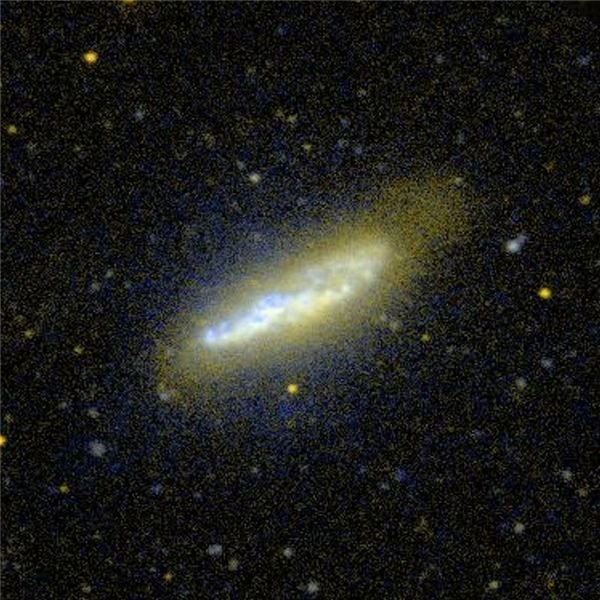
A young doctoral candidate, Josh Simon, at the University of California and his fellow researchers observing the dwarf galaxy NGC 4605, a satellite galaxy of M81, a big spirial in the M81/M82 group, found something very peculiar that may shed some light on this dilemma. Some 15 million lys away, a medium sized dwarf satellite, NGC 4605 exhibited a distinct halo around its group of stars. Measurements made of the star’s velocities as they orbited the galactic center and of radiation signatures from the halo seemed to suggest that most of the galaxy’s mass resided not in the central core—as do most galaxies—but in the halo. Yet the halo contained few stars, consisting mainly of hydrogen and dust glowing from radiation.
What was the mass coming from?
Sherlock Holmes said: “When you have eliminated the impossible, whatever is left, no matter how improbable, is the truth.”
That’s what Simon and his fellow researchers were left with. The invisible mass had to be cold dark matter (CDM).
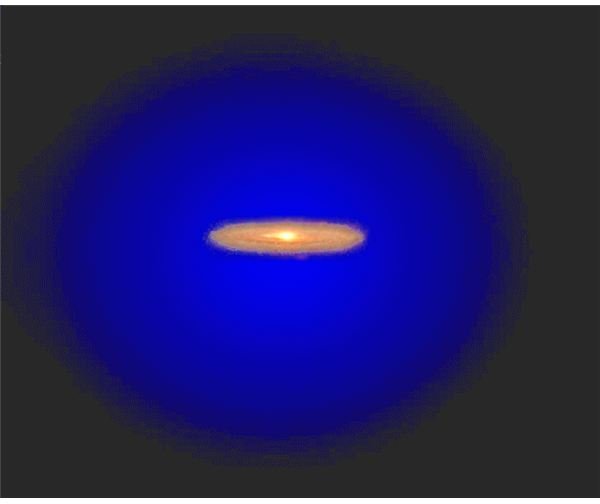
Were the Milky Way’s dim dwarf galaxies also hiding CDM? That was the question Simon asked for his doctoral thesis. He looked at three other dwarf galaxies. Like NGC 4605, they were far more massive than their collection of stars could account for. It seemed the Milky Way’s dwarf satellite galaxies were hiding places for cold dark matter. The image below is an artist’s impression of what the CDM halo might look like if we could see it.
Hiding in the Dark
That discovery opened another possibility. Could that empty sky beyond the Milky Way be not so empty after all? Could it instead be populated by even dimmer dwarfs that were mainly made up of CDM? We couldn’t see them from ground based telescopes, even the Keck, But the Hubble Space Telescope (HST) might find them.
It did.
By 2008, using HST, Simon and his team had found 12 new satellite galaxies orbiting the Milky Way. They are very dim, because they contain relatively few stars, but they are extremely massive. In short, they are made up almost entirely of CDM.
And that finding opened two more possibilities. The first is, could there be even dimmer dwarfs orbiting our home galaxy, perhaps masses of CDM with no stars. These would be totally invisible in the visible spectrum. But they might be detectable by a radiation signature, perhaps in the gamma ray region.
The search is on. The Milky Way’s empty sky may yet be found to be filled with satellite galaxies. They just have no stars.
Creator of Galaxies
The discovery of the dark matter satellite galaxies brings us to another possibility of galaxy formation. If there are galaxy-like structures in the Universe made up entirely of dark matter—and the evidence now is quite strong that there are—then these CDM galaxies were formed near the beginning of galaxy formation. Could it be that all galaxies began as CDM galaxies?
We know that our galaxy and its nearby sister galaxy, Andromeda, contain great amounts of CDM—about 50 percent of the mass of each of these two giants is CDM. Did they begin as starless masses of CDM? The Milky Way dwarf satellite galaxies are 90 percent CDM.
Here is what Simon and his team, and others now, postulate. The center of the swirling mass of CDM eventually coalesced into a supermassive black hole. The black hole caused the hydrogen and dust surrounding it to speed up to incredible velocities, as much as 150,000 mph. It began to coalesce into protostars. A galaxy was being born. Eventually stars were born throughout the cloud, and the rotation generated by the giant black hole flung the outer stars into spiral arms to form a spiral galaxy.
The Mystery of Dark Matter
But, what is this dark matter we can’t see or measure or weigh? There are several theories, but the one taking hold currently is that it is neutrinos. Neutrinos are unique subatomic particles that we once thought had no mass, moved almost at the speed of light and penetrated everything without being stopped by anything.
In the last 10 years or so we’ve found all that is only partly true. There are two basic types of neutrinos—fast and sterile. Fast neutrinos indeed have almost no mass and travel very near the speed of light. It took 20 years to capture one—one. So they did indeed zip through almost anything with impunity—but not completely.
Sterile neutrinos on the other hand do have some relatively significant mass, and are slower, again relatively. (When we talk mass regarding subatomic particles, we’re not talking weight as we think of stepping on a scale. Subatomic mass is measured in electron volts, eV, and is actually a unit of energy rather than mass. The mass of an electron is one eV. Various calculations and experiments at CERN and elsewhere have given all neutrinos masses between 0.2eV and 2eV.)
Neutrinos fit the equation for dark matter because just as there are two types of neutrinos—fast and sterile (slow), there are two types of dark matter—hot and cold. The fast neutrinos are a fairly good fit for hot dark matter, as it does not hang around in clumps to form great masses. Sterile neutrinos fit well with CDM because they do tend to orbit around a center core.
Finding the Invisible
As mentioned earlier, there may be one way to find those missing Milky Way satellite galaxies—via gamma rays. A number of gamma ray telescopes, ground based and spaceborne, are coming online or being built right now. When they all begin the search for invisible galaxies, and if they find them, cosmology will be changed again.
This time Arthur C. Clarke’s comment will prove true: “The universe may not only be stranger than we imagine. It may be stranger than we CAN imagine.”
Sources and Credits
Sources:
Dark matter in dwarf satellite galaxies: Cornell University https://users.obs.carnegiescience.edu/jsimon/thesis/jdsthesis.pdf
Dark matter galaxies: University of Texas https://chandra.as.utexas.edu/~kormendy/dm.html
Dark matter satellite galaxies: Scientific American https://www.scientificamerican.com/podcast/episode.cfm?id=A2B71EFB-ABFA-C6D7-0A728C56892215F8
4605 Halo: University of California https://arxiv.org/PS_cache/astro-ph/pdf/0108/0108050v2.pdf
Missing Milky Way satellites: Carnegei Instituion for Science https://users.obs.carnegiescience.edu/jsimon/research.html#proj1
Credits:
4605: https://iopscience.iop.org/0004-637X/565/1/238/pdf/0004-637X_565_1_238.pdf
Halo: https://chandra.as.utexas.edu/~kormendy/dm-halo-pic.html
