Jupiter's Asteroidal Escorts - The Trojan Asteroids
Where Are They?
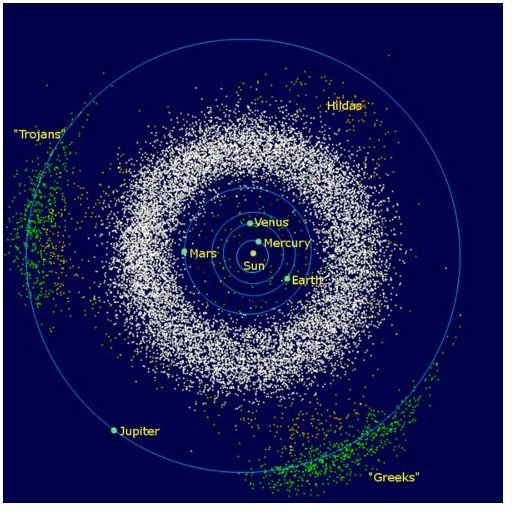
Between Mars and Jupiter is a region called the asteroid belt. This region is where most of the thousands of asteroids in the Solar System exist. Most are the size of small rocks, but some are more than 150 miles in diameter—not exactly planets, but not very small either.
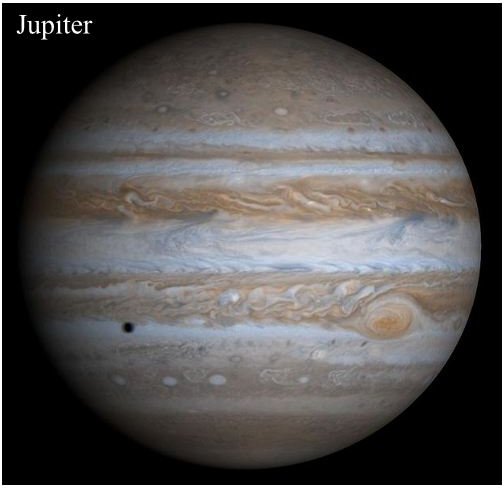
Jupiter orbits the Sun beyond the asteroid belt and has some of its own asteroids called Trojans. The Trojan asteroids reside in a specific area of Jupiter’s orbit called the Lagrangian points. Some of the asteroids trail behind Jupiter in orbit, while some race ahead of it.
The Lagrangian Points
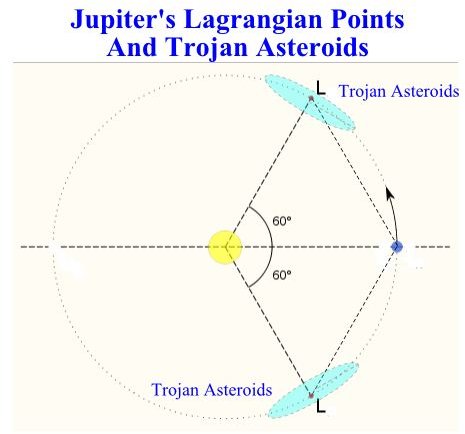
The Lagrangian points where the Trojans orbit the Sun are interesting places. They are about 60 degrees ahead of and behind Jupiter. This position in Jupiter’s orbit forms an equilateral triangle with Jupiter and the Sun (see drawing). These points are places where the planet’s gravity, an object’s velocity, and the Sun’s gravity all tend to neutralize each other. This means that Jupiter’s Trojans are far enough away from Jupiter to resist its gravity and they are also moving fast enough within Jupiter’s orbit to resist the pull of the Sun’s gravity.
If one of the Trojans begins to lag too far behind, Jupiter’s gravity pulls it ahead again. If it starts to fall towards the Sun, its speed increases, pulling itself back into orbit. When it starts to get too close to Jupiter, the Sun’s gravity slows it down. The forces of the two large objects (the Sun and Jupiter) and the velocity of the asteroid all work together to keep the asteroid in Jupiter’s orbital path.
The Lagrangian points were first discovered mathematically by Joseph Louis Lagrange in 1772. One hundred and thirty four years later, he was proven correct when the first Trojan asteroid was discovered by a German astronomer in 1906.
The Trojans
In Greek mythology, the Trojans were the occupants of a city called Troy. The Greeks went to war against Troy because the Trojans kidnapped Helena, the queen of Sparta. The war between the Greeks and the Trojans was called the Trojan war and the largest Trojan asteroids were named after heroes from that war.
Continuing the Trojan-Greek theme of Jupiter’s asteroids, those asteroids ahead of Jupiter in its orbit are called the “Greeks” and those behind Jupiter are called the “Trojans”. Collectively, they are all referred to as Trojans. So far, astronomers have found and numbered more than 4000 asteroids in these regions, but they believe that more than one million exist, similar to the number of asteroids believed to inhabit the asteroid belt.
Three other planets are known to have Trojan asteroids. Neptune has at least six that have been discovered, but there could be many more. Mars also has four asteroids that occupy Lagrangian points. In October of 2010, scientists discovered 2010 TK7, the first trojan asteroid belonging to earth. Scientists evaluated the orbit May of 2011 and published their findings in July. The 1000 foot diameter object orbits around the L4 Langrangian point, 60 degrees ahead of earth.
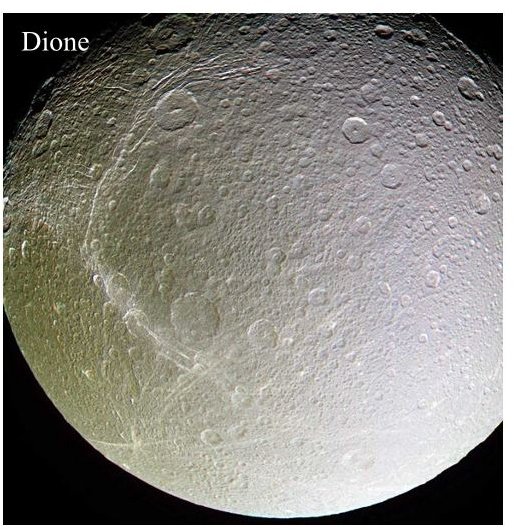
Another class of Trojan is called a Trojan moon. A Trojan moon follows or precedes a planet’s moon in much the same way a Trojan asteroid follows or precedes a planet. Two of Saturn’s moons, Tethys and Dione, each have two Trojan moons and thus far are the only moons in the Solar System known to have Trojan moons. Earth’s moon does not have any Trojan moons.
Image Credits
Image of Jupiter from Wikimedia Commons
Image of Inner Solar System from Wikimedia Commons
Image of Lagrangian points from Wikimedia Commons (with annotations by MJ Logan)
Image of Dione from Wikimedia Commons
All images from Wikimedia Commons
