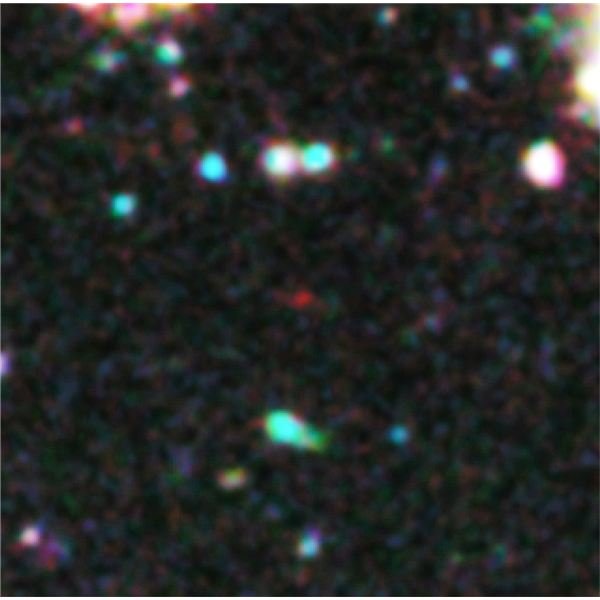
The Hubble Space Telescope has imaged the farthest galaxy yet seen. It is 13.2 billion light years away. That means it is 13.2 billion years old. It was being formed less than 500 million years after the Big Bang.
A Galaxy Far, Far Away
The Hubble Space Telescope (HST) recently imaged a small galaxy 13.2 billion light years (ly) away. That means it was being formed less than 500,000,000 years after the Big Bang.
That is sooner than we have thought galaxies began forming. This discovery could well change our view of the early Universe.
Not only did HST find this far away galaxy in formation, the European Space Organization (ESO), using its 8.2 meter Very Large Telescope (VLT) and a Gravitational Lens created by a cluster of nearby galaxies, imaged what astronomers believe were a cluster of forming galaxies at the distance of HST’s find.
A Small, Young Beginning
The galaxy Hubble discovered is actually a proto-galaxy—one just beginning to develop. It is small, scarcely more than 10 million times the mass of our Sun. It appears to be composed of young, hot stars—stars at the beginning of their life .
Because the galaxy is so far away, its red shift is severe, which is why it appears red in the image. Its distance also makes it impossible to resolve individual stars. But through spectrographic and radiation analysis, astronomers are confident of their findings.
The digitally enhanced closeup shown below gives you some idea of the amorphous shape of the early galaxy. It clearly has not completed its formative process. Whether it ever did or not, we will probably never know.
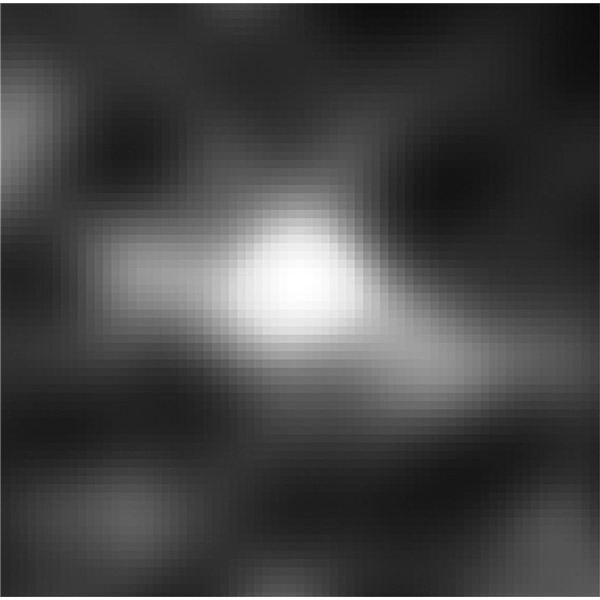
Astronomers believe this galaxy began its life 100 million to 200 million years before the image HST captured. That would put its birth perhaps as far back as 300 million years after the Big Bang. That is somewhat earlier than we generally have thought galaxies began to form.
Out of the Darkness
Current theory says that as the Universe expanded rapidly from the Big Bang—the Inflationary Period —it became opaque as the initial flash of the Big Bang was stretched into longer wavelengths by the rapid expansion. No galaxies or stars had been formed yet, so the Universe was dark. Once they did form, light flooded the universe and the opaque fog disappeared.
But when did this happen? Is Hubble looking at one of the first galaxies to form, or did others form before? If the Webb Space Telescope finds even earlier galaxies, we will be forced to rethink our concept of the early Universe, and the beginnings of galactic formation.
If we should find that galaxies began to form as early as 100 million years after the Universe’s birth, not only will our thinking of galaxy development change, but our thinking of the development of the Universe will be forever altered.
We have discovered recently that galaxies were likely created by supermassive black holes at their center. We’ve known there were quantum black holes filling the cosmos in the early days of the Universe. Will Hubble’s findings bring these theories together?
Sources and Credits
Sources:
NASA: https://www.nasa.gov/mission _pages/hubble/science/farthest-galaxy.html#briefing
ESO: https://www.eso.org/public/news/eso0405/
Credits:
All photos: NASA