Along with carbohydrates, fats and nucleic acids, proteins are the “building blocks of life.” Learn about the functions of protein in the human body to find out why these molecules are so important.
What does Protein Do?
Protein has a large number of important functions in the human body—and in fact, the human body is about 45% protein. It’s an essential macromolecule without which our bodies would be unable to repair, regulate, or protect themselves.
Functions of Protein
Protein has a range of essential functions in the body, including the following:
- Required for building and repair of body tissues (including muscle)
- Enzymes, hormones, and many immune molecules are proteins
- Essential body processes such as water balancing, nutrient transport, and muscle contractions require protein to function.
- Protein is a source of energy.
- Protein helps keep skin, hair, and nails healthy.
- Protein, like most other essential nutrients, is absolutely crucial for overall good health.
So what does protein do?
Proteins are, in effect, the main actioners in cells and in an entire organism. Without proteins the most basic functions of life could not be carried out. Respiration, for example, requires muscle contractions, and muscle contractions require proteins.
Proteins as Enzymes
The function of proteins as enzymes is perhaps their best-known function. Enzymes are catalysts—they initiate a reaction between themselves and another protein, working on the molecule to change it in some way.
The enzyme, however, is itself unchanged at the end of the reaction.
Enzymes are responsible for catalyzing reactions in processes such as metabolism, DNA replication, and digestion.
In fact, enzymes are known to be involved in some 4,000 bodily reactions.
Proteins in Cellular Signaling and Molecular Transport
Cells signal one another for an enormous variety of reasons, the most basic of which is simply to coordinate cellular activities. Signaling is how cells communicate with one another, allowing such essential processes as the contraction of the heart muscle to take place.
Proteins are important in these processes due to their ability to bind other molecules—a protein produced by one cell may bind to a molecule produced by another, thus providing a chemical signal which allows the cells to provide information about their state. Proteins are also involved in molecular transport.
A prime example of this is the protein called hemoglobin, which binds iron molecules and transports them in the blood from the lungs to organs and tissues throughout the body.
Protein Composition
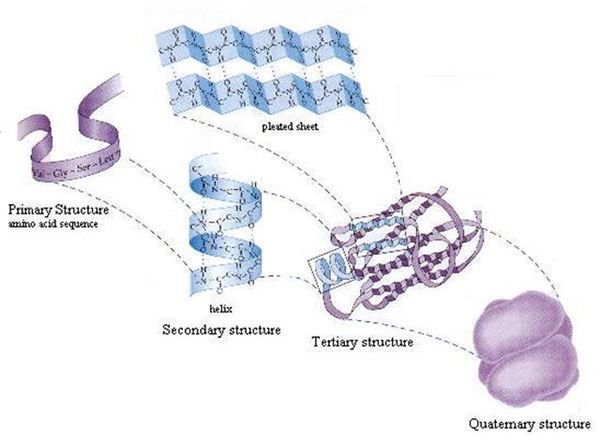
Proteins are organic macromolecules made up of linear chains of amino acids. However, while a protein’s basic structure is a linear amino acid chain, the final structure of a protein is not linear. Instead, the protein’s amino acid sequence—and the physical and chemical properties of the amino acids and of the entire protein molecule - influences how it folds into a three dimensional shape.
The amino acid sequence of a protein is determined by the base pair sequence in the gene which codes for the protein. There are twenty ‘standard’ amino acids (along with one or two non-standard proteins which are not coded for by DNA in the usual sense).
Structural Proteins
These are less ‘active’ than those involved in catalyzing reactions, signaling cells, and transporting molecules, but are no less important.
- Structural proteins are those which confer strength and rigidity to biological components which would otherwise be unable to support themselves.
- Structural proteins tend to have very specific shapes—long, thin fibers or other shapes which, when allowed to form polymers, provide strength and support.
- Structural proteins are essential components of collagen, cartilage, nails and hair, feathers, hooves, and other such components.
- Structural proteins are also essential components of muscles, and are necessary to generate the force which allows muscles to contract and move.
Additional Reading
Here is a list of some related reading covering a variety of topics on how protein plays a part in health, protein function, protein sources, and more on the role protein plays in the human body.