Parts of a Compound Microscope
Microscopic World of Science
The use of microscopes lets us see an invisible world that could bring delight and amazement. In the laboratory, it is necessary for student explorers to be able to use a microscope in order for them to appreciate the microscopic world of science. We know for a fact that a microscope can help us see things beyond our eyesight, but what are the basic parts of a compound microscope that enable us to do so?
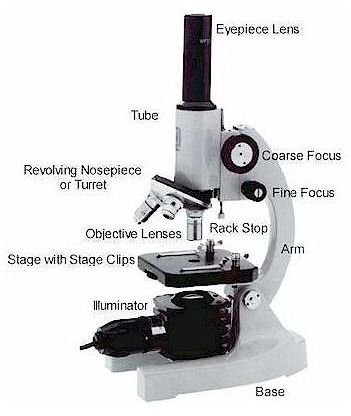
For a basic microscope that you usually see in school laboratories, there are several parts that make the device work. Take a look at the following list to recognize them and acquire some information about their respective functions.
Microscope

Eyepiece-This is the part where you will look through so that you can see the magnified image. It has a lens with a power of magnification of about 10X. This is one of the most recognizable parts of a compound microscope.
Tube-This part connects the Eyepiece to the Objective glass lenses.
Objective Lenses-In most microscopes, you will be able to identify about three to four objective lenses attached at the end of the Tube; the most common rate of these lenses range from 4X to 100X magnifying powers. As a standard, the longest objective lens provides greater magnifying power while the shortest provides the minimum.
Turret-The “dish” that provides support for all the Objective lenses. This dish can be rotated to allow the user to change power magnifications.
Arm-This is the metallic curved part of the microscope which connects the Tube to the Base of the device.
Base-It is the bottom part of the device which makes the microscope stable. It is somehow horseshoe in appearance.
Illuminator-Modern microscopes can use this device which provides a light source to illuminate the specimen in the glass. Other previously manufactured devices provide a type of reflecting glass which acquires light from external sources.
Stage-It is the area where you will place the specimen (on a glass slide) for observation.
As you may have noticed, there are several parts of the microscope that work together to perform a single goal—to let you see images at microscopic levels. Now that you are familiar with the basic parts of a microscope, you can enjoy more looking at miniature unseen worlds compared to simply being a user.
Picture Credit From: https://www.microscope-microscope.org/basic/microscope-parts.htm
