Macromolecular docking describes the way in which two very large molecules approach and interact with each other—in effect joining themselves—at least temporarily. Of prime importance in this maneuver is so-called “quaternary structure.” When the molecules are proteins, it is called protein docking.
What is a Protein?
A proteins is a nitrogen-containing organic compound made from smaller compounds called amino acids. These amino acids are chosen from a total of some twenty varieties. They are a kind of natural polymer. The order in which the individual amino acids appear in a particular protein is called its sequence. As an example, collagen consists of the amino acids glycine (Gly), proline (Pro), hydroxyproline (Hyp), and hydroxylysine (Hyl).
Proteins constitute a sizeable percentage of the human body and are essential to many highly important life processes. They are closely associated with DNA, the chemical associated closely with heredity and genetic characteristics. However, proteins do much more. For instance, they are an important component of the “nuclear envelope” - the structure which isolates a cell’s nucleoplasm (contents within the nucleus) from its cytoplasm (contents of the cell in general). Collagen, mentioned above, is the main component of connective tissue in animals and in humans.
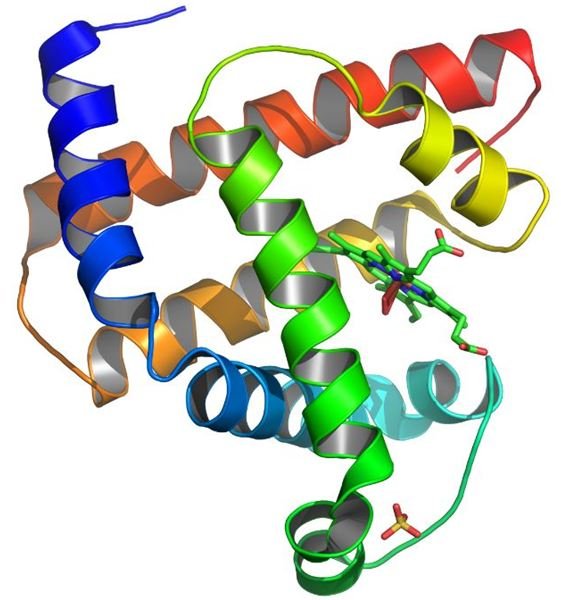
Myoglobin Protein
PD by Aza Toth, Wikimedia Commons
What is Docking?
Docking between molecules may be likened to docking a ship at a wharf. Two molecules of protein unite at least temporarily to perform a specific function. How they do so depends upon a number of factors, one of which is steric—that is it is dependent upon available space and shape of the molecules involved in the docking process. Structure in a protein may be defined as primary, secondary, tertiary, and quaternary. What do each of these terms refer to? It is important to know to understand why it is particularly quaternary structure that is involved in protein docking.
Molecular Structure: Primary, Secondary, Tertiary and Quaternary
The primary structure of a protein refers to its sequence—what the order is of its constituent amino acids. Each of these component parts has a shape to it, influencing the total shape of the protein molecule.
Biological proteins may twist or take a shape with some measure of local regularity to it. Thus some proteins adopt a helical shape. Others exist as strands, and so forth. These shapes make up the secondary structure. Hydrogen-bonding plays a major role in secondary structure.
These helices and other shapes may in turn fold in various ways, giving rise to a globule, for instance. This degree of spatial behavior is termed tertiary structure.
A little more difficult to visualize is quaternary structure. This relates to the spatial arrangement of proteins that form into groups. Perhaps it could be likened, to outer space, which has not only its galaxies, but its galaxy clusters. It is this quaternary shape that is especially relevant in protein docking.
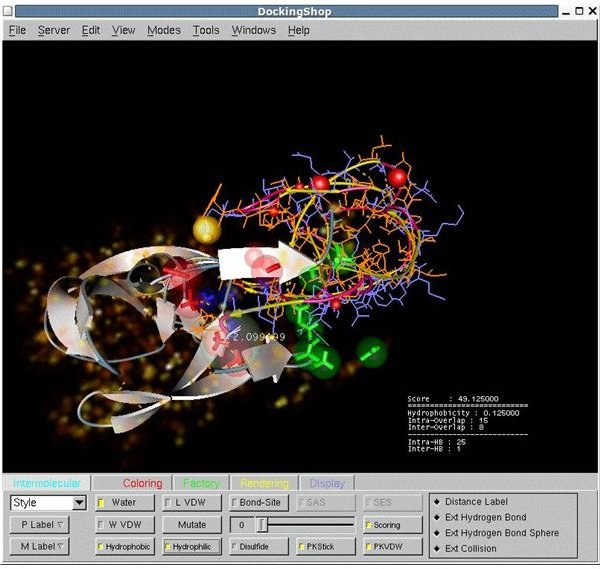
Molecular Modeling: Docking
Credit: LBNL/NERSC Visualization Group
Why Protein Docking is Important
Much as the principle of docking applies in the construction of a space station in outer space, docking enables the uniting of proteins into valuable functional cellular structures, whether they are to exist temporarily or permanently. This area of research is very modern and very complex. There are a number of sites online dedicated to those who are researching the property of protein docking as predicted by computer software. Scientists hope to learn much about the complexities of even the simplest of life’s building blocks, the single cell.
References and Resources
The University of Arizona - Campus Health Service: “What is Protein?”
The University of Utah: Discover How Proteins Function
Cornell University, Department of Molecular Biology and Genetics: Functions of Nuclear Envelope Proteins During Development
Florida State University - “A holistic approach to protein docking,” by Sanbo Qin and Huan-Xiang Zhou, Wiley Interscience, 2007
You Might Also Enjoy…
“Protein Sequencing: The Three Main Ways It Works,” by Robyn Broyles